Live Screenshot
Source link:
https://www.patheos.com/Topics/Immigration-and-Refugees/The-Use-and-Abuse-of-the-Bible-in-the-Immigration-Debate-James-K-HoffmeierPublished by: PATHEOS on 10 Aug 2016
1836 views · Last view: 23 hrs ago
News Text (from PATHEOS)
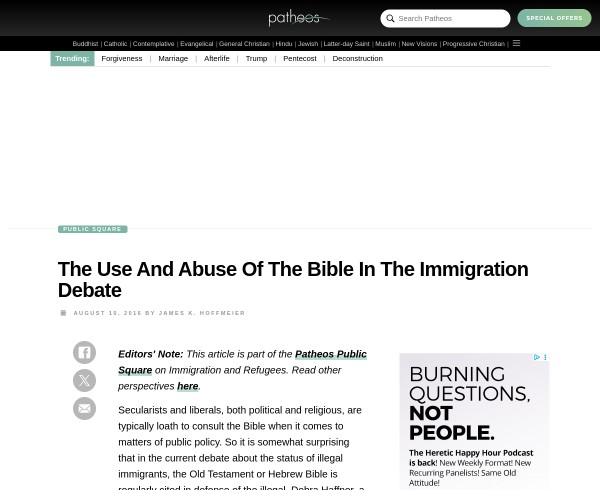
Editors' Note: This article is part of the Patheos Public Square on Immigration and Refugees. Read other perspectives here. Secularists and liberals, both political and religious, are typically loath to consult the Bible when it comes to matters of public policy. So it is somewhat surprising thatin the current debate about the status of illegal immigrants, the Old Testament or Hebrew Bible is regularly cited in defense of the illegal. Debra Haffner, a minister in the Unitarian Universalist—a denomination not known for taking scripture seriously—offered a critique of the Arizona illegal immigration law in the Washington Post online (May 25, 2010), saying "It's as if the 70 percent of Arizonans who support the law have forgotten the Biblical injunction to 'love the stranger for you were strangers in the land of Egypt'." This verse and others like it are frequently quoted in the name of "justice" for the illegal immigrant. A left-wing Christian advocacy group Christians for [...]
Explore More
The Bible PatheosSearch Google Search Explore Topics
 What is The Bible?
The Bible is a canonical collection of texts sacred in Judaism and Christianity. There is no single "Bible" and many Bibles with varying contents exist. The term Bible is shared between Judaism and Christianity, although the contents of each of their collections of canonical texts is not the same. Different religious groups include different books within their Biblical canons, in different orders, and sometimes divide or combine books, or incorporate additional material into canonical books. The Hebrew Bible, or Tanakh, contains 24 books. Christian Bibles range from the 66 books of the Protestant canon to the 81 books of the Ethiopian Orthodox Church canon. The first part of Christian Bibles is the Old Testament, which contains, at minimum, the 24 books of the Hebrew Bible divided into 39 books and ordered differently from the Hebrew Bible. The Catholic Church and Eastern Christian churches also hold certain deuterocanonical books and passages to be part of the Old Testament canon. The second part is the New Testament, containing 27 books: the 4 Canonical gospels, Acts of the Apostles, 21 Epistles or didactic letters, and the Book of Revelation.
 Who are Patheos?
Patheos is the leading web platform hosting dialogue on all of the world's religions. Our articles and Library have a visually stunning compendium of information about all the religions of the world compiled by some of the world's top religious leaders and scholars. Patheos exists to provide information, stories, and conversation that leads to understanding, empathy, and acceptance of all faiths. Head on over to each of the religious categories to read about the current events, philosophy, history, and more from leading authorities on every religion subject.