Live Screenshot
Source link:
https://www.theguardian.com/commentisfree/belief/2016/may/26/the-world-is-getting-more-religious-because-the-poor-go-for-godPublished by: THE GUARDIAN on 26 May 2016
1474 views · Last view: 4 hrs ago
News Text (from THE GUARDIAN)
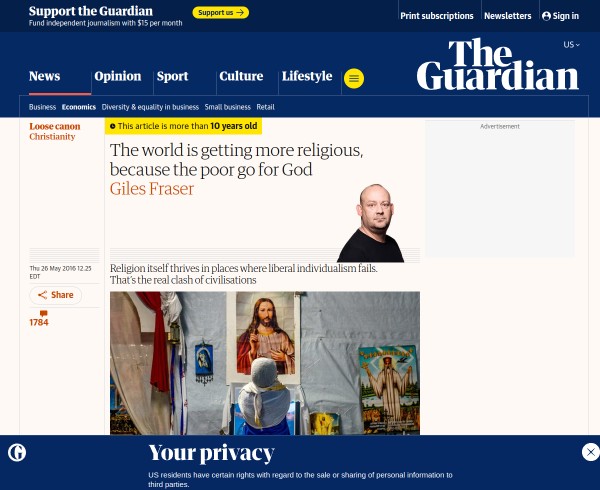
The so-called “masters of suspicion”, Nietzsche, Marx and Freud, all thought that religion would wither and die in the 20th century. Others enthusiastically backed the secularisation hypothesis. Intellectually, the enlightenment had punctured it below the waterline and it was sinking. Religion wasdead. Except, of course, the reverse happened: it flourished. In 1900, the year that Nietzsche died, there were 8 million Christians in Africa. Now there are 335 million. And the growth rate continues to accelerate. God wasn’t dead. God was reborn. Indeed, far from being the century in which religion went away, for both Christianity and Islam, the 20th century was numerically the most successful century since Christ was crucified and Muhammad gave his farewell sermon on Mount Arafat. By 2010, there were 2.2 billion Christians in the world and 1.6 billion Muslims, 31% and 23% of the world population respectively. The secularisation hypothesis is a European myth, a piece of myopic [...]
To view the original News article, click here
DISCLAIMER All news articles are shared for educational purposes only. The news content is hosted on the external news website. News articles titles are derived from the original news title, news content, dialogue, speech or general content theme. The news title may be edited and optimized for SEO, keyword density, information and internal website search purposes. You are advised to view the original news article for a better understanding. If you spot any mistakes, errors or omissions kindly contact us.
Search Results on 'The world is getting more religious, because the poor go for God - The Guardian'
TOPICS (1) | The GuardianNEWS | 0ARTICLES | 0FAQ | 0VIDEO | 10LINKS | 0SEARCH AGAIN? | VIDEO • NEWS • ARTICLE
Explore Topics: The Guardian (1)
Who are The Guardian? The Guardian is a British daily newspaper. It was founded in 1821 as The Manchester Guardian, and changed its name in 1959. Along with its sister papers The Observer and The Guardian Weekly, The Guardian is part of the Guardian Media Group, owned by the Scott Trust. The trust was created in 1936 to
"secure the financial and editorial independence of The Guardian in perpetuity and to safeguard the journalistic freedom and liberal values of The Guardian free from commercial or political interference". |
Youtube Videos on The Guardian (10)
|
368 views
8:56
|
|
333 views
30:16
|
|
587 views
4:50
|
|
216 views
15:34
|
|
376 views
16:27
|
|
186 views
16:55
|
|
207 views
16:43
|
|
250 views
19:38
|
|
245 views
18:40
|
|
112 views
16:00
|
 Pretty Radical: Inside Poland's Far-Right -
  Battle For Mosul, Iraq -
  Coronavirus leads to violence against 'Tablighi Jamaat' Muslims in divided India -
  'Palestinian Lives Matter' to
  'God gave us Israel. All of Jerusalem is Jewish' |
  'Even Refugee Camps are not safe from Israeli soldiers' |
  'I gave you Life, you chose Death', Israeli settler claims |
  Extremist Israeli settlers make living in Gaza impossible |
  Israeli Settlers destroy what
  Lebanon pays 'a big price' for resisting Israel |