Paul, looking steadfastly at the council, said, “Brothers, I have lived before God in all good conscience until today.”
The high priest, Ananias, commanded those who stood by him to strike him on the mouth.
Then Paul said to him, “God will strike you, you whitewashed wall! Do you sit to judge me according to the law, and command me to be struck contrary to the law?”
Those who stood by said, “Do you malign God’s high priest?”
Paul said, “I didn’t know, brothers, that he was high priest. For it is written, ‘You shall not speak evil of a ruler of your people.’”
But when Paul perceived that the one part were Sadducees and the other Pharisees, he cried out in the council, “Men and brothers, I am a Pharisee, a son of Pharisees. Concerning the hope and resurrection of the dead I am being judged!”
When he had said this, an argument arose between the Pharisees and Sadducees, and the crowd was divided.
For the Sadducees say that there is no resurrection, nor angel, nor spirit; but the Pharisees confess all of these.
A great clamor arose, and some of the scribes of the Pharisees’ part stood up, and contended, saying, “We find no evil in this man. But if a spirit or angel has spoken to him, let’s not fight against God!”
When a great argument arose, the commanding officer, fearing that Paul would be torn in pieces by them, commanded the soldiers to go down and take him by force from among them, and bring him into the barracks.
The following night, the Lord stood by him, and said,
“Cheer up, Paul, for as you have testified about me at Jerusalem, so you must testify also at Rome.”
When it was day, some of the Jews banded together, and bound themselves under a curse, saying that they would neither eat nor drink until they had killed Paul.
There were more than forty people who had made this conspiracy.
They came to the chief priests and the elders, and said, “We have bound ourselves under a great curse, to taste nothing until we have killed Paul.
Now therefore, you with the council inform the commanding officer that he should bring him down to you tomorrow, as though you were going to judge his case more exactly. We are ready to kill him before he comes near.”
But Paul’s sister’s son heard they were lying in wait, and he came and entered into the barracks and told Paul.
Paul summoned one of the centurions, and said, “Bring this young man to the commanding officer, for he has something to tell him.”
So he took him, and brought him to the commanding officer, and said, “Paul, the prisoner, summoned me and asked me to bring this young man to you, who has something to tell you.”
The commanding officer took him by the hand, and going aside, asked him privately, “What is it that you have to tell me?”
He said, “The Jews have agreed to ask you to bring Paul down to the council tomorrow, as though intending to inquire somewhat more accurately concerning him.
Therefore don’t yield to them, for more than forty men lie in wait for him, who have bound themselves under a curse neither to eat nor to drink until they have killed him. Now they are ready, looking for the promise from you.”
So the commanding officer let the young man go, charging him, “Tell no one that you have revealed these things to me.”
He called to himself two of the centurions, and said, “Prepare two hundred soldiers to go as far as Caesarea, with seventy horsemen, and two hundred men armed with spears, at the third hour of the night.”
He asked them to provide animals, that they might set Paul on one, and bring him safely to Felix the governor.
He wrote a letter like this:
“Claudius Lysias to the most excellent governor Felix: Greetings.
“This man was seized by the Jews, and was about to be killed by them, when I came with the soldiers and rescued him, having learned that he was a Roman.
Desiring to know the cause why they accused him, I brought him down to their council.
I found him to be accused about questions of their law, but not to be charged with anything worthy of death or of imprisonment.
When I was told that the Jews lay in wait for the man, I sent him to you immediately, charging his accusers also to bring their accusations against him before you. Farewell.”
So the soldiers, carrying out their orders, took Paul and brought him by night to Antipatris.
But on the next day they left the horsemen to go with him, and returned to the barracks.
When they came to Caesarea and delivered the letter to the governor, they also presented Paul to him.
When the governor had read it, he asked what province he was from. When he understood that he was from Cilicia, he said,
“I will hear you fully when your accusers also arrive.” He commanded that he be kept in Herod’s palace.
Acts 23
Plot to Assassinate Apostle Paul in Acts 23
Feel the rising administrative drama as Roman soldiers uncover a highly organized, dangerous underground plot to assassinate the Apostle Paul in Acts 23. 516 views · Last view: 22 hrs ago
Feel the rising administrative drama as Roman soldiers uncover a highly organized, dangerous underground plot to assassinate the Apostle Paul in Acts 23. 516 views · Last view: 22 hrs ago
Explore More
Search Google Search Explore Topics Apostle Paul Sin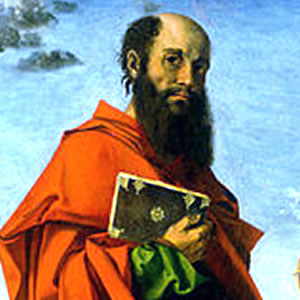 Who was Apostle Paul?
Paul the Apostle (Latin: Paulus), commonly known as Saint Paul and also known by his Jewish name Saul of Tarsus was an apostle (though not one of the Twelve Apostles) who taught the gospel of Christ to the first century world. Paul is generally considered one of the most important figures of the Apostolic Age and in the mid-30s to the mid-50s AD he founded several churches in Asia Minor and Europe. He took advantage of his status as both a Jew and a Roman citizen to minister to both Jewish and Roman audiences. According to writings in the New Testament and prior to his conversion, Paul was dedicated to persecuting the early disciples of Jesus in the area of Jerusalem. In Acts, Paul was traveling on the road from Jerusalem to Damascus on a mission to 'arrest them and bring them back to Jerusalem' when the resurrected Jesus appeared to him in a great light. He was struck blind, but after three days his sight was restored by Ananias of Damascus and Paul began to preach that Jesus of Nazareth is the Jewish Messiah and the Son of God.
 What is Sin?
In Abrahamic contexts, sin is the act of violating God's will. Sin can also be viewed as anything that violates the ideal relationship between an individual and God; or as any diversion from the ideal order for human living. To sin has been defined as "to miss the mark". Sins fall in a spectrum from minor errors to deadly misdeeds. Catholicism regards the least corrupt sins as venial sins which are part of human living and carry immediate consequences on earth, and, if unrepented for, more painful purgation, assuming the person is destined to heaven, as it is written in the formation letter "Purgatory", "most of the early Fathers of the Church speak of a cleansing fire, though we cannot tell whether this means actual or spiritual fire." Conversely, sins of great evil are mortal sins which bring the consequence of hell if they are not addressed either through an act of perfect contrition or going to confession about them.