Q Did the ancient Greek religions have a holy book like the Bible?
A No, ancient Greek religion had no single holy book, sacred scripture, or centralized religious dogma. Instead of relying on a strict text like the Bible or Quran, their religious beliefs, cosmologies and moral frameworks were preserved through oral traditions, epic poetry - most notably Homer's Iliad and Odyssey and Hesiod's Theogony and local civic rituals.
A No, ancient Greek religion had no single holy book, sacred scripture, or centralized religious dogma. Instead of relying on a strict text like the Bible or Quran, their religious beliefs, cosmologies and moral frameworks were preserved through oral traditions, epic poetry - most notably Homer's Iliad and Odyssey and Hesiod's Theogony and local civic rituals.
Explore More
Greek Religions The Bible Religions ONSSearch Google Search Explore Topics
 What is Greek Religions?
Many religions encompass what can be referred to as Greek religion. There are ancient Greek religions which include the classic Greek cult hero, the Elusinian mysteries, the Hellenistic religion that evolved through the Roman empire, and development of "platonic idealism", a theory that reality is a reflection of a higher truth. Today, there is the Greek Orthodox Church, whose liturgy includes the Koine Greek, the original language of the New Testament. However, reconstructionist movements since the 1990s (known as "Hellenic Polytheistic Reconstructionism") have emerged over the past 20 years, reviving some ancient Greek practices.
 What is The Bible?
The Bible is a canonical collection of texts sacred in Judaism and Christianity. There is no single "Bible" and many Bibles with varying contents exist. The term Bible is shared between Judaism and Christianity, although the contents of each of their collections of canonical texts is not the same. Different religious groups include different books within their Biblical canons, in different orders, and sometimes divide or combine books, or incorporate additional material into canonical books. The Hebrew Bible, or Tanakh, contains 24 books. Christian Bibles range from the 66 books of the Protestant canon to the 81 books of the Ethiopian Orthodox Church canon. The first part of Christian Bibles is the Old Testament, which contains, at minimum, the 24 books of the Hebrew Bible divided into 39 books and ordered differently from the Hebrew Bible. The Catholic Church and Eastern Christian churches also hold certain deuterocanonical books and passages to be part of the Old Testament canon. The second part is the New Testament, containing 27 books: the 4 Canonical gospels, Acts of the Apostles, 21 Epistles or didactic letters, and the Book of Revelation.
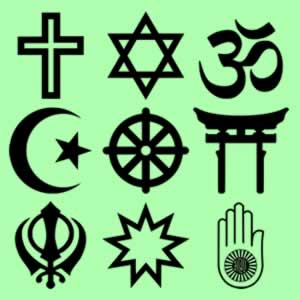
What are Religions?Religion is a range of social-cultural systems, including designated behaviors and practices, ethics, morals, beliefs, worldviews, texts, sanctified places, prophecies, or organizations, that generally relate humanity to supernatural, transcendental, and spiritual elements. There is no scholarly consensus over what precisely constitutes a religion. It is an essentially contested concept. Different religions may or may not contain various elements ranging from the divine, sacredness, faith, and a supernatural being or beings. The origin of religious belief is an open question, with possible explanations including awareness of individual death, a sense of community, and dreams. Religions have sacred histories, narratives, and mythologies, preserved in oral traditions, sacred texts, symbols, and holy places, that may attempt to explain the origin of life, the universe, and other phenomena. Religious practice may include rituals, sermons, commemoration or veneration (of deities or saints), sacrifices, festivals, feasts, trances, initiations, matrimonial and funerary services, meditation, prayer, music, art, dance, or public service. There are an estimated 10,000 distinct religions worldwide, though nearly all of them have regionally based, relatively small followings. Four religions: Christianity, Islam, Hinduism, and Buddhism account for over 77% of the world's population, and 92% of the world either follows one of those four religions or identifies as non-religious, meaning that the vast majority of remaining religions account for only 8% of the population combined.
 Who are ONS?
The Office for National Statistics (ONS) is the official national statistical institute of the United Kingdom.