227 views
·
Last viewed: 10 mins ago
Uploaded: 25 Jun 2026 (3 months ago) · Shared: 03 Jul 2026
Duration: 28:27
Uploaded: 25 Jun 2026 (3 months ago) · Shared: 03 Jul 2026
Duration: 28:27
Youtube Description:
In this episode of the MythVision Podcast, host Deric Lambert sits down with Michael Jones from Inspiring Philosophy for a deep and intense conversation about the historical reliability of Christianity, the role of Greco-Roman influences, and whether the New Testament writers shaped Jesus using mythological patterns.
The discussion explores major scholarly tensions:
- Did the Gospel authors engage in myth-making or historical reporting?
- Are parallels with pagan gods like Dionysus meaningful or overstated?
- What are “undesigned coincidences,” and do they actually support reliability?
- How should we compare Christianity with traditions like Islam and its later Hadith development?
- Can historians truly separate bias from evidence when studying ancient texts?
Both guests challenge each other on how theology, psychology, and historical method shape conclusions about Jesus and the origins of Christianity.
If you’re interested in:
Biblical scholarship, historical Jesus research, mythology comparisons, or debates between skeptics and Christian apologists—this conversation goes straight into the core arguments.
👉 Inspiring Philosophy: / @inspiringphilosophy
📺 Our second channel
@mythvisionTV
============================
FIND ALL LINKS HERE 👉
============================
RECOMMENDED ONLINE COURSES HERE
👉👉 Checkout MVP Courses to find new and upcoming online courses:
Sign up for Dr. James Tabor’s Course, “The Quest for the Historical Paul: Apostle or Apostate?” - -
Sign up for Dr. Kara Cooney’s Course, “Ancient Egyptian Cosmogony and Cosmology” - -
Sign up for Dr. Robyn Faith Walsh’s Course, “The Gospel Masterclass” - -
Sign up for Dr. James Tabor’s Course, “Jesus and The Dead Sea Scrolls” - -
Sign up for Dr. Robyn Faith Walsh’s Course, “Unforgettable Footprints of the Pauline Legacy” - -
Sign up for Dr. Dennis MacDonald’s Course, “Reading the Gospels with One Eye on Greek Poetry” - -
Sign up for Dr. James Tabor’s Course, 'Creating Jesus: Why Mark’s Gospel Was Forgotten?' - -
Sign up for Dr. Dale C. Allison Jr's Course, “The Quest for The Historical Jesus” - -
============================
GET RECOMMENDED BOOKS HERE: 👉
============================
Please consider supporting MythVision's work by joining our Patreon or contributing a one-time donation:
Patreon: 👉 / mythvision
Cashapp: 👉 $rewiredaddiction
Venmo: 👉 - - @Derek-Lambert-9
============================
CONTACT ME
Website: 👉
Discord: 👉 / discord
===========================
LISTEN TO THE PODCAST HERE:
🎧 Spotify:
🎧 Apple Podcast:
🎧 Castbox:
🎧 Pocket Casts:
🎧 iHeartRadio:
In this episode of the MythVision Podcast, host Deric Lambert sits down with Michael Jones from Inspiring Philosophy for a deep and intense conversation about the historical reliability of Christianity, the role of Greco-Roman influences, and whether the New Testament writers shaped Jesus using mythological patterns.
The discussion explores major scholarly tensions:
- Did the Gospel authors engage in myth-making or historical reporting?
- Are parallels with pagan gods like Dionysus meaningful or overstated?
- What are “undesigned coincidences,” and do they actually support reliability?
- How should we compare Christianity with traditions like Islam and its later Hadith development?
- Can historians truly separate bias from evidence when studying ancient texts?
Both guests challenge each other on how theology, psychology, and historical method shape conclusions about Jesus and the origins of Christianity.
If you’re interested in:
Biblical scholarship, historical Jesus research, mythology comparisons, or debates between skeptics and Christian apologists—this conversation goes straight into the core arguments.
👉 Inspiring Philosophy: / @inspiringphilosophy
📺 Our second channel
@mythvisionTV
============================
FIND ALL LINKS HERE 👉
============================
RECOMMENDED ONLINE COURSES HERE
👉👉 Checkout MVP Courses to find new and upcoming online courses:
Sign up for Dr. James Tabor’s Course, “The Quest for the Historical Paul: Apostle or Apostate?” - -
Sign up for Dr. Kara Cooney’s Course, “Ancient Egyptian Cosmogony and Cosmology” - -
Sign up for Dr. Robyn Faith Walsh’s Course, “The Gospel Masterclass” - -
Sign up for Dr. James Tabor’s Course, “Jesus and The Dead Sea Scrolls” - -
Sign up for Dr. Robyn Faith Walsh’s Course, “Unforgettable Footprints of the Pauline Legacy” - -
Sign up for Dr. Dennis MacDonald’s Course, “Reading the Gospels with One Eye on Greek Poetry” - -
Sign up for Dr. James Tabor’s Course, 'Creating Jesus: Why Mark’s Gospel Was Forgotten?' - -
Sign up for Dr. Dale C. Allison Jr's Course, “The Quest for The Historical Jesus” - -
============================
GET RECOMMENDED BOOKS HERE: 👉
============================
Please consider supporting MythVision's work by joining our Patreon or contributing a one-time donation:
Patreon: 👉 / mythvision
Cashapp: 👉 $rewiredaddiction
Venmo: 👉 - - @Derek-Lambert-9
============================
CONTACT ME
Website: 👉
Discord: 👉 / discord
===========================
LISTEN TO THE PODCAST HERE:
🎧 Spotify:
🎧 Apple Podcast:
🎧 Castbox:
🎧 Pocket Casts:
🎧 iHeartRadio:
Explore More
Search Google Search Explore Topics Christianity MythVision Philosophy Pagan What is Christianity?
Christianity is a global religion centered on the life and teachings of Jesus Christ, who followers believe is the Son of God. It's a monotheistic faith, meaning Christians believe in one God who exists in three co-equal persons: God the Father, God the Son (Jesus Christ), and the Holy Spirit. Christianity is based on the Bible, with the Old Testament and New Testament serving as sacred texts.
 Who is MythVision?
MythVision Podcast (MVP) brings you some of the finest information surrounding Mythology. Knowledge from a variety of people in search of a better understanding of ancient text. We discuss mythology, syncretism, astrotheology, gematria, sacred geometry, secret societies, ancient languages, history, prophecy, scholarship, conspiracies, heretical ideas, myth interpretations and much more.
 What is Philosophy?
Philosophy is the study of general and fundamental problems concerning matters such as existence, knowledge, values, reason, mind, and language. The term was probably coined by Pythagoras (c. 570-495 BCE). Philosophical methods include questioning, critical discussion, rational argument, and systematic presentation. Classic philosophical questions include: Is it possible to know anything and to prove it? What is most real? Philosophers also pose more practical and concrete questions such as: Is there a best way to live? Is it better to be just or unjust (if one can get away with it)? Do humans have free will?
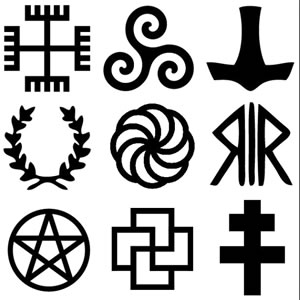 What is Pagan?
Paganism is a term first used in the fourth century by early Christians. It was applied on populations of the Roman Empire who practiced polytheism, either because they were increasingly rural and provincial relative to the Christian population or because they were not milites Christi (soldiers of Christ). Alternate terms in Christian texts for the same group were hellene, gentile, and heathen. Pagan and paganism were pejorative terms for the same polytheistic group, implying its inferiority. Paganism has broadly connoted the "religion of the peasantry", and for much of its history was a derogatory term. Both during and after the Middle Ages, pagan was a pejorative term that was applied to any non-Abrahamic or unfamiliar religion, and the term presumed a belief in false god(s).