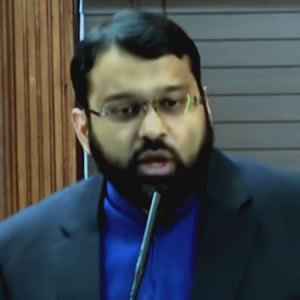
My Salafi Journey from Controversy to Humanity | Yasir Qadhi

628 views  ·  Last viewed: 4 hrs ago
Uploaded: 08 Jul 2025   (1 year ago)  ·  Shared: 11 Jul 2025

Video Description (from Youtube)

In this in-depth interview, Dr. Emad Hamdeh sits down with Dr. Yasir Qadhi to discuss his latest book Understanding Salafism and why he ultimately moved beyond the Salafi movement. This is one of

Yasir Qadhi’s most detailed public reflections on Salafism, Qur'anic interpretation, Islamic reform, and contemporary controversies.

Having both written on Salafism, Dr. Qadhi and Dr. Hamdeh have a rich conversation where they explore the origins and slogans of Salafism, how Qur’an and hadith are interpreted through the Salafi lens, why Salafi identity is both empowering and limiting, and how Dr. Qadhi remains influenced by Salafism even after distancing himself from it.

Chapters:
0:00 - 3:27 - Intro
3:28 - 8:18 Will Salafis See This as Critique?
8:19 - 12:10 What Academics Miss About Salafism
12:11 - 15:10 The Power and Problem of Salafi Slogans
15:11 - 17:30 Madhhab Issue That Made YQ Rethink Salafism
17:31 - 20:33 The Appeal of 'Just Follow Quran and Sunnah'
20:34 - 24:08 Who Gets to Interpret the Qur’an and Sunnah?
24:09 - 26:33 Why Did Salafism Become So Influential?
26:34 - 37:20 How Albani Spread Salafism Worldwide
37:20 - 41:00 Everyone Does Taqlid — Even If They Deny It
41:01 - 44:15 Albani and the Revival of Hadith Studies
44:16 - 52:40 North American Salafism: From MSA to Post-Salafism

52:41 - 55:15 The Disconnect Between Scholars and Real-World Problems
55:16 - 58:29 How All Movements Failed Gaza
58:30 - 1:08:14 Two Scholars Yasir Qadhi Admires the Most
1:08:15 - 110:10 Why One Mentor Won’t Talk to Yasir Qadhi
1:10:11 - 1:15:44 What Yasir Qadhi Held On To — And Let Go
1:15:45 - 1:29:02 Yasir Qadhi Gets Personal: Advice to Salafis & Non-Salafis

We also talk about:
- The legacy of Shaykh al-Albānī and textualism
- The shift from Salafi literalism to contextual understanding
- Dr. Qadhi’s reflections on Yusuf al-Qaradawi
- What it means to “leave” a movement but not reject it entirely

📚 BOOKS MENTIONED:
- Understanding Salafism by Yasir Qadhi → https://www.amazon.com/Salafism-Between-Fact-Fiction-Oneworld/dp/1786078481/
- Salafism and Traditionalism: Scholarly Authority in Modern Islam by Emad Hamdeh → https://www.amazon.com/Salafism-Traditionalism-Scholarly-Authority-Modern/dp/1108706908/

🔔 Subscribe for more deep-dive conversations on Islamic thought, modern Muslim identity, and Qur'anic interpretation.

👇 COMMENT BELOW:
What do you think about the future of Salafism?

#YasirQadhi #EmadHamdeh #UnderstandingSalafism #Salafismandtraditionalism #IslamicThought #SalafiMovement #QuranInterpretation #MuslimDebates #quran #sunnah #hadith #islamic #islamiclectures #Islamicmovements #muslimworld

Academia page: https://embryriddle.academia.edu/EmadHamdeh
https://www.instagram.com/dr._emad_hamdeh/
https://x.com/EmadHamdeh

Explore More

Who is Yasir Qadhi?
Yasir Qadhi is an American Muslim scholar and writer of Pakistani descent. Since 2001, he has served as Dean of Academic Affairs at the Al-Maghrib Institute, an international Islamic educational institution with a center in Houston, Texas. He also

teaches in the Religious Studies department at Rhodes College in Memphis, Tennessee, where he resides. Qadhi has written numerous books and lectured widely on Islam and contemporary Muslim issues. A 2011 The New York Times Magazine essay by Andea Elliott described Qadhi as "one of the most influential conservative clerics in American Islam."

What is Salafi?
Salafi refers to a fundamentalist movement within Sunni Islam that emphasizes a return to the practices of the early generations of Muslims. These are often described as the "pious predecessors" (al-salaf al-??li?). Salafis adhere to a literal

interpretation of the Quran and the Sunna (the Prophet Muhammad's teachings and practices). The movement is characterized by its emphasis on purifying Islam from what it perceives as later accretions and innovations.
SUBSCRIBE

Receive the latest news and updates by email - Subscribe Now!
About  |  Q&A  |  Contact Us    •    Terms  |  Privacy  |  Disclaimer  |  Sitemap
Connect:      Facebook  |    Twitter  |    Youtube
MuslimProphets.com is an educational website on the Prophets of God: David, Noah, Abraham, Moses, Jesus and Muhammad, who established the Abrahamic faiths of Judaism, Christianity and Islam.

MuslimProphets.com explores contemporary social themes through Scripture, Evidences, Photo, Video, Maps, Current Affairs, Debate and 'alternative' Views held by Theologians, Apologists, Scholars and Street Preachers.

In accordance with Islamic etiquette, all prophet names should be followed with 'Peace Be Upon Him (PBUH)'. This is omitted to minimise text.

DISCLAIMER
The historical information provided on this website is for educational and informational purposes only.
History is an ongoing interpretation of past events. Historical accounts are shaped by the perspectives, biases, and cultural influences of their time; therefore, no content on this website should be taken as absolute, 100% factual truth. We encourage readers to approach historical narratives with a critical mind.

All website content is available in the public domain. While all information is gathered from sources believed to be reliable, its absolute accuracy cannot be guaranteed.

EXTERNAL LINKS & SEO
External links are provided as a convenience and for informational purposes only. They do not constitute an endorsement or approval of any products, services, or opinions of any organization or individual. Title and text links may be edited for external SEO, internal site structure, and keyword search purposes. We bear no responsibility for the accuracy, legality, or content found on any external website or its subsequent links.

MEDIA & SOURCE ATTRIBUTIONS
Unless otherwise indicated, all images and content are licensed under a Creative Commons Attribution License distributed by Wikipedia, Wikimedia Commons, Pixabay, Unsplash, and similar platforms. While every effort is made to accurately source all media, contact us if you believe your copyright has been infringed so we can address and resolve the matter promptly.

All videos are hosted on and viewable via YouTube servers. Video titles are generated based on the original video title, the overall content theme (including actual dialogue and transcripts), and AI-based recommendations optimized for SEO, keyword density, and internal search functions. Video titles do not represent the views held by the YouTube video uploader, or any associated individual, organisation, or business.

All Torah, Psalms, and Old/New Testament Bible quotes are from the King James Version (KJV) Holy Bible, which is in the public domain.
All Quran quotes are from the Taqi-ud-Din al-Hilali / Muhsin Khan English Quran translation.

CORRECTIONS
If you spot a mistake, error, or omission of information, please contact us so we can review and correct it.