573 views
·
Last viewed: 2 days ago
Uploaded: 02 Jul 2020 (6 years ago) · Shared: 05 Jul 2020
Duration: 12:12
Uploaded: 02 Jul 2020 (6 years ago) · Shared: 05 Jul 2020
Duration: 12:12
Youtube Description
❱ Support our channel: https://www.patreon.com/LA328 ❱ Help us (one-time): https://www.gofundme.com/LA328 The Prophet (s.a.w) said that there will bemore than one Dajjal before the end of times.
❱ Speaker: Sheikh Dr. Yasir Qadhi
❱ EPIC Masjid Channel: https://www.youtube.com/user/EPICMASJID
❱ Donate: https://www.patreon.com/LA328
❱ Support Us: https://www.gofundme.com/LA328
❱ Subscribe: http://goo.gl/JX1RMN
❱ Facebook: https://www.facebook.com/1IslamicBrotherHood
Our content is based only on the Quran (Final Revelation from God) and Authentic Hadith books (taken from many of the classical books of Hadith) which include the narrations of the Prophet Muhammad (peace be upon him), we do include opinions from scholars and speakers who try their best to explain the meanings of the verses and narrations, but please keep in mind no human is perfect and mistakes can be made, if you believe that you have found any mistakes in our content, please leave a comment or message us at our Facebook page and we will try to correct the mistakes.
All our stock footage is licensed for LoveAllah328 channel, and vocals are produced exclusively for our content.
COPYRIGHT NOTICE:
We allow anyone to translate our content and re-share videos but the video must remain branded under LoveAllah328 (with our logo and channel link) all speakers and artists should also be credited in the description.
VIDEO FOOTAGE:
All footage used in our videos are licensed to LoveAllah328, and you are not permitted to cut clips and use in your own videos (without permission from the original owner of the stock footage or images) Please contact us for more information. you must also seek permission from the footage owner before monetization of any content.
Explore More
Yasir Qadhi Antichrist Prophet MUHAMMAD
Search Google Search Explore Topics
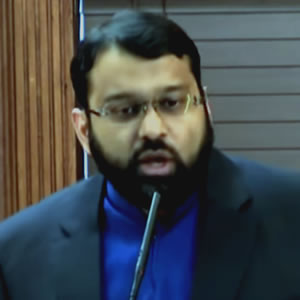 Who is Yasir Qadhi?
Yasir Qadhi is an American Muslim scholar and writer of Pakistani descent. Since 2001, he has served as Dean of Academic Affairs at the Al-Maghrib Institute, an international Islamic educational institution with a center in Houston, Texas. He also teaches in the Religious Studies department at Rhodes College in Memphis, Tennessee, where he resides. Qadhi has written numerous books and lectured widely on Islam and contemporary Muslim issues. A 2011 The New York Times Magazine essay by Andea Elliott described Qadhi as "one of the most influential conservative clerics in American Islam."
 Who is Antichrist?
The word 'antichrist' combines two roots: anti + Khristos. Anti can mean not only 'against' and 'opposite of', but also 'in place of'. Khristos, translated 'Christ', is Greek for the Hebrew 'Messiah'. Both Christ and Messiah literally mean 'Anointed One', and refer to Jesus of Nazareth in Christian and Islamic theology. In Christianity, antichrist is a term found solely in the First Epistle of John and Second Epistle of John, and often lowercased in Bible translations. In Islamic eschatology, Masih ad-Dajjal is an anti-messiah figure (similar to the Christian concept of a last antichrist), who will appear to deceive humanity before the second coming of Isa, as Jesus is known by Muslims. The concept of an antichrist is absent in traditional Judaism; however, in the medieval diaspora, his inevitable destruction is narrated as the symbol of ultimate victory of good over evil in the Messianic age.
 What is a Prophet?
In religion, a prophet is an individual who is regarded as being in contact with a divine being and is said to speak on that entity's behalf. They claim to be serving as an intermediary with humanity by delivering messages or teachings from the supernatural source to other people. The message that the prophet conveys is called a prophecy. In Islam, all prophetic messengers are prophets (such as Adam, Noah, Abraham, Moses, Jesus, and Muhammad) though not all prophets are prophetic messengers. The primary distinction is that a prophet is required to demonstrate God's law through his actions, character, and behavior without necessarily calling people to follow him, while a prophetic messenger is required to pronounce God's law (i.e. revelation) and call his people to submit and follow him.