Uploaded: 23 May 2020 (6 years ago) · Shared: 25 May 2020
Duration: 12:17
Video Description
In this enlightening video, Tovia Singer delves into the fascinating intersection of pagan, Graeco-Roman mythology and the narrative of Prophet Jesus in the Bible. He explores the historical context where virgin births were common in ancient myths, drawing parallels to the story of Jesus. This discussion offers a unique perspective, encouraging viewers to reflect on the similarities and differences between these narratives. Whether you are interested in Islamic guidance, Jewish teachings, or Christian faith, this video provides valuable insights into the early history and spiritual reminders that can deepen your understanding of these traditions. Join Tovia Singer as he navigates this complex topic with respect and thoughtfulness, making it a must-watch for anyone curious about the roots of religious narratives.
Explore More
Search Google Search Explore Topics Tovia Singer Virgin Birth Mythology Pagan Roman GOD Who is Tovia Singer?
Tovia Singer (born 1960) is a Jewish rabbi. Singer is the founder and director of Outreach Judaism, Indonesia.
 What was the Virgin Birth?
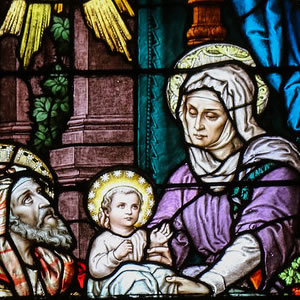
In Christianity and Islam, it is asserted that Jesus of Nazareth was conceived by his mother Mary solely through divine intervention and without sexual intercourse, thus resulting in his virgin birth. In accordance with these beliefs, Jesus had just one biological parent instead of the necessary two; Mary's husband Joseph was his father only in the legal sense. Most Christians hold that Mary's virginity was perpetual. Though not biologically related, Jesus being Joseph's adoptive son is cited as linking him to the Davidic line. The Christian understanding is that the birth of Jesus by a virgin woman was made possible by the Holy Spirit of the Trinity.
 What is Mythology?
Mythology refers to a collection of sacred, traditional tales from a specific culture that explain natural phenomena, world origins, and cultural values. This often featuring gods, goddesses, and heroes. It serves as a lens for interpreting shared human experiences through stories, rituals, and art. Myth is a genre of folklore consisting primarily of narratives that play a fundamental role in a society. For scholars, this is totally different from the ordinary sense of the term myth, meaning a belief that is not true, as the veracity of a piece of folklore is entirely irrelevant to determining whether it constitutes a myth. Myths are often endorsed by religious and secular authorities, and may be natural or supernatural in character. Many societies group their myths, legends, and history together, considering myths and legends to be factual accounts of their remote past. In particular, creation myths take place in a primordial age when the world had not achieved its later form. Origin myths explain how a society's customs, institutions, and taboos were established and sanctified. National myths are narratives about a nation's past that symbolize the nation's values. There is a complex relationship between recital of myths and the enactment of rituals.
 What is Pagan?
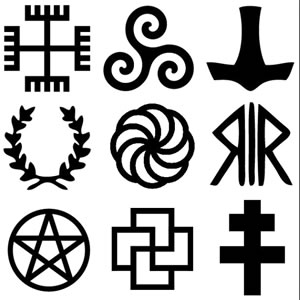
Paganism is a term first used in the fourth century by early Christians. It was applied on populations of the Roman Empire who practiced polytheism, either because they were increasingly rural and provincial relative to the Christian population or because they were not milites Christi (soldiers of Christ). Alternate terms in Christian texts for the same group were hellene, gentile, and heathen. Pagan and paganism were pejorative terms for the same polytheistic group, implying its inferiority. Paganism has broadly connoted the "religion of the peasantry", and for much of its history was a derogatory term. Both during and after the Middle Ages, pagan was a pejorative term that was applied to any non-Abrahamic or unfamiliar religion, and the term presumed a belief in false god(s).
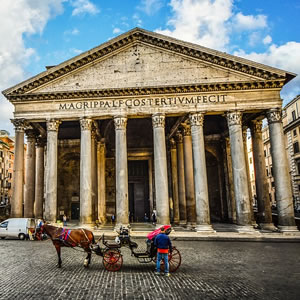 What is Roman?
In historiography, ancient Rome is Roman civilization. From the founding of the city of Rome in the 8th century BC to the collapse of the Western Roman Empire in the 5th century AD, encompassing the Roman Kingdom, Roman Republic and Roman Empire until the fall of the western empire. The civilization began as an Italic settlement in the Italian peninsula, dating from the 8th century BC, that grew into the city of Rome and which subsequently gave its name to the empire over which it ruled and to the widespread civilisation the empire developed. The Roman empire expanded to become one of the largest empires in the ancient world, though still ruled from the city, with an estimated 50 to 90 million inhabitants (roughly 20% of the world's population) and covering 5.0 million square kilometres at its height in AD 117.
Who is GOD?In monotheism and henotheism, God is conceived as the Supreme Being and principal object of faith. The concept of God as described by theologians commonly includes the attributes of omniscience (infinite knowledge), omnipotence (unlimited power), omnipresence (present everywhere), omnibenevolence (perfect goodness), divine simplicity, and eternal and necessary existence. In theism, God is the creator and sustainer of the universe In deism, God is the creator, but not the sustainer, of the universe Monotheism is the belief in the existence of one God or in the oneness of God In pantheism, God is the universe itself In atheism, God is purported not to exist, while deemed unknown or unknowable within the context of agnosticism.