Uploaded: 29 Aug 2012 (14 years ago) · Shared: 05 Dec 2016
Duration: 10:30
Video Description
Explore a captivating biblical analysis with Prophet John Schoenheit as he examines 1 Corinthians 15:45 and its connection to the Christian Trinity. Delving into the heart of scripture, this insightful video offers a fresh perspective on core Christian theology, early church history, and the true nature of faith. By thoughtfully unpacking commonly cited Bible passages, Schoenheit invites viewers from all backgrounds to deepen their understanding of sacred texts and engage in meaningful theological reflection.
Whether you are seeking spiritual guidance, studying comparative religion across Jewish, Christian, and Islamic traditions, or looking to clarify foundational scriptures, this presentation provides clear, engaging commentary. Discover compelling answers regarding unitarian theology and gain valuable insights that enrich your personal journey of faith and scriptural study. Watch now to transform your approach to biblical interpretation and elevate your understanding of God's Word.
Explore More
John Schoenheit Unitarian Trinity GOD JESUS
JESUS
Search Google Search Explore Topics
 Who are John Schoenheit?
BiblicalUnitarian serves as the digital media outlet for BiblicalUnitarian.com, a web resource operated in connection with Christian ministries like Spirit & Truth Fellowship International. The channel focuses on teaching non-Trinitarian theology based directly on Scripture.
 What is Unitarian?
Unitarianism can be viewed as a form of Nontrinitarianism which is a form of Christianity that rejects the mainstream Christian doctrine of the Trinity. The teaching that God is three distinct hypostases or persons who are coeternal, coequal, and indivisibly united in one being, or essence (from the Greek ousia). Certain religious groups that emerged during the Protestant Reformation have historically been known as antitrinitarian, but are not considered Protestant in popular discourse due to their nontrinitarian nature. According to churches that consider the decisions of ecumenical councils final, Trinitarianism was definitively declared to be Christian doctrine at the 4th-century ecumenical councils, that of the First Council of Nicaea (325 AD), which declared the full divinity of the Son, and the First Council of Constantinople (381 AD), which declared the divinity of the Holy Spirit. In terms of number of adherents, nontrinitarian denominations comprise a minority of modern Christianity. The largest nontrinitarian Christian denominations are The Church of Jesus Christ of Latter-day Saints ("Mormons") and Jehovah's Witnesses.
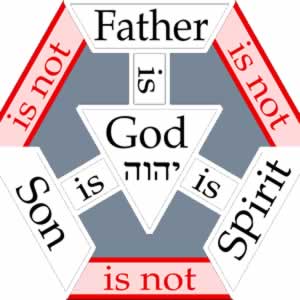 What is Trinity?
The Christian doctrine of the Trinity (Latin: trinus "threefold") holds that God is one God, but three coeternal consubstantial persons or hypostases. These being the Father, the Son (Jesus Christ), and the Holy Spirit - as "one God in three Divine Persons". The three Persons are distinct, yet are one "substance, essence or nature" (homoousios).
Who is GOD?In monotheism and henotheism, God is conceived as the Supreme Being and principal object of faith. The concept of God as described by theologians commonly includes the attributes of omniscience (infinite knowledge), omnipotence (unlimited power), omnipresence (present everywhere), omnibenevolence (perfect goodness), divine simplicity, and eternal and necessary existence. In theism, God is the creator and sustainer of the universe In deism, God is the creator, but not the sustainer, of the universe Monotheism is the belief in the existence of one God or in the oneness of God In pantheism, God is the universe itself In atheism, God is purported not to exist, while deemed unknown or unknowable within the context of agnosticism.