Youtube Description:
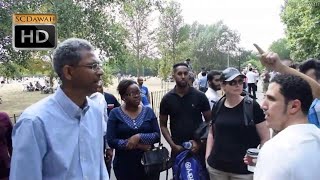
Dr El-Fadl speaks truth to power about the current state of affairs confronting Muslims and human rights abuses around the world, and speaks out against the expected unjust execution of three prominent Saudi scholars, Salman al-Odah, Awad al-Qarni and Ali al-Omari. He emphasizes that Islam is a message of human dignity and liberation despite all attempts by authoritarian regimes to silence the voices that affirm this message. Protest outside Saudi Consulate, Los Angeles, 2 June 2019.
Dr El-Fadl speaks truth to power about the current state of affairs confronting Muslims and human rights abuses around the world, and speaks out against the expected unjust execution of three prominent Saudi scholars, Salman al-Odah, Awad al-Qarni and Ali al-Omari. He emphasizes that Islam is a message of human dignity and liberation despite all attempts by authoritarian regimes to silence the voices that affirm this message. Protest outside Saudi Consulate, Los Angeles, 2 June 2019.
Explore More
 Who is Usuli Institute?
Building upon the foundations of the rich and nuanced Islamic jurisprudential tradition, we apply God's timeless moral imperatives to our current world to advance human knowledge, challenge the status quo, and set a new standard for beauty, reasonableness and goodness in the world. Under the guidance of Islamic scholar and jurist, Dr. Khaled Abou El Fadl, we are a team of dedicated academics, professionals and volunteers that are passionate about the beauty of the Islamic tradition. The Islamic tradition once inspired Muslims to be at the forefront of human discovery and knowledge. Today, Muslims have been left behind in virtually all global conversations and play no role in the moral leadership of our times. By returning to the foundational virtues of the Islamic tradition, we seek to rekindle the spirit of exploration, renew the commitment to knowledge, and represent a moral message that inspires the world.
 What is Saudi Arabia?
Saudi Arabia, officially the Kingdom of Saudi Arabia (KSA) is a country in Western Asia constituting the bulk of the Arabian Peninsula. With a land area of approximately 2,150,000 km2 (830,000 sq mi), Saudi Arabia is geographically the largest sovereign state in the Middle East, the 2nd largest in the Arab world (after Algeria), the 5th largest in Asia, and the 12th largest in the world. Saudi Arabia is bordered by Jordan and Iraq to the north, Kuwait to the northeast, Qatar, Bahrain, and the United Arab Emirates to the east, Oman to the southeast and Yemen to the south; most of its terrain consists of arid desert, lowland and mountains. As of October 2018, the Saudi economy was the largest in the Middle East and the 18th largest in the world. Saudi Arabia also enjoys one of the world's youngest populations; 50% of its 33.4 million people are under 25 years old.
 What is Muslim?
One of the major religions of the world, Islam literally translates to "submission," as a follower of Islam (Muslims) devotes their life to that of their God. The religion began with the teachings of Muhammad in the 7th century. The theology of Islam is based on the Qur'an, which was given to Muhammad by God. Some of the major fundamental principles of Islam include the Five Pillars, which hope to unite all Muslims into a community. Two different factions of Muslims exist - the majority are known as Sunni, with a small percentage known as Shi'a - both predominantly reside throughout the Middle East. Muhammad died in 632 AD and the religion of Islam formally started after his death. The Quran was formally compiled and finalised in 650 AD, prior to which it was 'memorised' and written across many parchments.
What is Prison?A prison, also known as a correctional facility, jail, penitentiary, detention center, remand center, or internment facility is a facility in which inmates are forcibly confined. The inmates are denied a variety of freedoms under the authority of the state. Prisons are most commonly used within a criminal justice system: people charged with crimes may be imprisoned until their trial; those pleading or being found guilty of crimes at trial may be sentenced to a specified period of imprisonment.