995 views
·
Last viewed: 9 hrs ago
Uploaded: 29 Aug 2011 (15 years ago) · Shared: 04 Jan 2019
Duration: 19:21
Uploaded: 29 Aug 2011 (15 years ago) · Shared: 04 Jan 2019
Duration: 19:21
Youtube Description
This is a response to an invitation from bossman103 to debate the existence and significance of similarities between the Jesus story found in the NewTestament and older, pre-Christian myths. Sorry for being a little long . . .
Watch bossman103's response:
http://www.youtube.com/watch?v=HhyiBbOOoiU
Check out bossman103's channel:
http://www.youtube.com/user/bossman103
Sources for the Raglan scores of Jesus I cite:
Thomas J. Sienkewicz:
http://department.monm.edu/classics/Courses/Clas230/MythDocuments/HeroPattern/JesusPattern.htm
Abigail Acland:
http://tam-lin.org/abby/raglan.html
Alan Dundes:
http://www.religioustolerance.org/chr_jcpa4.htm
Bernard Muller:
http://historical-jesus.info/
And for a contrary opinion, see this article from tektonics.org:
http://www.tektonics.org/copycat/raglan.html
Finally, read and see more from me at:
http://www.stevelikestocurse.com
Explore More
Search Google Search Explore Topics Mythical Mithras Pagan GOD What is Mythical?
Mythology refers to a collection of sacred, traditional tales from a specific culture that explain natural phenomena, world origins, and cultural values. This often featuring gods, goddesses, and heroes. It serves as a lens for interpreting shared human experiences through stories, rituals, and art. Myth is a genre of folklore consisting primarily of narratives that play a fundamental role in a society. For scholars, this is totally different from the ordinary sense of the term myth, meaning a belief that is not true, as the veracity of a piece of folklore is entirely irrelevant to determining whether it constitutes a myth. Myths are often endorsed by religious and secular authorities, and may be natural or supernatural in character. Many societies group their myths, legends, and history together, considering myths and legends to be factual accounts of their remote past. In particular, creation myths take place in a primordial age when the world had not achieved its later form. Origin myths explain how a society's customs, institutions, and taboos were established and sanctified. National myths are narratives about a nation's past that symbolize the nation's values. There is a complex relationship between recital of myths and the enactment of rituals.
 Who was Mithras?
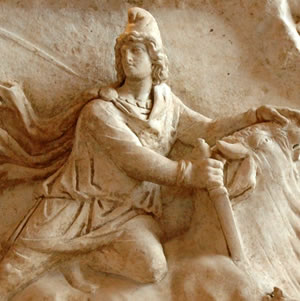
Mithraism, was a mystery religion centered on the god Mithras that was practised in the Roman Empire from about the 1st to the 4th century CE. The religion was inspired by Persian worship of the god Mithra (Proto-Indo-Iranian/Vedic Mitra), though the Greek Mithras was linked to a new and distinctive imagery, and the level of continuity between Persian and Greco-Roman practice is debated. Worshippers of Mithras had a complex system of seven grades of initiation and communal ritual meals. Initiates called themselves syndexioi, those "united by the handshake". They met in underground temples, called mithraea, which survive in large numbers. The cult appears to have had its centre in Rome.
 What is Pagan?
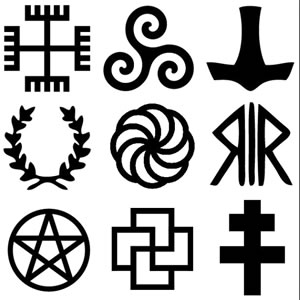
Paganism is a term first used in the fourth century by early Christians. It was applied on populations of the Roman Empire who practiced polytheism, either because they were increasingly rural and provincial relative to the Christian population or because they were not milites Christi (soldiers of Christ). Alternate terms in Christian texts for the same group were hellene, gentile, and heathen. Pagan and paganism were pejorative terms for the same polytheistic group, implying its inferiority. Paganism has broadly connoted the "religion of the peasantry", and for much of its history was a derogatory term. Both during and after the Middle Ages, pagan was a pejorative term that was applied to any non-Abrahamic or unfamiliar religion, and the term presumed a belief in false god(s).
Who is GOD?In monotheism and henotheism, God is conceived as the Supreme Being and principal object of faith. The concept of God as described by theologians commonly includes the attributes of omniscience (infinite knowledge), omnipotence (unlimited power), omnipresence (present everywhere), omnibenevolence (perfect goodness), divine simplicity, and eternal and necessary existence. In theism, God is the creator and sustainer of the universe In deism, God is the creator, but not the sustainer, of the universe Monotheism is the belief in the existence of one God or in the oneness of God In pantheism, God is the universe itself In atheism, God is purported not to exist, while deemed unknown or unknowable within the context of agnosticism.