569 views
·
Last viewed: 20 hrs ago
Uploaded: 07 May 2018 (8 years ago) · Shared: 10 Jul 2018
Duration: 23:52
Uploaded: 07 May 2018 (8 years ago) · Shared: 10 Jul 2018
Duration: 23:52
Youtube Description
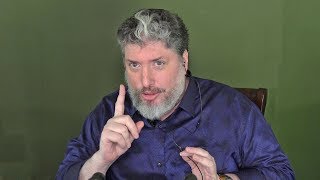
http://JewTube.Info Controversial street-preacher, Israel Reuben, returned with 4-day-glo-clad disciples to the Celebrate Israel Festival in LosAngeles, preaching his message of Jewish cursedness for deicide. He deprecates the Jews for 'faithlessness of the 'chosen-people' to provoke a holy war with the Muslim world by conquering the Temple Mount / Al Aqsa Mosque and provoke Armageddon with Islam in order to expedite the Messiah to rapture Christians.
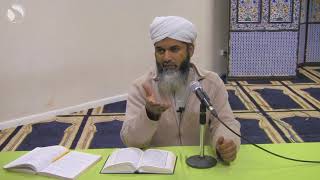
An orthodox-Jewish, wholistic-doctor engages and challenges Reuben in a respectful debate. Then the police show up to speak with the group and escort them from the fair over reported annoyances.
Explore More
Temple Mount Ruben Israel Al-Aqsa Judaism Israel Islam GODSearch Google Search Explore Topics
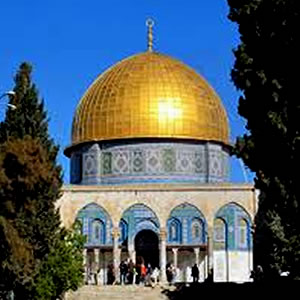 What is Temple Mount?
The Temple Mount known to Muslims as the Haram esh-Sharif and the Al Aqsa Compound is a hill located in the Old City of Jerusalem. This for thousands of years has been venerated as a holy site, in Judaism, Christianity, and Islam alike. According to the Bible, the Jewish Temples stood on the Temple Mount. According to Jewish tradition and scripture, the First Temple was built by King Solomon the son of King David in 957 BCE and destroyed by the Babylonians in 586 BCE. The second was constructed under the auspices of Zerubbabel in 516 BCE and destroyed by the Roman Empire in 70 CE. Jewish tradition maintains it is here that a third and final Temple will also be built. The location is the holiest site in Judaism and is the place Jews turn towards during prayer. Among Sunni Muslims, the Mount is widely considered the third holiest site in Islam. Revered as the Noble Sanctuary, the location of Muhammad's journey to Jerusalem and ascent to heaven, the site is also associated with Jewish biblical prophets who are also venerated in Islam.
 Who is Ruben Israel?
I am a God fearing Christian Patriot that is willing to fight for my Country and die for my faith. I am not ashamed of the gospel of Christ.
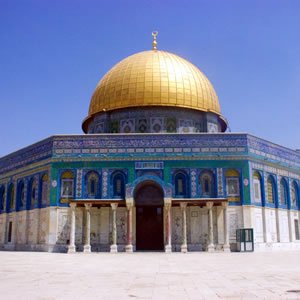 What is Al-Aqsa?
Al-Aqsa Mosque, 'the Farthest Mosque' located in the Old City of Jerusalem. This is the third holiest site in Islam. The mosque was built on top of the Temple Mount, known as Haram esh-Sharif in Islam. Muslims believe that Muhammad was transported from the Sacred Mosque in Mecca to al-Aqsa during the Night Journey. Islamic tradition holds that Muhammad led prayers towards this site until the 17th month after his migration from Mecca to Medina, when Allah directed him to turn towards the Kaaba in Mecca.
 What is Judaism?
Judaism encompasses the religion, philosophy, culture and way of life of the Jewish people. Judaism is a monotheistic religion, with the Torah as its foundational text (part of the larger text known as the Tanakh or Hebrew Bible), and supplemental oral tradition represented by later texts such as the Midrash and the Talmud. Judaism is considered by religious Jews to be the expression of the covenantal relationship that God established with the Children of Israel. Judaism includes a wide corpus of texts, practices, theological positions, and forms of organization. Within Judaism there are a variety of movements, most of which emerged from Rabbinic Judaism, which holds that God revealed his laws and commandments to Moses on Mount Sinai in the form of both the Written and Oral Torah. The Jews are an ethnoreligious group and include those born Jewish and converts to Judaism. In 2012, the world Jewish population was estimated at about 14 million, or roughly 0.2% of the total world population. About 42% of all Jews reside in Israel and about 42% reside in the United States and Canada, with most of the remainder living in Europe.
 Where is Israel?
Israel, officially the State of Israel, is a country in the Middle East. Located on the southeastern shore of the Mediterranean Sea and the northern shore of the Red Sea. It has land borders with Lebanon to the north, Syria to the northeast, Jordan on the east, the Palestinian territories of the West Bank and Gaza Strip to the east and west, respectively, and Egypt to the southwest.
 What is Islam?
One of the major religions of the world, Islam literally translates to "submission," as a follower of Islam (Muslims) devotes their life to that of their God. The religion began with the teachings of Muhammad in the 7th century. The theology of Islam is based on the Qur'an, which was given to Muhammad by God. Some of the major fundamental principles of Islam include the Five Pillars, which hope to unite all Muslims into a community. Two different factions of Muslims exist - the majority are known as Sunni, with a small percentage known as Shi'a - both predominantly reside throughout the Middle East. Muhammad died in 632 AD and the religion of Islam formally started after his death. The Quran was formally compiled and finalised in 650 AD, prior to which it was 'memorised' and written across many parchments.
Who is GOD?In monotheism and henotheism, God is conceived as the Supreme Being and principal object of faith. The concept of God as described by theologians commonly includes the attributes of omniscience (infinite knowledge), omnipotence (unlimited power), omnipresence (present everywhere), omnibenevolence (perfect goodness), divine simplicity, and eternal and necessary existence. In theism, God is the creator and sustainer of the universe In deism, God is the creator, but not the sustainer, of the universe Monotheism is the belief in the existence of one God or in the oneness of God In pantheism, God is the universe itself In atheism, God is purported not to exist, while deemed unknown or unknowable within the context of agnosticism.