873 views
·
Last viewed: 6 hrs ago
Uploaded: 02 Oct 2016 (10 years ago) · Shared: 12 Dec 2017
Duration: 25:57
Uploaded: 02 Oct 2016 (10 years ago) · Shared: 12 Dec 2017
Duration: 25:57
Video Description
In this insightful video, Omar Suleiman addresses the pervasive myth that all terrorists are Muslim, offering a nuanced and compassionate perspective that resonates with followers of all faiths. Drawing from Islamic teachings and historical context, Suleiman challenges this harmful stereotype, emphasizing the importance of understanding and empathy. He highlights how Islam, Christianity, and Judaism share a commitment to peace and justice, urging viewers to look beyond media narratives and seek the truth. This video is a powerful reminder of the need for interfaith dialogue and mutual respect, making it a valuable resource for anyone interested in fostering a more harmonious and informed society.
Explore More
Search Google Search Explore Topics Omar Suleiman Terrorist Muslim Myth Who is Omar Suleiman?
Omar Suleiman (born 1986) is an American Muslim scholar, civil rights activist and speaker. He is the Founder and President of the Yaqeen Institute for Islamic Research professor of Islamic Studies at Southern Methodist University. Suleiman is also the Resident Scholar of the Valley Ranch Islamic Center and the Co-Chair of Faith Forward Dallas at Thanks-Giving Square.
 What is Terrorist?
Terrorism is the use of intentionally indiscriminate violence as a means to create terror among masses of people. With aim to create fear to achieve a financial, political, religious or ideological aim. It is used in this regard primarily to refer to violence against peacetime targets or in war against non-combatants. The terms "terrorist" and "terrorism" originated during the French Revolution of the late 18th century but gained mainstream popularity during the U.S. presidency of Ronald Reagan (1981-89) after the 1983 Beirut barracks bombings and again after the 2001 September 11 attacks. There is no commonly accepted definition of "terrorism". Being a charged term, with the connotation of something "morally wrong", it is often used, both by governments and non-state groups, to abuse or denounce opposing groups.
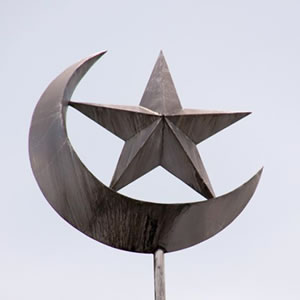 What is Muslim?
One of the major religions of the world, Islam literally translates to "submission," as a follower of Islam (Muslims) devotes their life to that of their God. The religion began with the teachings of Muhammad in the 7th century. The theology of Islam is based on the Qur'an, which was given to Muhammad by God. Some of the major fundamental principles of Islam include the Five Pillars, which hope to unite all Muslims into a community. Two different factions of Muslims exist - the majority are known as Sunni, with a small percentage known as Shi'a - both predominantly reside throughout the Middle East. Muhammad died in 632 AD and the religion of Islam formally started after his death. The Quran was formally compiled and finalised in 650 AD, prior to which it was 'memorised' and written across many parchments.
 What is Myth?
Mythology refers to a collection of sacred, traditional tales from a specific culture that explain natural phenomena, world origins, and cultural values. This often featuring gods, goddesses, and heroes. It serves as a lens for interpreting shared human experiences through stories, rituals, and art. Myth is a genre of folklore consisting primarily of narratives that play a fundamental role in a society. For scholars, this is totally different from the ordinary sense of the term myth, meaning a belief that is not true, as the veracity of a piece of folklore is entirely irrelevant to determining whether it constitutes a myth. Myths are often endorsed by religious and secular authorities, and may be natural or supernatural in character. Many societies group their myths, legends, and history together, considering myths and legends to be factual accounts of their remote past. In particular, creation myths take place in a primordial age when the world had not achieved its later form. Origin myths explain how a society's customs, institutions, and taboos were established and sanctified. National myths are narratives about a nation's past that symbolize the nation's values. There is a complex relationship between recital of myths and the enactment of rituals.