Youtube Description:
The Council of Nicaea convened to decide the guiding rules of the church - and to resolve the questions posed by Arian theology. A deacon named Athanasius set himself against Arius and succeeded in getting his teachings declared heresy.
Support us on Patreon! --- (Episode details below)
Grab your Extra Credits gear at the store!
Subscribe for new episodes every Saturday!
Watch the beginning of the Early Christian Schisms!
Play games with us on Extra Play!
Get our list of recommended games on Steam:
____________
Disclaimer: This series is intended for students, to give them a broad overview of a complicated subject that has driven world history for centuries. Our story begins and focuses on Rome.
Constantine called the Council of Nicaea not only to address the teachings of Arius, but also to decide basic matters for how the church would go forward. Yet it was the debate over Arian theology which quickly came to dominate the council's time. The bishops effectively split into two factions, one backing Arius and the other led by a deacon named Athanasius. Athanasius vehemently opposed the Arian teachings and would not allow any compromise to be formed with the other group. Yet he played the politics very carefully, adopting in his own arguments the phrase 'homoousian' (or 'of the same substance') to describe the relationship between the Father and the Son, knowing full well that Arius would never accept an agreement which included this idea. Even when others tried to compromise with the phrase 'homoiousian' (or 'of similar substance'), Arius would not agree. Athanasius used the extra time to make private deals and assemble a majority coalition, with which he successfully caused Arianism to be declared heresy and forced Arius himself into exile. Emperor Constantine was just happy a decision had been reached, but a bishop in his own court would not let matters rest so easily. This bishop, Eusebius, campaigned tirelessly for the restoration of Arius and managed to get Athanasius exiled instead. Constantine himself wound up being baptized by Eusebius, and his son Emperor Constantius II would be a die-hard Arian in his turn. Eusebius even ordained a Goth named Ulfilas to preach to the Gothic tribes, and his sucess meant that the tribes became Arian Christians who would never completely assimilate into the Roman Empire. Thus, despite the firm decree at the First Council of Nicaea, Arian Christianity continued to grow and thrive alongside orthodox teachings.
____________
♫ Get the intro music here!
*Music by Demetori:
♫ Get the outro music here!
*Music by Sean and Dean Kiner:
The Council of Nicaea convened to decide the guiding rules of the church - and to resolve the questions posed by Arian theology. A deacon named Athanasius set himself against Arius and succeeded in getting his teachings declared heresy.
Support us on Patreon! --- (Episode details below)
Grab your Extra Credits gear at the store!
Subscribe for new episodes every Saturday!
Watch the beginning of the Early Christian Schisms!
Play games with us on Extra Play!
Get our list of recommended games on Steam:
____________
Disclaimer: This series is intended for students, to give them a broad overview of a complicated subject that has driven world history for centuries. Our story begins and focuses on Rome.
Constantine called the Council of Nicaea not only to address the teachings of Arius, but also to decide basic matters for how the church would go forward. Yet it was the debate over Arian theology which quickly came to dominate the council's time. The bishops effectively split into two factions, one backing Arius and the other led by a deacon named Athanasius. Athanasius vehemently opposed the Arian teachings and would not allow any compromise to be formed with the other group. Yet he played the politics very carefully, adopting in his own arguments the phrase 'homoousian' (or 'of the same substance') to describe the relationship between the Father and the Son, knowing full well that Arius would never accept an agreement which included this idea. Even when others tried to compromise with the phrase 'homoiousian' (or 'of similar substance'), Arius would not agree. Athanasius used the extra time to make private deals and assemble a majority coalition, with which he successfully caused Arianism to be declared heresy and forced Arius himself into exile. Emperor Constantine was just happy a decision had been reached, but a bishop in his own court would not let matters rest so easily. This bishop, Eusebius, campaigned tirelessly for the restoration of Arius and managed to get Athanasius exiled instead. Constantine himself wound up being baptized by Eusebius, and his son Emperor Constantius II would be a die-hard Arian in his turn. Eusebius even ordained a Goth named Ulfilas to preach to the Gothic tribes, and his sucess meant that the tribes became Arian Christians who would never completely assimilate into the Roman Empire. Thus, despite the firm decree at the First Council of Nicaea, Arian Christianity continued to grow and thrive alongside orthodox teachings.
____________
♫ Get the intro music here!
*Music by Demetori:
♫ Get the outro music here!
*Music by Sean and Dean Kiner:
Explore More
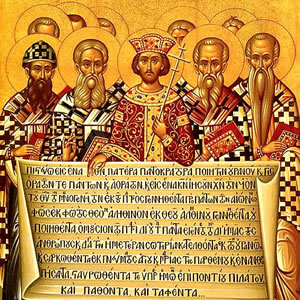 What was the Council of Nicaea?
The First Council of Nicaea was a council of Christian bishops convened in the Bithynian city of Nicaea (now ?znik, Bursa province, Turkey) by the Roman Emperor Constantine I in 325 AD. Its main accomplishments were settlement of the Christological
issue of the divine nature of God the Son and his relationship to God the Father, the construction of the first part of the Nicene Creed, establishing uniform observance of the date of Easter, and promulgation of early canon law.