Youtube Description:
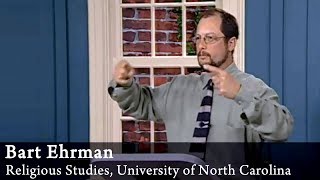
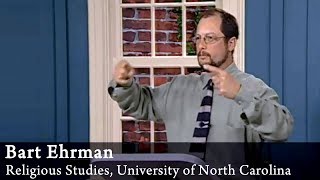
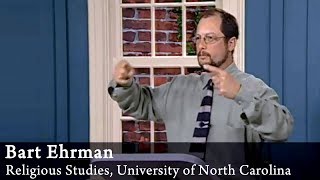
The Diane Rehm Show is produced at WAMU 88.5 and distributed by National Public Radio, NPR Worldwide, and SIRIUS satellite radio. Diane Rehm is the host who interviews Bart live on the air on Thursday, December 8, 2005. She titles the radio program, 'Who Changed the Bible and Why?' while referencing Bart's book 'Misquoting Jesus: The Story Behind Who Changed the Bible and Why.'
Professor Bart Ehrman describes how mistakes and intentional changes made by scribes who hand copied the words of Jesus and the writings of Saint Paul have shaped cherished biblical stories and widely held beliefs. How beliefs concerning the divinity of Jesus, the Trinity, and the divine origins of the Bible itself are the results of both intentional and accidental alterations by scribes. He addresses questions about homosexuality as understood in Jesus' time and the holiday Christmas, among other topics.
Program discussed on Bart Ehrman's Foundation Blog:
Bart D. Ehrman is the James A. Gray Distinguished Professor at the University of North Carolina at Chapel Hill. He came to UNC in 1988, after four years of teaching at Rutgers University. At UNC he has served as both the Director of Graduate Studies and the Chair of the Department of Religious Studies. A graduate of Wheaton College (Illinois), Professor Ehrman received both his Masters of Divinity and Ph.D. from Princeton Theological Seminary, where his 1985 doctoral dissertation was awarded magna cum laude.
Copyright © Bart D. Ehrman and The Diane Rehm Show. All Rights Reserved. Unauthorized use, re-posting and/or duplication of this media without express and written permission from Bart D. Ehrman and The Diane Rehm Show is strictly prohibited.
The Diane Rehm Show is produced at WAMU 88.5 and distributed by National Public Radio, NPR Worldwide, and SIRIUS satellite radio. Diane Rehm is the host who interviews Bart live on the air on Thursday, December 8, 2005. She titles the radio program, 'Who Changed the Bible and Why?' while referencing Bart's book 'Misquoting Jesus: The Story Behind Who Changed the Bible and Why.'
Professor Bart Ehrman describes how mistakes and intentional changes made by scribes who hand copied the words of Jesus and the writings of Saint Paul have shaped cherished biblical stories and widely held beliefs. How beliefs concerning the divinity of Jesus, the Trinity, and the divine origins of the Bible itself are the results of both intentional and accidental alterations by scribes. He addresses questions about homosexuality as understood in Jesus' time and the holiday Christmas, among other topics.
Program discussed on Bart Ehrman's Foundation Blog:
Bart D. Ehrman is the James A. Gray Distinguished Professor at the University of North Carolina at Chapel Hill. He came to UNC in 1988, after four years of teaching at Rutgers University. At UNC he has served as both the Director of Graduate Studies and the Chair of the Department of Religious Studies. A graduate of Wheaton College (Illinois), Professor Ehrman received both his Masters of Divinity and Ph.D. from Princeton Theological Seminary, where his 1985 doctoral dissertation was awarded magna cum laude.
Copyright © Bart D. Ehrman and The Diane Rehm Show. All Rights Reserved. Unauthorized use, re-posting and/or duplication of this media without express and written permission from Bart D. Ehrman and The Diane Rehm Show is strictly prohibited.
Explore More
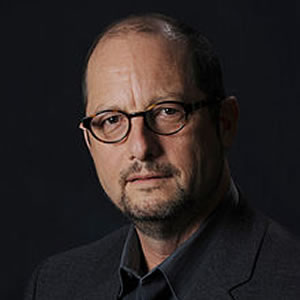 Who is Bart Ehrman?
Bart Ehrman (born 1955) is an American New Testament scholar focusing on textual criticism of New Testament, historical Jesus, and development of early Christianity. Ehrman has written and edited 30 books, including three college textbooks. He has
also authored six New York Times bestsellers. He is currently the James A. Gray Distinguished Professor of Religious Studies at the University of North Carolina at Chapel Hill.
 What is The Bible?
The Bible is a canonical collection of texts sacred in Judaism and Christianity. There is no single "Bible" and many Bibles with varying contents exist. The term Bible is shared between Judaism and Christianity, although the contents of each of their
collections of canonical texts is not the same.
Different religious groups include different books within their Biblical canons, in different orders, and sometimes divide or combine books, or incorporate additional material into canonical books.
The Hebrew Bible, or Tanakh, contains 24 books. Christian Bibles range from the 66 books of the Protestant canon to the 81 books of the Ethiopian Orthodox Church canon.
The first part of Christian Bibles is the Old Testament, which contains, at minimum, the 24 books of the Hebrew Bible divided into 39 books and ordered differently from the Hebrew Bible. The Catholic Church and Eastern Christian churches also hold certain deuterocanonical books and passages to be part of the Old Testament canon.
The second part is the New Testament, containing 27 books: the 4 Canonical gospels, Acts of the Apostles, 21 Epistles or didactic letters, and the Book of Revelation.