Who was Apostle Paul?
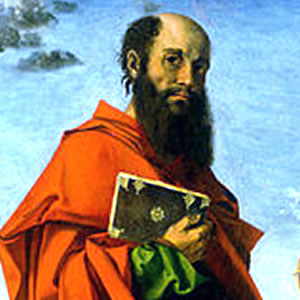 Paul the Apostle (Latin: Paulus), commonly known as Saint Paul and also known by his Jewish name Saul of Tarsus was an apostle (though not one of the Twelve Apostles) who taught the gospel of Christ to the first century world. Paul is generally considered one of the most important figures of the Apostolic Age and in the mid-30s to the mid-50s AD he founded several churches in Asia Minor and Europe. He took advantage of his status as both a Jew and a Roman citizen to minister to both Jewish and Roman audiences. According to writings in the New Testament and prior to his conversion, Paul was dedicated to persecuting the early disciples of Jesus in the area of Jerusalem. In Acts, Paul was traveling on the road from Jerusalem to Damascus on a mission to 'arrest them and bring them back to Jerusalem' when the resurrected Jesus appeared to him in a great light. He was struck blind, but after three days his sight was restored by Ananias of Damascus and Paul began to preach that Jesus of Nazareth is the Jewish Messiah and the Son of God.
What is Sacrifice?
 Sacrifice is the offering of food, objects or the lives of animals to a higher purpose, in particular divine beings, as an act of propitiation or worship. While sacrifice often implies the ritual killing of an animal, the term offering can be used for bloodless sacrifices of food or artifacts.
 Who is Hashim?
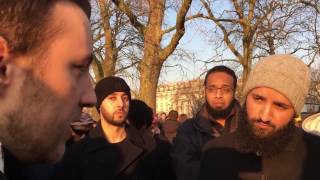
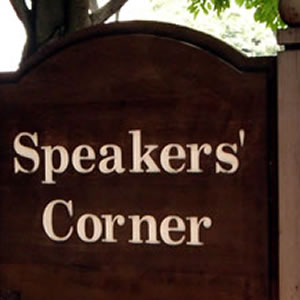 A Speakers' Corner is an area where open-air public speaking, debate, and discussion are allowed. The original and most noted is in the north-east corner of Hyde Park in London, England. Speakers here may talk on any subject, as long as the police consider their speeches lawful, although this right is not restricted to Speakers' Corner only. Contrary to popular belief, there is no immunity from the law, nor are any subjects proscribed, but in practice the police intervene only when they receive a complaint. Speakers' Corner is often held up to demonstrate freedom of speech, as anyone can turn up unannounced and talk on almost any subject, although always at the risk of being heckled by regulars.
 What is Isaiah?
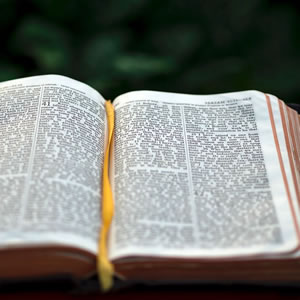 Book of Isaiah, or Isaiah is the first of the Latter Prophets in the Hebrew Bible and the first of the Major Prophets in the Christian Old Testament. It is identified by a superscription as the words of the 8th-century BCE prophet Isaiah ben Amoz, but there is extensive evidence that much of it was composed during the Babylonian captivity and later. The consensus through most of the 20th century, that the book comprises three separate collections of oracles: Proto-Isaiah (chapters 1-39), containing the words of Isaiah; Deutero-Isaiah (chapters 40-55), the work of an anonymous 6th-century BCE author writing during the Exile; and Trito-Isaiah (chapters 56-66), composed after the return from Exile. While virtually no scholars today attribute the entire book, or even most of it, to one person, the book's essential unity has become a focus in current research.
Video Description (from Youtube)
» If you liked this video, please subscribe & share on your social media platforms. The Prophet said, “Whoever guides someone to goodness will have a similar reward.” [Sahih Muslim 1893]
Disclaimer: The views and opinions of partakers in these debates and videos in no way represent the views of Sam Dawah but are a representation of what takes place at Speakers Corner.
Disclaimer: The views and opinions of partakers in these debates and videos in no way represent the views of Sam Dawah but are a representation of what takes place at Speakers Corner.
DISCLAIMER
All videos are shared for educational and information purposes only. All videos are hosted and viewable on Youtube servers. Video titles are generated using the original video title; overall content theme including actual dialogue and speech (Transcript); and A.I-based recommendations with a focus on SEO, keyword density, and internal search functions. The video title does not represent the views held by the Youtube video uploader, or any individual, organisation or business.
If you spot any mistake, omission or give feedback, kindly Contact Us with details