9:19
862 views
·
Last viewed: 3 hrs ago
Uploaded: 11 Aug 2019 (7 years ago) · Shared: 13 Aug 2019
Video Description (from Youtube)
Overview & Key Concepts
What is Trinity?
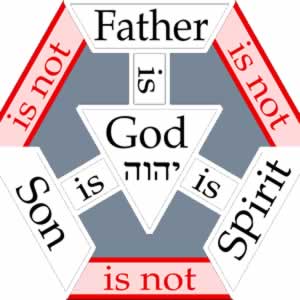 The Christian doctrine of the Trinity (Latin: trinus "threefold") holds that God is one God, but three coeternal consubstantial persons or
hypostases. These being the Father, the Son (Jesus Christ), and the Holy Spirit - as "one God in three Divine Persons". The three Persons are distinct, yet are one "substance, essence or nature" (homoousios).
What is Israel?
 Israel, officially the State of Israel, is a country in the Middle East. Located on the southeastern shore of the Mediterranean Sea and the northern
shore of the Red Sea. It has land borders with Lebanon to the north, Syria to the northeast, Jordan on the east, the Palestinian territories of the West Bank and Gaza Strip to the east and west, respectively, and Egypt to the southwest.
What is Isaiah?
 Book of Isaiah, or Isaiah is the first of the Latter Prophets in the Hebrew Bible and the first of the Major Prophets in the Christian Old Testament
It is identified by a superscription as the words of the 8th-century BCE prophet Isaiah ben Amoz, but there is extensive evidence that much of it was composed during the Babylonian captivity and later. The consensus through most of the 20th century, that the book comprises three separate collections of oracles: Proto-Isaiah (chapters 1-39), containing the words of Isaiah; Deutero-Isaiah (chapters 40-55), the work of an anonymous 6th-century BCE author writing during the Exile; and Trito-Isaiah (chapters 56-66), composed after the return from Exile. While virtually no scholars today attribute the entire book, or even most of it, to one person, the book's essential unity has become a focus in current research.
Who is GOD?
 In monotheism and henotheism, God is conceived as the Supreme Being and principal object of faith. The concept of God as described by theologians
commonly includes the attributes of omniscience (infinite knowledge), omnipotence (unlimited power), omnipresence (present everywhere), omnibenevolence (perfect goodness), divine simplicity, and eternal and necessary existence.
<ul>
<li>In theism, God is the creator and sustainer of the universe</li>
<li>In deism, God is the creator, but not the sustainer, of the universe</li>
<li>Monotheism is the belief in the existence of one God or in the oneness of God</li>
<li>In pantheism, God is the universe itself</li>
<li>In atheism, God is purported not to exist, while deemed unknown or unknowable within the context of agnosticism. </li>
</ul>
Frequently Asked Questions
1.How were the Triadic or 'Trinity-like' Pagan Gods presented?
The pagan Triadic dieties were shown as a single-head with 3 faces, 3 mouths but only 4 mouths. Such images were preserved across the Roman Empire.
2.Does the Christian Trinity come from pagan Triadic dieties?
Does the Christian Trinity come from pagan Triadic dieties?
Yes. The core teachings of the Trinitarian Christian churches
today do not come from Jesus.
The three-in-one Gods are pagan concepts that existed long before
Jesus arrived. Later on, Christians adopted this concept and
instantly made Christian doctrine an appealing alternative to the
pagan God worshipping masses.
3.Why is the Trinity so difficult to understand?
"It is not a biblical doctrine in the sense that any formulation of it can be found in the Bible."
(Illustrated Bible Dictionary)
Trinitarians have been looking for Bible texts and even twisting verses to find support for the Trinity teaching.
4.How did the Christian Trinity come about?
The concept of a dual human and divine nature in the person of Jesus is known as the Hypostatic Union, an essential component of modern Trinitarianism.
Yet it wasn’t until the Council of Chalcedon that we see the emergence of an official doctrine of the Trinity in a form that is recognisable with what Christian Trinitarians believe in today. This took place in the fifth century, over 400 years after Jesus!
The evangelical theologian and Professor Wayne A. Grudem sums this up as follows:
"A precise understanding of how full deity and full humanity" argues Grudem, "could be combined together in one person was formulated only gradually in the church and did not reach the final form until the Chalcedonian Definition in 451 AD
Source: [Grudem, Systematic Theology: Chapter 26 – The Person of Christ, 1994, p. 554.]
5.Does the Bible support the Trinity (3-in-1) God concept?
This verse mentions the Trinity (Father, Son, Holy Ghost) in the King James Version Bible (KJV). Bible critics agree the KJV verse is a forgery that was added into the Bible. More modern, accurate Bibles give different text:
And the Spirit is the witness, because the Spirit is the truth - (RSV Bible)
And it is the Spirit that beareth witness, because the Spirit is the truth - (ASV Bible)
For there are three that testify: the Spirit, the water and the blood; and the three are in agreement. (NIV Bible)
6.Does the Old Testament teach the Christian Trinity?
The Old Testament does not teach the Trinity, or even set forth the Messiah would be God. There is no evidence of anyone knowing about, or believing in, the Trinity in all the Jewish literature before Christ, including the Old Testament, the Jewish targums and commentaries, the Apocrypha or other apocryphal literature, or the Dead Sea Scrolls.
7.What is the Christian Trinity?
Orthodox Christian theologians define the doctrine of the Trinity is that the Father is God, the Son is God, the Holy Spirit is God, and together these 'three Persons' make one God; and these three are co-equal and co-eternal, the Son having been 'eternally begotten' of the Father, and Jesus being simultaneously 100% God and 100% man.
Today, many Christians think they are Trinitarians simply because they believe in the Father, Son, and the Holy Spirit - but that is not the Trinity!
8.What do Christian 'Trinity' scholars say about the Old Testament?
The distinguished Trinitarian scholar Bertrand de Margerie in his book The Christian Trinity in History (p.3) writes:
"…contemporary exegetes [Bible teachers] affirm unanimously that the Old Testament did not bring to the Jewish people a clear and distinct Revelation of the existence of a plurality of persons in God. In this they agree with the clear and frequent affirmation of Fathers such as Irenaeus, Hilary, and Gregory of Nazianzus: that the doctrine of the Trinity is revealed only in the New Testament."
So any person who lived before Jesus' ministry did not have to believe in the Trinity to be saved because the Trinity is not mentioned in the Old Testament.
9.What do Christian scholars say about the Trinity?
Scholars freely admit that the Trinity is never presented as a complete doctrine in the New Testament, but rather is built from scattered Bible verses.
In the NT there is no explicit statement of the doctrine….
Evangelical Dictionary of Theology (p. 1112)
…it is not a Biblical doctrine in the sense that any formulation of it can be found in the Bible….
New Bible Dictionary (p.1221)
The New Testament does not present a systematic presentation of the Trinity. The scattered segments from various writers that appear throughout the New Testament reflect a seemingly accepted understanding that exists without a full-length discussion.
Holman Bible Dictionary (p.1372)
Theologians admit the New Testament does not define the Trinity. Furthermore, there is no clear teaching that salvation depends on the belief in the Trinity.