0:40
977 views
·
Last viewed: 10 hrs ago
Uploaded: 01 Jul 2017 (9 years ago) · Shared: 26 Aug 2019
Video Description (from Youtube)
Kegan Chandler, author of the book, “The God of Jesus,” speaks to his audience regarding the question “Did John write his gospel to compete with Gnosticism?” Kegan asserts that orthodox Christology isultimately Gnostic Christology repackaged and painted over.
DISCLAIMER
All videos are shared for educational and information purposes only. All videos are hosted and viewable on Youtube servers. Video titles are generated using the original video title; overall content theme including actual dialogue and speech (Transcript); and A.I-based recommendations with a focus on SEO, keyword density, and internal search functions. The video title does not represent the views held by the Youtube video uploader, or any individual, organisation or business.
If you spot any mistake, omission or give feedback, kindly Contact Us with details
Overview & Key Concepts
Who is Kegan Chandler?
 Kegan Chandler is a Christian author and researcher of Early Christianity, pagan religion, and Gnosticism. He is an adjunct professor at Atlanta Bible
College. Chandler holds a Master of Theology from Campbellsville University's School of Theology, where he studied Church History and Theology, and is a graduate of SCAD University, where he studied Graeco-Roman drama, medieval literature, and dramatic writing.
<br><br>
He is the author of the forthcoming book 'Constantine and the Divine Mind' (Wipf and Stock, TBD), and 'The God of Jesus in Light of Christian Dogma' (Restoration Fellowship, 2016). He is also an award-winning screenwriter, and currently writes for his blog on Church history.
<br><br>
Chandler also sits on the board of directors of the Unitarian Christian Alliance (formed 2019), and New Life Ministries of America, Inc., a small non-profit which has been producing Christian literature and financing overseas missions since 1994.
What is Gnosticism?
 Gnosticism (from Ancient Greek: gnostikos, "having knowledge") is a modern name for a variety of ancient religious ideas and systems. Originating in
Jewish-Christian milieus in the first and second century AD. These systems believed that the material world is created by an emanation of the highest God, trapping the divine spark within the human body.<br><br>Gnosticism is also defined as the belief in, dualism of good and bad and special knowledge for salvation.
Who was Irenaeus?
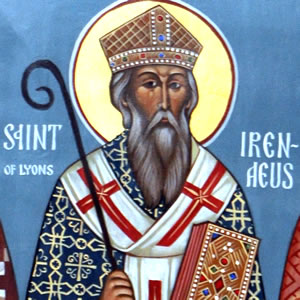 Irenaeus (130-202 AD) was a Greek bishop. He is noted for his role in guiding and expanding Christian communities in what is now the south of France
and, more widely, for the development of Christian theology by combating heresy and defining orthodoxy. Originating from Smyrna, now Izmir in Turkey, he had heard the preaching of Polycarp, who in turn was said to have heard John the Evangelist.
What is Gospel?
 Gospel is the Old English translation of Greek evangelion, meaning "good news". It originally meant the Christian message itself, but in the 2nd
century it came to be used for the books in which the message was set out. The four gospels of the New Testament: Matthew, Mark, Luke and John are the main source of information on the life of Jesus.
Frequently Asked Questions
1.What do Synoptic Gospels say about Jesus?
The Synoptic Gospels portray Jesus as a prophet, hero and martyr - not as a God who became a Man, was sacrificed and rose again for the salvation of humanity.
2.What did Apostle Paul think of his fellow Gospel writers?
As we said before, so say I now again, If any man preach any other gospel unto you than that ye have received, let him be accursed.
(Galatians 1:9)
Paul would curse other gospel writers (James, Peter etc.) as if to say their was only one Christianity, one truth and that was his version.
(Galatians 1:9)
3.How did Matthew (Gospel) support Apostle Pauline Christian doctrine?
It did not! Matthew (85 CE) was written for Jewish-Christians who observed the Law and did not wish to break away from Judaism. Matthew is in complete opposition to Pauline doctrine.
4.When were the Gospels written?
Not a single one of the Gospels were written by eyewitnesses.
Not one of the Gospels was written in the lifetime of Jesus, the earliest known Gospel recounting the life of Jesus came 30-35 years after his ministry - this being the Gospel of Mark.
5.What did Apostle Paul say about the other gospels?
Paul rebuked other gospel writers.
6.Who wrote John's gospel?
The writer of John is believed to be a Greek convert and he often shows a lack of knowledge of Judaism and the Torah; and even shows a disrespect for the Jews, as he uses the term "Jews" as a slur over 60 times in the Gospel of John alone.
7.What were the Apocryphal Gospels?
Apocrypha are works, usually written works, that are of unknown authorship, or of doubtful authenticity, or spurious, or not considered to be within a particular canon.
The Apocrypha (Greek for 'hidden away') are revered Biblical text which were excluded from the canon Bible. They were literally hidden away from the early Christians, and tell a very different story of Jesus.
Gospel of Nazoreans
Gospel of Ebionites
Gospel of Egyptians
Gospel of Peter
Gospel of Thomas
Gospel of Hebrews
8.What is the significance of the Gospel of Thomas?
Thomas is the most important non-canonical Gospel recently discovered in the last century. It positively features in current studies of Christian origins and the historical Jesus.
Gospel of Thomas with sayings of Jesus is thought to be earliest written record of his life produced within ten years of his death.
9.How was the Gospel of John viewed?
In the 2nd century, some Christians felt John gospel was so different in tone and approach in comparison to the other three synoptic gospels (Mark, Matthew, Luke); it should have been excluded from the cannon.
10.In 325 AD, did Emperor Constantine burn gospels, writings and religious text?
The books of Arius and his followers, after the first Council of Nicaea (325 C.E.), were burned for heresy by the Roman emperors Constantine, Honorius, and Theodosius I, who published a decree commanding that, "the doctrine of the Trinity should be embraced by those who would be called catholics; that all others should bear the infamous name of heretics".
Snippet Video
This is a Youtube Video Clip. To view full video click here.
This is a Youtube Video Clip. To view full video click here.
Videos on Gnosticism (4)
 8:04
8:04
1133
1509201244
1786872649
What is worse, believing the Quran or living in Agnosticism? - Mohammed Hijab vs Atheists 3/3
000484
1
 1:58
1:58
973
1566862421
1786926996
2nd century Christians questioned John's Gospel due to Gnosticism - Kegan Chandler
000118
2
0:40
977
1566862369
1787024674
Irenaeus (130-202 AD): John's Gospel written to refute Gnosticism - Kegan Chandler
000040
3
1:27
609
1566862363
1786833400
Hermeticism, a pagan form of Gnosticism, believed God is within us all - Kegan Chandler
000087
4