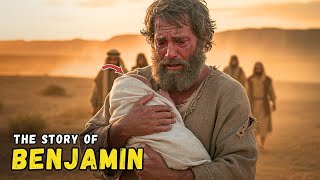
3:22
95 views
·
Last viewed: 22 hrs ago
Uploaded: 16 May 2026 (3 months ago) · Shared: 02 Jul 2026
Video Description (from Youtube)
The Bible — from Creation, the fall of mankind and the promises of God to the life of Jesus Christ and the message that still changes lives today. If you enjoyed this video please share it with yourfriends and family! Every like, share and comment helps us bring more videos your way! ❤️
Want to learn how we create viral AI videos? Join our Skool community and get access to the tools, workflow, and strategies we use.
Join our Skool here: https://www.skool.com/ai-filmmaking-masterclass
Get premium AI-voices with Elevenlabs: https://try.elevenlabs.io/hppnlabp4gyz
Consider becoming a member here on Youtube to support our mission of making full length animated Bible movies. We are grateful for your support! ❤️ ✝️
TIMESTAMPS
00:00 Creation
01:16 Adam and Eve
03:23 Cain and Abel
04:28 Noah's Ark
07:30 Tower of Babel
08:32 Abraham and the Promise
09:14 Moses and the Plagues of Egypt
15:30 Samson
16:18 David and Goliath
17:39 Elijah the Prophet
18:51 Jonah and the Great Fish
21:13 Daniel and the Lions' Den
22:23 Prophets and Prophecy
22:50 The Story of Jesus Christ
28:44 The Message of Christianity
29:41 Join AI Filmmaking Academy
Listen to the songs featured in our movies 🎧
https://www.youtube.com/@BibleNutshellsMusic
Listen to our music on Spotify
https://open.spotify.com/artist/2d4Pm0Zsusyh0gVRIC6KlH
SOCIAL MEDIA
Instagram: https://www.instagram.com/biblenutshells?igsh=MWl0d2NmcmJrdTV4cg%3D%3D&utm_source=qr
TikTok: https://www.tiktok.com/@biblenutshells?_t=8myHbs876BN&_r=1
Facebook: https://www.facebook.com/people/Bible-In-a-Nutshell/61561073485384/
Copyright © 2025 Bible in a Nutshell
#bible #biblestories #3d #3danimation #christian
DISCLAIMER
All videos are shared for educational and information purposes only. All videos are hosted and viewable on Youtube servers. Video titles are generated using the original video title; overall content theme including actual dialogue and speech (Transcript); and A.I-based recommendations with a focus on SEO, keyword density, and internal search functions. The video title does not represent the views held by the Youtube video uploader, or any individual, organisation or business.
If you spot any mistake, omission or give feedback, kindly Contact Us with details
Overview & Key Concepts
Who are Bible In Nutshell?
 Welcome to Bible in a Nutshell!
Our vision is to create full-length movies that bring the Bible to life. Imagine watching a beautifully animated
Welcome to Bible in a Nutshell!
Our vision is to create full-length movies that bring the Bible to life. Imagine watching a beautifully animated
film about the life of Jesus or the adventures of David and Goliath with your family. While mainstream media may never produce these movies, we are committed to making them a reality with the help of AI technology.
You can watch all our content for free on YouTube.
What is The Bible?
 The Bible is a canonical collection of texts sacred in Judaism and Christianity. There is no single "Bible" and many Bibles with varying contents
exist. The term Bible is shared between Judaism and Christianity, although the contents of each of their collections of canonical texts is not the same.
<br><br>
Different religious groups include different books within their Biblical canons, in different orders, and sometimes divide or combine books, or incorporate additional material into canonical books.
<br><br>
The Hebrew Bible, or Tanakh, contains 24 books. Christian Bibles range from the 66 books of the Protestant canon to the 81 books of the Ethiopian Orthodox Church canon.
<br><br>
The first part of Christian Bibles is the Old Testament, which contains, at minimum, the 24 books of the Hebrew Bible divided into 39 books and ordered differently from the Hebrew Bible. The Catholic Church and Eastern Christian churches also hold certain deuterocanonical books and passages to be part of the Old Testament canon.
<br><br>
The second part is the New Testament, containing 27 books: the 4 Canonical gospels, Acts of the Apostles, 21 Epistles or didactic letters, and the Book of Revelation.
What is Creation?
 A creation myth or cosmogonic myth is a type of cosmogony, a symbolic narrative of how the world began and how people first came to inhabit it. While
in popular usage the term myth often refers to false or fanciful stories, members of cultures often ascribe varying degrees of truth to their creation myths. In the society in which it is told, a creation myth is usually regarded as conveying profound truths - metaphorically, symbolically, historically, or literally. They are commonly, although not always, considered cosmological myths - that is, they describe the ordering of the cosmos from a state of chaos or amorphousness.
Creation myths often share several features. They often are considered sacred accounts and can be found in nearly all known religious traditions. They are all stories with a plot and characters who are either deities, human-like figures, or animals, who often speak and transform easily.
Frequently Asked Questions
1.Do Muslims believe in The Bible?
Muslims believe that God originally revealed the Gospel to Jesus as a source of guidance, light, and instruction.
And We sent, following in their footsteps, Jesus, the son of Mary, confirming that which came before him in the Torah; and We gave him the Gospel, in which was guidance and light and confirming that which preceded it of the Torah as guidance and instruction for the righteous. [Quran 5:46]
2.What is the Bible?
The Bible is the holy book of the Christian faith.
3.In the Bible, God says "For God so loved the world, that he gave his only Begotten son"
The words 'Begotten' and 'Son' are not factually accurate when describing Jesus's relationship to the divine Creator. To support this point, it contrasts the Biblical text with the Quran, specifically quoting Chapter 19, Verses 88-92, which strongly condemns the claim that God has begotten a son, describing the assertion as a monstrous falsehood that contradicts the absolute majesty of the Creator.
4.Who were the authors of the books in the Bible?
Mainstream biblical scholarship notes that the four New Testament gospels were originally written anonymously and did not carry their authors' signatures inside the early texts. Christian tradition later attributed them to Matthew, Mark, Luke, and John based on early church history and theological consensus.
5.Does the Bible tell us to act like slaves?
Historically, the Bible has been used by some to enslave, subjugate and dominate over a people.
The 'Curse of Ham' Myth: Pro-slavery advocates twisted Genesis 9 to claim that people of African descent were divinely cursed to be eternal servants.
Old Testament Legal Protection: Slaveholders cited Leviticus 25 to argue that purchasing foreign bondmen and passing them down as inherited property was biblically sanctioned.
Weaponising Obedience Verses: Plantation owners frequently read verses like Ephesians 6:5 ('Slaves, obey your masters') to religiously brainwash enslaved people against rebelling.
The Redacted 'Slave Bible': British and American authorities physically censored the scriptures, deleting the entire Book of Exodus to hide the narrative of freedom from bondage.
Enforcing Fugitive Slave Laws: Pro-slavery preachers used Paul's letter to Philemon to argue that runaway slaves were legally and spiritually obligated to return to their masters.
6.Is Muhammad mentioned in the Bible?
Mainstream Christian and Jewish biblical scholars state that Muhammad is not mentioned anywhere in the Hebrew Bible or New Testament, as these texts predate Islam by centuries. However, Islamic theology interprets specific biblical passages as prophecies of his coming, most notably Deuteronomy 18:18 (a prophet 'from among their brothers') and the promised 'Comforter' (Paracletos) in John 14-16, which Muslims believe refers to Muhammad rather than the Holy Spirit.
7.Does the Bible support the Trinity (3-in-1) God concept?
Mainstream biblical scholars and historians state that the doctrine of the Trinity is never explicitly laid out as a formal dogma anywhere in the text of the Old or New Testaments. While the New Testament contains early triadic formulas (such as the baptismal command in Matthew 28:19 and apostolic blessings in 2 Corinthians 13:14), the actual systemic theology of a three-in-one God was developed later by early church fathers over centuries. Christian theologians argue that the doctrine is implicitly woven throughout the scriptures, while critics and Islamic scholars point to the lack of clear, direct scriptural definitions to argue it was a later modification of strict biblical monotheism.
8.The Bible is about peace and forgiveness
No, historical-critical analysis shows that the Bible is a vast anthology containing highly diverse themes, including both messages of profound peace and accounts of severe warfare. While the New Testament emphasizes love, grace, and forgiveness through Jesus, the Old Testament contains complex legal codes, civil laws, and narratives where God commands total military warfare and strict retributive punishments against rival nations to protect the monotheistic identity of ancient Israel.
9.What is the punishment for apostasy in The Bible (Old Testament)?
In the legal codes of the Old Testament, most notably Deuteronomy 13:6-11, the prescribed statutory punishment for an Israelite who entices others to worship foreign gods is death by public stoning. While historical narratives like Exodus 32 document severe executions for national apostasy (such as the incident with the Golden Calf), biblical scholars note that this capital penalty was legally designed to protect the monotheistic identity of ancient Israel.
10.Is the Bible a peaceful scripture with no violence?
No, historical-critical analysis proves the Bible contains highly diverse themes, including intense descriptions of ancient warfare and divine judgments. In the Old Testament, there are several instances where God commands total military destruction such as Moses ordering the execution of Midianite captives in Numbers 31 or Joshua's campaigns in Canaan to legally protect Israel's monotheistic identity from neighboring polytheistic influences.
11.What is the oldest manuscript of the Bible New Testament?
It is of enormous importance in establishing the biblical text. There are three earliest manuscripts of the Bible New Testament:
1. Codex Alexandrinus is one of the earliest and most important manuscripts of the entire Bible in Greek
2. Codex Sinaiticus is one of the most important books in the world and is kept in the British Library. Handwritten well over 1600 years ago, the manuscript contains the Christian Bible in Greek, including the oldest complete copy of the New Testament.
3. Codex Vaticanus in Rome
12.Is the word 'Bible' used in the Bible itself?
No, the specific title 'Holy Bible' is not found within the biblical text itself, as the underlying Greek word biblos or biblia was simply a standard, generic term used in antiquity to describe a collection of any books or scrolls. For example, in Acts 19:19, when the text mentions that people compiled and burned their biblos, it refers to their local books of magic arts rather than sacred scripture.
13.Who are the Gods in the Bible?
Historically, the term 'God' was applied to powerful figures, such as leaders and magistrates, who served as representatives on Earth. Emperor Constantine referenced this, citing Psalm 82:6 to remind bishops of their high, albeit human, office.
Emperor Constantine at the opening of the Council of Nicaea (325 AD) quoted Psalm 82:6 to remind the bishops that their high office should raise them above jealousy and party feeling.
The term 'God' was applied to people of power, authority and rule who were considered to have greater nearness to God than others - an appellation which implies that you are God's representatives on earth, and that your decision is, in an important sense, to be regarded as his.
14.Who translated the Bible from Greek into Latin?
Saint Jerome (342-420) was commissioned to translate the gospels from Greek into Latin. This key Catholic Biblical scholar was highly regarded and often represented with the figure of a lion.
15.When were Catholics encouraged to read the Bible for themselves?
In 1909, Pope Pius X first encouraged Bible study. For the first time, Catholics could now study the Bible for themselves and Catholicism returned to being a 'religion of the book' for the people
16.How was the Bible used to manipulate the people?
The 16th century translators of the Geneva Bible harnassed it to promote their anti-monarchist views.
The medieval Church prohibited use of the Bible to ensure people believed that they were told, not what they read, or others read to them.
17.Who was Lazarus of Bethany in the Bible?
In the Gospel of John, Lazarus was a close friend of Jesus Christ and the brother of Mary and Martha. They lived in the village of Bethany near Jerusalem.
18.What was the miracle of Lazarus of Bethany in the Bible?
Lazarus fell ill and died. According to the text, Jesus arrived four days after Lazarus was buried in a tomb, ordered the stone to be rolled away, and commanded, 'Lazarus, come out!' The Raising of Lazarus is considered one of Jesus' most significant and dramatic miracles, directly setting off the events leading to the Crucifixion because it drew massive public attention.
Videos on Creation (26)
 1:02
1:02
291
1438041600
1787141752
Creation of Adam ,The First Sin & The Expulsion of Iblees 3
000062
1
 14:00
14:00
637
1438041600
1787148061
The Creation of Adam and Satan - Yusuf Estes
000840
2
289 views
47:26
289
1452384000
1786906287
Creation Of Adam - Mufti Menk
002846
3
 12:22
12:22
328
1490659200
1787087993
Does God exist in his Creation? - Hamza Myatt vs Panantheist
000742
4
 1:19:39
603
1501545600
1786397385
The Creation of the King James Bible - Bart Ehrman
004779
5
 20:01
20:01
265
1503692274
1787086270
Before Creation, did God have Love. If so, was it a selfish, self-centered Love? - Mansur vs Philip 1/2
001201
6
 13:55
13:55
182
1503692614
1787075321
Before Creation, did God have Love. If so, was it a selfish, self-centered Love? - Mansur vs Philip 2/2
000835
7
 20:38
20:38
376
1511300167
1787073581
Jews are Monotheists. One Creator (God) and His Creation (Man/Jesus) - Michael Lebovic
001238
8
 19:02
19:02
552
1514607031
1787127890
In Micah 5:2, the Trinity holds Jesus pre-existed Creation alongside the Father - Trinity Delusion
001142
9
 27:55
27:55
701
1514850825
1786934479
Let's discuss Evolution, Creation and Intelligent Design in the Universe without getting fired! - Ben Stein
001675
10

581 views
17:12
581
1516315013
1787152024
Creation of Adam - Merciful Servant
001032
11
 28:12
28:12
286
1523010476
1786242801
Did Jesus Pre-exist Creation? - Christadelphian
001692
12
 5:26
5:26
658
1528310789
1787117435
In Quran 36:36, the Creation is in pairs - Quran Miracle
000326
13
 2:16
2:16
717
1533124661
1786551197
In 420 AD, Augustine of Hippo believed Jesus participated in the creation of Holy Spirit - Lorence Yufa | Milwaukee Atheists
000136
14
 5:32
5:32
791
1545161074
1787020313
Islamic views on Evolution and Creation of Adam - Abu Layth
000332
15
 5:12
5:12
913
1548092459
1787032799
In Romans 15:20, Apostle Paul announces creation of a New Religion ('new foundation') - Muhammad Lamin
000312
16
 6:25
6:25
270
1550537427
1787087364
In John 12:41 and 17:5, did Jesus pre-exist Creation? He must be God? - Restoration Fellowship
000385
17

291 views
10:08
291
1550556974
1786240549
Creation of Adam - Bilal Assad
000608
18
 10:33
10:33
430
1558442565
1786426786
In 1916, British influence led to creation of Saudi Arabia, and demise of Ottoman Caliphate - Imran Hosein
000633
19
 37:14
37:14
548
1569931850
1786796978
Jesus, the Christian God can come In & Out of His Creation. Allah cannot! - Daniel vs Shamsi
002234
20
 36:59
36:59
355
1574944422
1786240193
New World Order: Creation of a '4th World' to promote Universal Environmental & Conservation ideals - George Hunt
002219
21
 6:22
6:22
635
1602172917
1787159560
Creation of the Universe in The Quran - Khalid Yasin
000382
22
 16:44
16:44
363
1758648540
1786918390
Biblical differences in Creation Story and Noah's Flood | Stephans History
001004
23
 3:22
3:22
95
1782956159
1787080555
Creation of Adam & Eve | The Bible (2026) | Bible In Nutshell
000202
24
 12:27
12:27
30
1785716098
1787048696
Genesis - The Creation Story | JudahSketch Animation
000747
25
 28:16
28:16
28
1785892272
1786839126
Adam and Eve - The Creation and The Fall | Epic Bible Animation
001696
26