Thomas

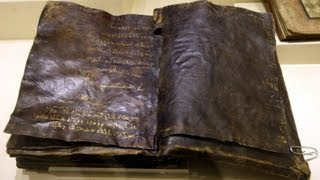
The Gospel of Thomas is an early Christian non-canonical sayings-gospel that many scholars believe provides insight into the oral gospel traditions. It was discovered near Nag Hammadi, Egypt, in December 1945 among a group of books known as the Nag Hammadi library.

While the Gospel of Thomas does not directly point to Jesus' divinity, it also does not directly contradict it, and therefore neither supports nor contradicts gnostic beliefs. When asked his identity in the Gospel of Thomas, Jesus usually deflects, ambiguously asking the disciples why they do not see what is right in front of them, similar to some passages in the canonical gospels like John 12:16 and Luke 18:34.

The Gospel of Thomas is very different in tone and structure from other New Testament apocrypha and the four Canonical Gospels. Unlike the canonical Gospels, it is not a narrative account of the life of Jesus; instead, it consists of sayings attributed to Jesus, sometimes stand-alone, sometimes embedded in short dialogues or parables.

Year: 50-140 AD
 |  Wikipedia: Gospel_of_Thomas

SUBSCRIBE

Receive the latest news and updates by email - Subscribe Now!
About  |  Q&A  |  Contact Us    •    Terms  |  Privacy  |  Disclaimer  |  Sitemap
Connect:      Facebook  |    Twitter  |    Youtube
MuslimProphets.com is an educational website on the Prophets of God: David, Noah, Abraham, Moses, Jesus and Muhammad, who established the Abrahamic faiths of Judaism, Christianity and Islam.

MuslimProphets.com explores contemporary social themes through Scripture, Evidences, Photo, Video, Maps, Current Affairs, Debate and 'alternative' Views held by Theologians, Apologists, Scholars and Street Preachers.

In accordance with Islamic etiquette, all prophet names should be followed with 'Peace Be Upon Him (PBUH)'. This is omitted to minimise text.

DISCLAIMER
The historical information provided on this website is for educational and informational purposes only.
History is an ongoing interpretation of past events. Historical accounts are shaped by the perspectives, biases, and cultural influences of their time; therefore, no content on this website should be taken as absolute, 100% factual truth. We encourage readers to approach historical narratives with a critical mind.

All website content is available in the public domain. While all information is gathered from sources believed to be reliable, its absolute accuracy cannot be guaranteed.

EXTERNAL LINKS & SEO
External links are provided as a convenience and for informational purposes only. They do not constitute an endorsement or approval of any products, services, or opinions of any organization or individual. Title and text links may be edited for external SEO, internal site structure, and keyword search purposes. We bear no responsibility for the accuracy, legality, or content found on any external website or its subsequent links.

MEDIA & SOURCE ATTRIBUTIONS
Unless otherwise indicated, all images and content are licensed under a Creative Commons Attribution License distributed by Wikipedia, Wikimedia Commons, Pixabay, Unsplash, and similar platforms. While every effort is made to accurately source all media, contact us if you believe your copyright has been infringed so we can address and resolve the matter promptly.

All videos are hosted on and viewable via YouTube servers. Video titles are generated based on the original video title, the overall content theme (including actual dialogue and transcripts), and AI-based recommendations optimized for SEO, keyword density, and internal search functions. Video titles do not represent the views held by the YouTube video uploader, or any associated individual, organisation, or business.

All Torah, Psalms, and Old/New Testament Bible quotes are from the King James Version (KJV) Holy Bible, which is in the public domain.
All Quran quotes are from the Taqi-ud-Din al-Hilali / Muhsin Khan English Quran translation.

CORRECTIONS
If you spot a mistake, error, or omission of information, please contact us so we can review and correct it.