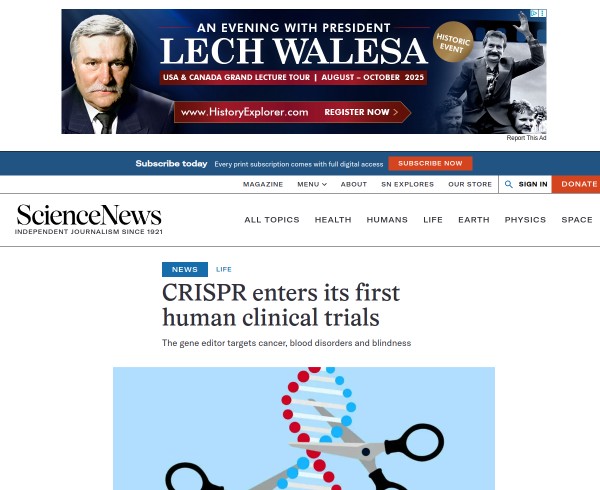
Live Screenshot
Source link:
https://www.sciencenews.org/article/crispr-gene-editor-first-human-clinical-trialsPublished by: SCIENCENEWS on 14 Aug 2019
1312 views · Last view: 16 hrs ago
News Text (from SCIENCENEWS)
The gene editor targets cancer, blood disorders and blindness CUTTING ROOM Scientists will soon wield the molecular scissors CRISPR/Cas9 in the human body. Some people with a form of inherited blindness will have the gene editor injected into their eyes, where researchers hope it will snip out amutation. Two other trials are CRISPR editing cells outside of the body to treat cancer or blood disorders.
traffic_analyzer/getty images plus
By Tina Hesman Saey
August 14, 2019 at 8:00 am - More than 2 years ago
Since its debut in 2012, CRISPR gene
editing has held the promise of curing most of the over 6,000 known genetic
diseases. Now it’s being put to the test.
In the first spate of clinical trials, scientists
are using CRISPR/Cas9 to combat cancer and blood disorders in people. In these
tests, researchers remove some of a person’s cells, edit the DNA and then inject
the cells back in, now hopefully armed to fight disease.
Researchers are also set to see how
CRISPR/Cas9 works [...]
To view the original News article, click here
DISCLAIMER All news articles are shared for educational purposes only. The news content is hosted on the external news website. News articles titles are derived from the original news title, news content, dialogue, speech or general content theme. The news title may be edited and optimized for SEO, keyword density, information and internal website search purposes. You are advised to view the original news article for a better understanding. If you spot any mistakes, errors or omissions kindly contact us.
SEARCH RESULTS: CRISPRExplore Topics | 1News | 5Articles | 0FAQ | 0Video | 1Links | 0
SEARCH AGAIN? | VIDEO • NEWS • ARTICLE
Explore Topics: CRISPR (1)
What is CRISPR? CRISPR (clustered regularly interspaced short palindromic repeats) is a family of DNA sequences found in the genomes of prokaryotic organisms such as bacteria and archaea. These sequences are derived from DNA fragments of bacteriophages that had previously infected the prokaryote. They are used to
detect and destroy DNA from similar bacteriophages during subsequent infections. CRISPR technology is a simple yet powerful tool for editing genomes. It allows researchers to easily alter DNA sequences and modify gene function. Its many potential applications include correcting genetic defects, treating and preventing the spread of diseases and improving crops. |
News on CRISPR (5)
Youtube Videos on CRISPR (1)
|
448 views
14:20
|