Then Yahweh answered Job out of the whirlwind,
“Who is this who darkens counsel
by words without knowledge?
Brace yourself like a man,
for I will question you, then you answer me!
“Where were you when I laid the foundations of the earth?
Declare, if you have understanding.
Who determined its measures, if you know?
Or who stretched the line on it?
Whereupon were its foundations fastened?
Or who laid its cornerstone,
when the morning stars sang together,
and all the sons of God shouted for joy?
“Or who shut up the sea with doors,
when it broke out of the womb,
when I made clouds its garment,
and wrapped it in thick darkness,
marked out for it my bound,
set bars and doors,
and said, ‘Here you may come, but no further.
Here your proud waves shall be stayed?’
“Have you commanded the morning in your days,
and caused the dawn to know its place;
that it might take hold of the ends of the earth,
and shake the wicked out of it?
It is changed as clay under the seal,
and presented as a garment.
From the wicked, their light is withheld.
The high arm is broken.
“Have you entered into the springs of the sea?
Or have you walked in the recesses of the deep?
Have the gates of death been revealed to you?
Or have you seen the gates of the shadow of death?
Have you comprehended the earth in its width?
Declare, if you know it all.
“What is the way to the dwelling of light?
As for darkness, where is its place,
that you should take it to its bound,
that you should discern the paths to its house?
Surely you know, for you were born then,
and the number of your days is great!
Have you entered the treasuries of the snow,
or have you seen the treasures of the hail,
which I have reserved against the time of trouble,
against the day of battle and war?
By what way is the lightning distributed,
or the east wind scattered on the earth?
Who has cut a channel for the flood water,
or the path for the thunderstorm;
To cause it to rain on a land where no man is;
on the wilderness, in which there is no man;
to satisfy the waste and desolate ground,
to cause the tender grass to grow?
Does the rain have a father?
Or who fathers the drops of dew?
Out of whose womb came the ice?
The gray frost of the sky, who has given birth to it?
The waters become hard like stone,
when the surface of the deep is frozen.
“Can you bind the cluster of the Pleiades,
or loosen the cords of Orion?
Can you lead the constellations out in their season?
Or can you guide the Bear with her cubs?
Do you know the laws of the heavens?
Can you establish its dominion over the earth?
“Can you lift up your voice to the clouds,
That abundance of waters may cover you?
Can you send out lightnings, that they may go?
Do they report to you, ‘Here we are?’
Who has put wisdom in the inward parts?
Or who has given understanding to the mind?
Who can count the clouds by wisdom?
Or who can pour out the bottles of the sky,
when the dust runs into a mass,
and the clods of earth stick together?
“Can you hunt the prey for the lioness,
or satisfy the appetite of the young lions,
when they crouch in their dens,
and lie in wait in the thicket?
Who provides for the raven his prey,
when his young ones cry to God,
and wander for lack of food?
Job 38
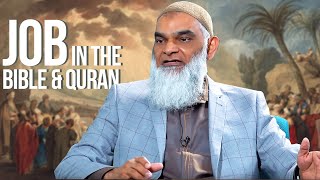
God Speaks to Prophet Job out of Whirlwind (Job 38-42)
Listen to the majestic divine cross-examination as God speaks directly to Prophet Job out of a terrifying desert whirlwind across Job 38-42.
JOB
948 views · Last view: 15 hrs ago
Listen to the majestic divine cross-examination as God speaks directly to Prophet Job out of a terrifying desert whirlwind across Job 38-42.
JOB
948 views · Last view: 15 hrs ago
Explore More
Search Google Search Explore Topics Prophet GOD What is a Prophet?
In religion, a prophet is an individual who is regarded as being in contact with a divine being and is said to speak on that entity's behalf. They claim to be serving as an intermediary with humanity by delivering messages or teachings from the supernatural source to other people. The message that the prophet conveys is called a prophecy. In Islam, all prophetic messengers are prophets (such as Adam, Noah, Abraham, Moses, Jesus, and Muhammad) though not all prophets are prophetic messengers. The primary distinction is that a prophet is required to demonstrate God's law through his actions, character, and behavior without necessarily calling people to follow him, while a prophetic messenger is required to pronounce God's law (i.e. revelation) and call his people to submit and follow him.
 Who is GOD?
In monotheism and henotheism, God is conceived as the Supreme Being and principal object of faith. The concept of God as described by theologians commonly includes the attributes of omniscience (infinite knowledge), omnipotence (unlimited power), omnipresence (present everywhere), omnibenevolence (perfect goodness), divine simplicity, and eternal and necessary existence. In theism, God is the creator and sustainer of the universe In deism, God is the creator, but not the sustainer, of the universe Monotheism is the belief in the existence of one God or in the oneness of God In pantheism, God is the universe itself In atheism, God is purported not to exist, while deemed unknown or unknowable within the context of agnosticism.