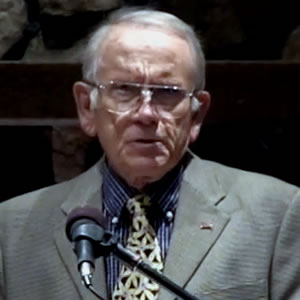
Early Church advanced Jesus to divinity, and later, to Triune 'Trinity' Godhead - Charles Hedrick

   0:36
465 views  ·  Last viewed: 19 hrs ago
Uploaded: 19 Jul 2018   (8 years ago)  ·  Shared: 21 Jul 2018

Video Description (from Youtube)

Charles Hedrick (born 11 April 1934) is a distinguished Professor Emeritus at Missouri State University. Hedrick’s research interests include Christian Origins, Jesus of Nazareth, New Testament

Introduction, Parables, Gnosticism etc. He has written books in the areas of Gospels, Nag Hammadi, Gnosticism, the Graeco-Roman world and related topics.
Link to Charles Hedrick videos:
http://muslimprophets.com/videos.php?search=Charles+Hedrick

Link to the original video:
https://www.youtube.com/watch?v=-vzD6vkEFUA

DISCLAIMER

We do NOT own the video materials and all credits belong to the respectful owners. In case of copyright issues, please contact us immediately for further credits or clip delete.

COPYRIGHT

Under Section 107 of the Copyright Act 1976, allowance is made for 'fair use' for purposes such as criticism, comment, news reporting, teaching, scholarship and research. Fair use is a use permitted by copyright statute that might otherwise be infringing. Non-profit, educational or personal use tips the balance in favour of fair use.

DISCLAIMER
All videos are shared for educational and information purposes only. All videos are hosted and viewable on Youtube servers. Video titles are generated using the original video title; overall content theme including actual dialogue and speech (Transcript); and A.I-based recommendations with a focus on SEO, keyword density, and internal search functions. The video title does not represent the views held by the Youtube video uploader, or any individual, organisation or business.

If you spot any mistake, omission or give feedback, kindly Contact Us with details

Overview & Key Concepts


Who is Charles Hedrick?

Charles Hedrick (born 1934) is a distinguished Professor Emeritus at Missouri State University. Hedrick's research interests include Christian

Origins, Jesus of Nazareth, New Testament Introduction, Parables, Gnosticism etc. He has written books in the areas of Gospels, Nag Hammadi, Gnosticism, the Graeco-Roman world and related topics.

What is Trinity?

The Christian doctrine of the Trinity (Latin: trinus "threefold") holds that God is one God, but three coeternal consubstantial persons or

hypostases. These being the Father, the Son (Jesus Christ), and the Holy Spirit - as "one God in three Divine Persons". The three Persons are distinct, yet are one "substance, essence or nature" (homoousios).
What is the Church?

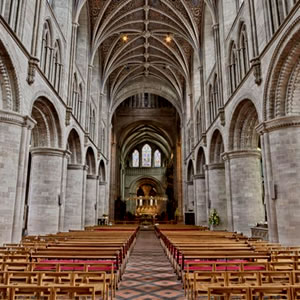
A church is a building used for Christian worship services and Christian activities. The earliest identified Christian church is a house church

founded between 233 AD and 256 AD. The word church also describes a body or assembly of Christian believers, while "the Church" refers to the worldwide Christian religious community.

Who is GOD?

In monotheism and henotheism, God is conceived as the Supreme Being and principal object of faith. The concept of God as described by theologians

commonly includes the attributes of omniscience (infinite knowledge), omnipotence (unlimited power), omnipresence (present everywhere), omnibenevolence (perfect goodness), divine simplicity, and eternal and necessary existence.
<ul>
<li>In theism, God is the creator and sustainer of the universe</li>
<li>In deism, God is the creator, but not the sustainer, of the universe</li>
<li>Monotheism is the belief in the existence of one God or in the oneness of God</li>
<li>In pantheism, God is the universe itself</li>
<li>In atheism, God is purported not to exist, while deemed unknown or unknowable within the context of agnosticism. </li>
</ul>

Frequently Asked Questions


1.How were the Triadic or 'Trinity-like' Pagan Gods presented?

Ancient triadic deities in the Roman Empire were depicted in art and monuments as a single, unified figure featuring three distinct faces or heads to illustrate their triune nature.


2.Does the Christian Trinity come from pagan Triadic dieties?

Yes, the core teachings of modern Trinitarian Christian churches do not come from Jesus, but were pagan three-in-one concepts that existed long before his arrival and were later adopted by Christians to make their doctrine highly appealing to idol-worshipping masses.


3.Why is the Trinity so difficult to understand?

The Trinity is a complex theological doctrine because it describes God as existing as three distinct Persons: Father, Son, and Holy Spirit who are co-equal and co-eternal, yet remain one single, unified divine Being. It requires balancing the concepts of strict monotheism with the distinct actions and relationships of the three divine Persons as revealed across the New Testament text.


4.How did the Christian Trinity come about?

The New Testament gospels show Jesus selecting twelve apostles to lead his immediate followers, but he did not lay down a detailed blueprint for a complex institutional priesthood or administrative hierarchy. The elaborate structures, clerical offices, and distinct liturgical traditions seen in modern churches developed gradually over centuries as the movement adapted to Roman institutional frameworks.

The concept of a dual human and divine nature in the person of Jesus is known as the Hypostatic Union, an essential component of modern Trinitarianism.

Yet it was not until the Council of Chalcedon that we see the emergence of an official doctrine of the Trinity in a form that is recognisable with what Christian Trinitarians believe in today. This took place in the fifth century, over 400 years after Jesus!

The evangelical theologian and Professor Wayne A. Grudem sums this up as follows: 'A precise understanding of how full deity and full humanity' argues Grudem, 'could be combined together in one person was formulated only gradually in the church and did not reach the final form until the Chalcedonian Definition in 451 AD.


5.Does the Bible support the Trinity (3-in-1) God concept?

Mainstream biblical scholars and historians state that the doctrine of the Trinity is never explicitly laid out as a formal dogma anywhere in the text of the Old or New Testaments. While the New Testament contains early triadic formulas (such as the baptismal command in Matthew 28:19 and apostolic blessings in 2 Corinthians 13:14), the actual systemic theology of a three-in-one God was developed later by early church fathers over centuries. Christian theologians argue that the doctrine is implicitly woven throughout the scriptures, while critics and Islamic scholars point to the lack of clear, direct scriptural definitions to argue it was a later modification of strict biblical monotheism.


6.Does the Old Testament teach the Christian Trinity?

Mainstream biblical scholars and historians agree that the Old Testament does not explicitly teach the doctrine of the Trinity, nor did ancient Jewish communities possess a concept of a triune Godhead. There is no historical evidence in pre-Christian Jewish literature including the Hebrew text, the Dead Sea Scrolls, or ancient commentaries of a belief in a plurality of divine Persons. While Christian theologians retrospectively interpret certain plural expressions (such as 'Let us make man' in Genesis 1:26) as hints of the Trinity, ancient Judaism strictly maintained a unitarian monotheistic understanding of God.


7.What is the Christian Trinity?

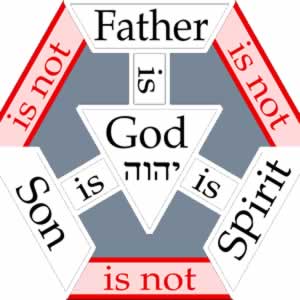
Orthodox Christian theologians define the doctrine of the Trinity as the belief that the Father is God, the Son is God, and the Holy Spirit is God, existing eternally as three distinct Persons within one single, undivided divine Being. These three Persons are considered entirely co-equal in power and co-eternal in time, with the Son being understood as 'eternally begotten' of the Father and existing simultaneously as 100% God and 100% man. The platform notes that many modern Christians mistakenly believe they are practicing Trinitarianism simply by acknowledging the Father, Son, and Holy Spirit, without understanding the complex historical and philosophical mechanics required by the formal church dogma.


8.What do Christian 'Trinity' scholars say about the Old Testament?

Many theologians, including this analysis of Trinity dogma, note that the Old Testament does not explicitly contain the Trinity, which they believe was only fully revealed later.

The distinguished Trinitarian scholar Bertrand de Margerie in his book The Christian Trinity in History writes:

'Contemporary exegetes [Bible teachers] affirm unanimously that the Old Testament did not bring to the Jewish people a clear and distinct Revelation of the existence of a plurality of persons in God. In this they agree with the clear and frequent affirmation of Fathers such as Irenaeus, Hilary, and Gregory of Nazianzus: that the doctrine of the Trinity is revealed only in the New Testament.'

So any person who lived before Jesus' ministry did not have to believe in the Trinity to be saved because the Trinity is not mentioned in the Old Testament.


9.What do Christian scholars say about the Trinity?

Mainstream scholars acknowledge that the Trinity is not explicitly defined in the New Testament but was formulated later by combining various verses and theological concepts.

Scholars freely admit that the Trinity is never presented as a complete doctrine in the New Testament, but rather is built from scattered Bible verses.

In the New Testament there is no explicit statement of the doctrine
Evangelical Dictionary of Theology (p. 1112)

It is not a Biblical doctrine in the sense that any formulation of it can be found in the Bible
New Bible Dictionary (p.1221)

The New Testament does not present a systematic presentation of the Trinity. The scattered segments from various writers that appear throughout the New Testament reflect a seemingly accepted understanding that exists without a full-length discussion.
Holman Bible Dictionary (p.1372)

Theologians admit the New Testament does not define the Trinity. Furthermore, there is no clear teaching that salvation depends on the belief in the Trinity.


10.Why did early Christians have church synods and councils?

Early Christian bishops organized regional synods and ecumenical councils to systematically define orthodox Christian doctrines and combat widespread heresies. These massive assemblies were essential for creating a unified creed, standardizing the New Testament canon, and establishing clear administrative laws for a rapidly growing global church. Prominent gatherings, like the Council of Nicaea, were often financed and politically mandated by Roman emperors to secure empire-wide religious stability.


11.How did James, leader of the Jerusalem Church, view Apostle Paul?

Paul's new doctrine met with disapproval from the Jewish-Christians of the Jerusalem Church led by James, who regarded the substitution of Jesus' atoning death for the observance of the Torah as a lapse into paganism.

Paul was duly summoned to Jerusalem by the leaders James, Peter and John to explain his doctrine in 50 AD.


12.What are the origins of Christian church music?

Saint Ambrose (334-397), a keen advocate of church music is credited with introducing it into Christian worship.


13.What are the main practices of the Aladura Church?

  • Fervent, charismatic worship.
  • Extended prayer and fasting.
  • Focus on divine healing.
  • Prophetic visions and revelations.


14.Why do Aladura church members wear white?

  • Members of many Aladura branches, like the Church of the Lord, traditionally wear white garments.
  • The white robes symbolize holiness, purity, and equality before God.


Videos on Charles Hedrick (20)

Video: Christianity Before Constantine - Charles Hedrick 51:59
Video: At Nicaea 325 AD, Jesus was declared co-equal, co-substantial, co-eternal with God - Charles Hedrick 1:52
Video: After Nicaea 325 AD, Constantine had Eusebius determine the earliest New Testament canon - Charles Hedrick 1:48
Video: Christianity did not exist until AFTER the Council of Nicaea (325 AD) - Charles Hedrick 1:46
Video: Athanasius (340 AD) compiled NT Bible canon, refering to Septuagint (Greek OT) - Charles Hedrick 1:19
Video: No physical evidence for Christianity exists until 200 AD, or 170 years after Jesus - Charles Hedrick 2:38
Video: Mark, Matthew, Luke & John do not compliment each other, but are 'competitive' - Charles Hedrick 0:36
Video: Apostle Paul did not see Jesus as a real, historical Jewish Man - Charles Hedrick 1:28
Video: Mark, Matthew & Luke write of Jesus a mythical Jewish Man who did 'mighty deeds' - Charles Hedrick 1:36
Video: John's Gospel presents Jesus as a pre-existing divine Son, coming from the Father - Charles Hedrick 1:59
Video: Early Christian texts elevate Jesus the man to pre-existant, eternal, divine being - Charles Hedrick 2:29
Video: Bible differs when Jesus became God's Son: Birth, Baptism, Resurrection or Eternity - Charles Hedrick 8:21
Video: Council of Nicaea (325 AD) ignored earlier writings on Jesus' divinity in the Gospels - Charles Hedrick 0:56
Video: After Jesus' Crucifixion, Isaiah (OT) quoted as evidence God sent His Son to die - Charles Hedrick 4:28
Video: In Gospel of Thomas (Syria, 40-140 AD), Jesus' words matter, not the Crucifixion - Charles Hedrick 1:50
Video: Before the Christian Cross (Sarcophagus 320-350 AD) was the Fish, Dove & Shepherd - Charles Hedrick 1:17
Video: Gospels are anonymous, 'romantic', religious propaganda texts, not Historical realities - Charles Hedrick 0:49
Video: Early Church advanced Jesus to divinity, and later, to Triune 'Trinity' Godhead - Charles Hedrick 0:36
Video: Christianity is based on Mythology. Gospels record historically unreliable events of Jesus - Charles Hedrick 0:53
Video: Mark, Matthew, Luke & John are 4 Gospels. Their are 34 more Gospels - Charles Hedrick 1:25

EXPLORE TOPICS : TRINITY | 154 TRINITARIAN | 18 CHARLES HEDRICK | 20 CHURCH | 256 GOD | 0   JESUS

Latest videos  •  6,061 videos  •  0 viewed/24 hour

SUBSCRIBE

Receive the latest news and updates by email - Subscribe Now!
About  |  Q&A  |  Contact Us    •    Terms  |  Privacy  |  Disclaimer  |  Sitemap
Connect:      Facebook  |    Twitter  |    Youtube
MuslimProphets.com is an educational website on the Prophets of God: David, Noah, Abraham, Moses, Jesus and Muhammad, who established the Abrahamic faiths of Judaism, Christianity and Islam. MuslimProphets.com explores contemporary social themes through Scripture, Evidences, Photo, Video, Maps, Current Affairs, Debate and 'alternative' Views held by Theologians, Apologists, Scholars and Street Preachers. Take a Site Tour

In accordance with Islamic etiquette, all prophet names should be followed with 'Peace Be Upon Him (PBUH)'. This is omitted to minimise text.

DISCLAIMER: All website content is for general information and educational purposes only and available in the public domain. Whilst all information comes from sources believed to be reliable, this cannot be guaranteed. External links are provided as a convenience and for informational purposes only. They do not constitute endorsement or approval for any products, services or comments by organizations or individuals. Title and Text links may be edited for external SEO, internal site and keyword search purposes. We bear no responsibility for the accuracy, legality, or content found on any external website or its subsequent links. Unless indicated, all images and content is licensed under a Creative Commons Attribution License distributed by Wikipedia, Wikimedia Commons, Pixabay, Pxhere, Pexels, Unsplash, Flickr and others. All Torah, Psalms, Old and New Testament Bible quotes are from the King James Version (KJV) Holy Bible in the public domain. All Quran quotes are from Taqi-ud-Din al-Hilali/Muhsin Khan English Quran translation.

ALWAYS DO YOUR OWN RESEARCH. If you spot any mistake, error or omission of information, contact us so we can correct it.