1087 views
·
Last viewed: 5 hrs ago
Uploaded: 12 Dec 2016 (10 years ago) · Shared: 01 Aug 2017
Duration: 52:57
Uploaded: 12 Dec 2016 (10 years ago) · Shared: 01 Aug 2017
Duration: 52:57
Youtube Description
Make sure to like and Subscribe! Follow us on Facebook to see what we're up to: https://www.facebook.com/AtheistCommunityOfMilwaukee/ Follow us onTwitter: https://twitter.com/MKEAtheists
Support us on Patreon: https://www.patreon.com/MKEAtheists
Richard Carrier joins ACM to discuss other dying and rising god throughout history, the zeitgeist movie, and much more! Always a pleasure having Richard on the show! You don't want to miss this! And you wont want to miss what he's been up to!
Richard Carrier on the historicity of Jesus: https://www.youtube.com/watch?v=qqpX-OyvsYI
Carrier links:
Richard's Website: http://richardcarrier.info/
On the Historicity Of Jesus: http://www.amazon.com/On-Historicity-Jesus-Might-Reason/dp/1909697494
Explore More
Richard Carrier Resurrection Dionysus Horus Pagan GOD JESUS
JESUS
Search Google Search Explore Topics
 Who is Richard Carrier?
Richard Carrier (born 1969) is an American historian, atheist activist, author, public speaker and blogger. Carrier has a doctorate in ancient history from Columbia University where his thesis was on the history of science in antiquity.
 What is Resurrection?
Resurrection is the concept of coming back to life after death. In a number of ancient religions, a dying-and-rising god is a deity which dies and resurrects. The death and resurrection of Jesus, an example of resurrection, is the central focus of Christianity. As a religious concept, it is used in two distinct respects: a belief in the resurrection of individual souls that is current and ongoing (Christian idealism, realized eschatology), or else a belief in a singular resurrection of the dead at the end of the world. The resurrection of the dead is a standard eschatological belief in the Abrahamic religions.
 Who was Dionysus?
Dionysus, also known as Bacchus, was a significant god in ancient Greek religion, revered for his association with wine, vegetation, fertility, and ecstasy.
 Who was Horus?
Horus is one of the most significant ancient Egyptian deities. He was worshipped from at least the late prehistoric Egypt until the Ptolemaic Kingdom and Roman Egypt. Different forms of Horus are recorded in history and these are treated as distinct gods by Egyptologists. He was most often depicted as a falcon, most likely a lanner falcon or peregrine falcon, or as a man with a falcon head. The most commonly encountered family relationship describes Horus as the son of Isis and Osiris, and he plays a key role in the Osiris myth as Osiris's heir and the rival to Set, the murderer of Osiris.
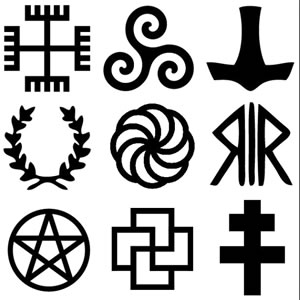 What is Pagan?
Paganism is a term first used in the fourth century by early Christians. It was applied on populations of the Roman Empire who practiced polytheism, either because they were increasingly rural and provincial relative to the Christian population or because they were not milites Christi (soldiers of Christ). Alternate terms in Christian texts for the same group were hellene, gentile, and heathen. Pagan and paganism were pejorative terms for the same polytheistic group, implying its inferiority. Paganism has broadly connoted the "religion of the peasantry", and for much of its history was a derogatory term. Both during and after the Middle Ages, pagan was a pejorative term that was applied to any non-Abrahamic or unfamiliar religion, and the term presumed a belief in false god(s).
Who is GOD?In monotheism and henotheism, God is conceived as the Supreme Being and principal object of faith. The concept of God as described by theologians commonly includes the attributes of omniscience (infinite knowledge), omnipotence (unlimited power), omnipresence (present everywhere), omnibenevolence (perfect goodness), divine simplicity, and eternal and necessary existence. In theism, God is the creator and sustainer of the universe In deism, God is the creator, but not the sustainer, of the universe Monotheism is the belief in the existence of one God or in the oneness of God In pantheism, God is the universe itself In atheism, God is purported not to exist, while deemed unknown or unknowable within the context of agnosticism.