Uploaded: 27 Aug 2018 (8 years ago) · Shared: 06 Feb 2019
Duration: 2:16
Video Description
Delve into the intriguing historical roots of religious doctrines with this thought-provoking study by approvedofGod. Exploring the comparative theology between ancient pagan beliefs and later theological developments, this video examines claims linking the Christian concept of the Trinity to ancient Babylonian traditions dating back to 2700 BC. By looking at the triad of Nimrod, Tammuz, and Semiramis, the discussion offers unique insights into how early history, ancient symbolism, and doctrinal evolutions shaped interfaith perspectives.
Whether you are exploring Christian history, investigating biblical studies, or seeking deeper spiritual reminders about monotheism and pure faith, this analysis bridges connections between ancient Babylon and scriptural prophecy. Ideal for viewers interested in theology, Church history, the Bible, and
Explore More
approvedofGod Babylon Trinity Nimrod GODSearch Google Search Explore Topics
 Who are approvedofGod?
I am here to teach all people, but especially the "body of Christ" (the Church), that the bible is sufficient for what we believe. Throughout the centuries, men have brought many doctrines into the church that have caused confusion and separation. My desire and goal is to clarify some of these errors and bring all Christians back to the basics of the Bible.
Where is Babylon?Babylon was an ancient city located on the lower Euphrates river in southern Mesopotamia, within modern-day Hillah, Iraq. This is about 85 kilometres (53 miles) south of modern-day Baghdad. Babylon functioned as the main cultural and political centre of the Akkadian-speaking region of Babylonia. Its rulers established two important empires in antiquity, the 19th-16th century BC Old Babylonian Empire, and the 7th-6th century BC Neo-Babylonian Empire. Babylon was also used as a regional capital of other empires, such as the Achaemenid Empire. Babylon was one of the most important urban centres of the ancient Near East, until its decline during the Hellenistic period.
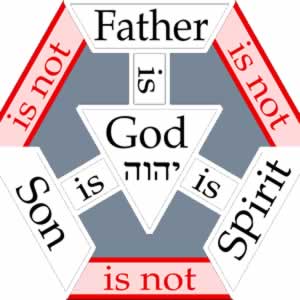 What is Trinity?
The Christian doctrine of the Trinity (Latin: trinus "threefold") holds that God is one God, but three coeternal consubstantial persons or hypostases. These being the Father, the Son (Jesus Christ), and the Holy Spirit - as "one God in three Divine Persons". The three Persons are distinct, yet are one "substance, essence or nature" (homoousios).
What is Nimrod?Nimrod is a biblical figure mentioned in the Book of Genesis and the Books of Chronicles. The son of Cush and thus the great-grandson of Noah, Nimrod was described as a king in the land of Shinar (Lower Mesopotamia). The Bible states that he was "a mighty hunter before the Lord ... began to be mighty in the earth". Nimrod became a symbol of defiance against God. Biblical and non-biblical traditions identify Nimrod as the ruler associated with the Tower of Babel; Jewish, Christian, and Islamic accounts variously portray him as a tyrant who led its builders, turned people from God, and opposed Abraham, even attempting unsuccessfully to kill him by fire.
Who is GOD?In monotheism and henotheism, God is conceived as the Supreme Being and principal object of faith. The concept of God as described by theologians commonly includes the attributes of omniscience (infinite knowledge), omnipotence (unlimited power), omnipresence (present everywhere), omnibenevolence (perfect goodness), divine simplicity, and eternal and necessary existence. In theism, God is the creator and sustainer of the universe In deism, God is the creator, but not the sustainer, of the universe Monotheism is the belief in the existence of one God or in the oneness of God In pantheism, God is the universe itself In atheism, God is purported not to exist, while deemed unknown or unknowable within the context of agnosticism.