CONSTANTINE
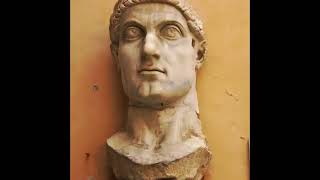
Born on the territory now known as Nis, located in Serbia, he was the son of Flavius Valerius Constantius, a Roman Army officer of Illyrian origins. His mother Helena was Greek. His father became Caesar, the deputy emperor in the west, in 293 AD. Constantine was sent east, where he rose through the ranks to become a military tribune under Emperors Diocletian and Galerius. Constantine was the first Roman emperor to convert to Christianity. Although he lived most of his life as a pagan, he joined the Christian faith on his deathbed, being baptised by Eusebius of Nicomedia. He played an influential role in the proclamation of the Edict of Milan in 313, which declared religious tolerance for Christianity in the Roman empire. He called the First Council of Nicaea in 325 AD that produced the statement of Christian belief known as the Nicene Creed.
Search Result on 'Constantine' (36 total)
Youtube Videos on Constantine (29)
 How Christianity Was Invented by Titus Flavius
 Rome and
 Christianity from Judaism to
 Serapis Christus, Ptolemy and how
 Christianity Before
 The Christian Story: Sun God, Horus,
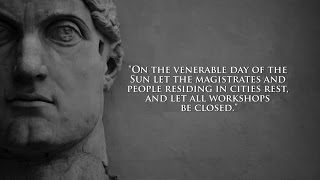 In 321 AD, Emperor
 Rome:
 The Deception of
 Arius, Athanasius &
 Emperor
 Emperor
 After Nicaea 325 AD,
 Did
 From 306 AD,
 Emperor
 Emperor
FAQ on Constantine (3)
1.What is the Codex Sinaiticus?
The Codex Sinaiticus is one of the most important books in the world. Handwritten well over 1600 years ago, the manuscript contains the Christian Bible in Greek, including the oldest complete copy of the New Testament
It is a fact of Christian history that the earliest Gospels did not record a resurrection of Jesus Christ, and this fact is supported in the Codex Sinaiticus.
Called the Codex Sinaiticus, or Sinai Bible, the oldest known complete Bible available to mankind today, was named after Mt. Sinai, the location of St. Catherines Monastery where it was discovered in 1859 by Dr Constantine Von Tischendorf (1815-1874).
The discovery of the Sinai Bible provided biblical scholars with irrefutable evidence of wilful falsifications in all modern-day Gospels, and a comparison identified a staggering 14,800 later editorial alterations in modern Bibles.
2.Who are the Gods in the Bible?
Historically, the term 'God' was applied to powerful figures, such as leaders and magistrates, who served as representatives on Earth. Emperor Constantine referenced this, citing Psalm 82:6 to remind bishops of their high, albeit human, office.
Emperor Constantine at the opening of the Council of Nicaea (325 AD) quoted Psalm 82:6 to remind the bishops that their high office should raise them above jealousy and party feeling.
The term 'God' was applied to people of power, authority and rule who were considered to have greater nearness to God than others - an appellation which implies that you are God's representatives on earth, and that your decision is, in an important sense, to be regarded as his.
3.In 325 AD, did Emperor Constantine burn gospels, writings and religious text?
The books of Arius and his followers, after the first Council of Nicaea (325 C.E.), were burned for heresy by the Roman emperors Constantine, Honorius, and Theodosius I, who published a decree commanding that, 'the doctrine of the Trinity should be embraced by those who would be called catholics; that all others should bear the infamous name of heretics'.
Articles on Constantine (2)
Emperor Constantine's Impact on Early Christian Doctrine and Politics

26,311 views
|
|
Emperor Constantine at Council of Nicaea (325 AD) Shaped Modern Christianity
22,010 views
|
News on Constantine (1)
| 1. Archeologists discover site of Emperor Constantine and Council of Nicaea, 325 AD in Turkey | RT News |