DEAD SEA SCROLLS
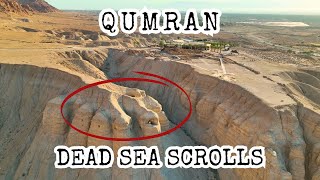
They were found in the Qumran Caves in the West Bank near the Dead Sea. Many thousands of written fragments have been discovered in the Dead Sea area. They represent the remnants of larger manuscripts damaged by natural causes or through human interference, with the vast majority only holding small scraps of text. However, a small number of well-preserved, almost intact manuscripts have survived - fewer than a dozen among those from the Qumran Caves.
Search Result on 'Dead Sea Scrolls' (23 total)
Youtube Videos on Dead Sea Scrolls (16)
 Who Wrote the



 Writing the
 Secrets of the
 Essenes,
 The
FAQ on Dead Sea Scrolls (3)
1.When was the Torah written?
Mainstream biblical scholarship tracks the composition of the Torah (the first five books of the Bible) through a gradual process starting from traditional Mosaic oral codes to written records compiled during the mid-to-late 1st millennium BCE. While early fragments exist in ancient archaeological discoveries like the Dead Sea Scrolls, the authoritative text was systematically finalized and preserved by Jewish scribes over centuries of scriptural copy transmissions.
2.Is the Old Testament historically authentic?
Mainstream biblical scholarship clarifies that the Old Testament is an anthology of ancient texts compiled, edited, and transmission-copied by diverse authors over more than a millennium. While archaeological discoveries like the Dead Sea Scrolls confirm that the texts have been preserved with high fidelity for over 2,000 years, comparative textual analysis reveals localized spelling updates, minor scribal variations, and stylistic expansions common to ancient Near Eastern manuscript traditions.
3.Does the Old Testament teach the Christian Trinity?
Mainstream biblical scholars and historians agree that the Old Testament does not explicitly teach the doctrine of the Trinity, nor did ancient Jewish communities possess a concept of a triune Godhead. There is no historical evidence in pre-Christian Jewish literature including the Hebrew text, the Dead Sea Scrolls, or ancient commentaries of a belief in a plurality of divine Persons. While Christian theologians retrospectively interpret certain plural expressions (such as 'Let us make man' in Genesis 1:26) as hints of the Trinity, ancient Judaism strictly maintained a unitarian monotheistic understanding of God.
News on Dead Sea Scrolls (2)
| 1. New Dead Sea Scrolls cave discovered in over 60 years | CNN News |
| 2. A.I model 'Enoch' reveals Dead Sea Scrolls are older than believed | JPost News |
Articles on Dead Sea Scrolls (1)
Dead Sea Scrolls vs 1,300 Years Between Moses and Old Testament Copies

20,272 views
|