When it was determined that we should sail for Italy, they delivered Paul and certain other prisoners to a centurion named Julius, of the Augustan band.
Embarking in a ship of Adramyttium, which was about to sail to places on the coast of Asia, we put to sea; Aristarchus, a Macedonian of Thessalonica, being with us.
The next day, we touched at Sidon. Julius treated Paul kindly, and gave him permission to go to his friends and refresh himself.
Putting to sea from there, we sailed under the lee of Cyprus, because the winds were contrary.
When we had sailed across the sea which is off Cilicia and Pamphylia, we came to Myra, a city of Lycia.
There the centurion found a ship of Alexandria sailing for Italy, and he put us on board.
When we had sailed slowly many days, and had come with difficulty opposite Cnidus, the wind not allowing us further, we sailed under the lee of Crete, opposite Salmone.
With difficulty sailing along it we came to a certain place called Fair Havens, near the city of Lasea.
When much time had passed and the voyage was now dangerous, because the Fast had now already gone by, Paul admonished them,
and said to them, “Sirs, I perceive that the voyage will be with injury and much loss, not only of the cargo and the ship, but also of our lives.”
But the centurion gave more heed to the master and to the owner of the ship than to those things which were spoken by Paul.
Because the haven was not suitable to winter in, the majority advised going to sea from there, if by any means they could reach Phoenix, and winter there, which is a port of Crete, looking northeast and southeast.
ACTS 27:1-12
Apostle Paul sets sail under guard on his final journey to Rome
Follow the dangerous, wind-swept maritime voyage as the Apostle Paul sets sail under imperial guard on his historic final journey to Rome. 647 views · Last view: 3 days ago
Follow the dangerous, wind-swept maritime voyage as the Apostle Paul sets sail under imperial guard on his historic final journey to Rome. 647 views · Last view: 3 days ago
Explore More
Apostle Paul RomanSearch Google Search Explore Topics
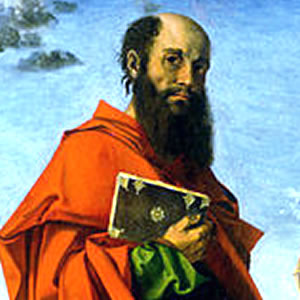 Who was Apostle Paul?
Paul the Apostle (Latin: Paulus), commonly known as Saint Paul and also known by his Jewish name Saul of Tarsus was an apostle (though not one of the Twelve Apostles) who taught the gospel of Christ to the first century world. Paul is generally considered one of the most important figures of the Apostolic Age and in the mid-30s to the mid-50s AD he founded several churches in Asia Minor and Europe. He took advantage of his status as both a Jew and a Roman citizen to minister to both Jewish and Roman audiences. According to writings in the New Testament and prior to his conversion, Paul was dedicated to persecuting the early disciples of Jesus in the area of Jerusalem. In Acts, Paul was traveling on the road from Jerusalem to Damascus on a mission to 'arrest them and bring them back to Jerusalem' when the resurrected Jesus appeared to him in a great light. He was struck blind, but after three days his sight was restored by Ananias of Damascus and Paul began to preach that Jesus of Nazareth is the Jewish Messiah and the Son of God.
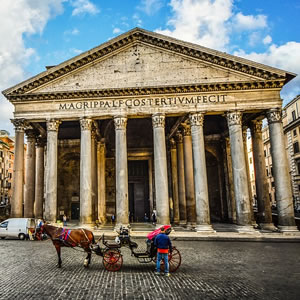 What is Roman?
In historiography, ancient Rome is Roman civilization. From the founding of the city of Rome in the 8th century BC to the collapse of the Western Roman Empire in the 5th century AD, encompassing the Roman Kingdom, Roman Republic and Roman Empire until the fall of the western empire. The civilization began as an Italic settlement in the Italian peninsula, dating from the 8th century BC, that grew into the city of Rome and which subsequently gave its name to the empire over which it ruled and to the widespread civilisation the empire developed. The Roman empire expanded to become one of the largest empires in the ancient world, though still ruled from the city, with an estimated 50 to 90 million inhabitants (roughly 20% of the world's population) and covering 5.0 million square kilometres at its height in AD 117.