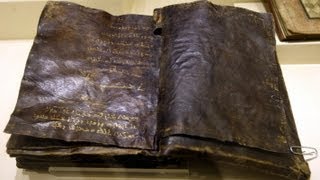
Codex

The Codex collection lists hundreds of early Gospels and texts.
These texts were ultimately excluded from the standard biblical canon due to reasons such as partial damage, unknown authorship, controversial origins and political influences.
 |  WIKIPEDIA: List_of_Hebrew_Bible_manuscripts

BOOKS, CHAPTER & VERSE
120 COLLECTIONS

1. Aleppo Codex | 930 AD

Widely regarded as the supreme and most authoritative witness to the Tiberian Masorah. Corrected and vocalized by Aaron ben Asher, it was consulted by Maimonides in Cairo before being kept for centuries in Syria, where it suffered partial destruction during anti-Jewish riots in 1947.

2. Badishche Landesbibliothek | 850 AD

A highly valued monastic Bible text preserved in Karlsruhe, Germany. It illustrates the cross-regional transmission of the Vulgate, documenting how local scribes adapted standardized ecclesiastical texts for local German scriptoriums.

3. Basel Library | 950 AD

A medieval New Testament manuscript fragment preserved at Basel. It documents the late survival of localized pre-Vulgate phrasing alongside the official ecclesiastical Bible revisions of the Carolingian era.

4. Bavarian State Library | 850 AD

Refers to a specific New Testament manuscript fragment within the Munich collections that contains pre-Vulgate elements. It provides critical context for examining the coexistence of multiple Latin scriptural editions in German territories.

5. Ben Asher |

Refers to the elite lineage of Tiberian Masoretic scholars, culminating in Aaron ben Asher in the 10th century. Their specialized system of vowel points, accents, and marginal notes established the universally accepted textus receptus of the Hebrew Bible.

6. Biblioteca Capitolare | 600 AD

An early Italian New Testament witness from Verona, preserving early standardizations of ecclesiastical books. It documents how standard Roman versions of the Vulgate began to systematically replace regional pre-Vulgate variations.

7. Biblioteca Vallicelliana | 800 AD

A major Carolingian Bible manuscript preserved in Rome, closely associated with the sweeping textual recension of Alcuin of York. It provides an excellent template for analyzing early medieval imperial standardization of Jerome's translation.

8. Bibliotheque Municipale | 450 AD

An ancient fragmentary parchment witness of the New Testament preserved in a local French repository. Dating to the mid-5th century, it captures the foundational, un-revised dissemination of Jerome's Vulgate across Western Europe.

9. Book of Mulling | 450 AD

An Irish pocket gospel book that preserves a highly distinctive localized text. While predominantly Vulgate, it retains a heavy array of Vetus Latina readings in the Gospel of St. John, characteristic of early Celtic Christian isolation.

10. Cairo Geniza | 300 AD

A massive collection of some 400,000 Jewish manuscript fragments and historical documents found in the storeroom of the Ben Ezra Synagogue in Old Cairo. It provides an unparalleled window into medieval Mediterranean religious and daily life.

11. Clementinum | 1400 AD

Designated as "z", this late medieval manuscript of the Gospels preserves an archaic, pre-Vulgate Latin tradition despite its exceptionally late transcription date, showing the deep persistence of local textual strains.

12. Codex Alexandrinus | 400-440 AD

The Codex Alexandrinus is a 5th century manuscript of the Greek Bible, containing the majority of the Septuagint and the New Testament. It is one of the earliest and most complete manuscripts of the Bible.

It derives its name from Alexandria where it resided for a number of years before it was brought by Cyril Lucaris from Alexandria to Constantinople.

Today, it rests along with Codex Sinaiticus in one of the showcases in the Ritblat Gallery of the British Library.

As the text came from several different traditions, different parts of the codex are not of equal textual value. The text has been edited several times since the 18th century.

13. Codex Ambrosianus | 700 AD

Designated as "s", this early Milanese manuscript contains fragments of the Gospels. It serves as an essential regional anchor for identifying how pre-Vulgate texts shifted grammatically in northern Italy.

14. Codex Ambrosianus | 600 AD

An exceptionally early Milanese vellum fragment containing New Testament selections. Its text offers a pristine window into the localized Italian transmission lines where old pre-Vulgate readings were carefully maintained.

15. Codex Amiatinus | 716 AD

The oldest surviving complete manuscript of the Latin Vulgate Bible, produced in the Kingdom of Northumbria. It is widely considered by textual scholars to be the most accurate witness to Jerome's original translation.

16. Codex Ardmachanus | 850 AD

Commonly known as the Book of Armagh, this famous Irish manuscript contains an unique iteration of the New Testament. It blends distinct Old Latin textual strains alongside Jerome's Vulgate text, serving as a pillar of Insular art and scribal culture.

17. Codex Augiensis | 850 AD

Designated as "f" for the Pauline Epistles, this Greek-Latin bilingual codex was copied at Reichenau Abbey. The Latin text represents a highly corrected version of the Old Latin tradition that was later harmonized with early Vulgate variants.

18. Codex Aureus | 750 AD

Also called the Stockholm Codex Aureus, this beautiful illuminated gospel book is written on alternating purple and white vellum sheets in golden ink. Its text presents an advanced Vulgate line mixed with an array of older Vetus Latina readings.

19. Codex Babylonicus Petropolitanus | 916 AD

Also called the Petersburg Codex of the Prophets, this major manuscript contains the Latter Prophets and is famed for its use of the superlinear Babylonian vowel system. Discovered in 1839 by Abraham Firkovich, it resides in the National Library of Russia.

20. Codex Bernensis | 500 AD

Designated as "t", this early manuscript from Bern contains vital fragments of the Acts of the Apostles. It represents a highly stable, non-revised version of the European Old Latin text, offering clean variants untouched by later overhauls.

21. Codex Bezae | 400 AD

Designated as "d", this is a major Greek and Latin bilingual codex containing the Gospels and Acts. The Latin column presents an Old Latin text closely tailored to the accompanying Greek, representing a cornerstone of the Western textual tradition.

22. Codex Bobiensis | 400 AD

Designated as "k", this is one of the most critical Old Latin manuscripts in existence, containing fragments of Mark and Matthew. It preserves the most prominent, primitive witness to the African Latin text-type, mirroring 3rd-century citations.

23. Codex Bobiensis | 550 AD

A separate chronological layer or related fragment linked to the Bobbio scriptorium. It demonstrates how pre-Vulgate Latin wording evolved grammatically across generations of monastic isolation.

24. Codex Bodleianus | 850 AD

A highly important Oxford manuscript fragment preserving segments of the New Testament. It is frequently cross-referenced by textual critics to isolate pre-Vulgate variants from Carolingian Vulgate overhauls.

25. Codex Boernerianus | 850 AD

Designated as "g", this unique Greek-Latin bilingual manuscript of the Pauline Epistles features the Old Latin translation interlined directly above the Greek text, showing an Irish scribal hand operating in a German monastic setting.

26. Codex Brixianus | 550 AD

Designated as "f", this beautifully crafted purple vellum manuscript containing the Gospels is preserved at Brescia. It is considered an excellent example of the Italian branch of the Old Latin text and influenced Jerome's Vulgate translation.

27. Codex Budapestiensis | 800 AD

Catalogued as part of the broader Old Latin New Testament corpus, this medieval manuscript features an intricate mix of Latin textual traditions. It preserves specific pre-Vulgate phrasings and archaic terminology across its text.

28. Codex Cairensis | 895 AD

The Cairo Codex of the Prophets is a major Hebrew vellum manuscript containing the Nevi'im. While its historic colophon credits its transcription to the master Masorete Moses ben Asher in Tiberias, modern scientific analysis leans toward an 11th-century origin.

29. Codex Carinthianus | 650 AD

A manuscript fragment containing portions of the New Testament scriptures. It is highly valued by modern textual critics for preserving specific regional linguistic adaptations that predated the standardisation of the Latin Vulgate.

30. Codex Cavensis | 850 AD

An important 9th-century Latin Bible manuscript produced in Spain and preserved at Cava de' Tirreni. It represents a premier textual witness to the Spanish family of the Vulgate text, displaying distinct Visigothic artistic styles.

31. Codex Claromontanus | 500 AD

Designated as "d" in the Pauline Epistles, this magnificent Greek-Latin bilingual manuscript contains all of Paul's letters. The Latin text is an independent witness to the Old Latin tradition that predates the systematic textual revisions of Jerome.

32. Codex Claromontanus V | 450 AD

Designated as "h", this early manuscript contains portions of the Gospels. It stands apart from standard ecclesiastical copies by offering a highly archaic variant strain closely tied to early southern European Christian communities.

33. Codex Colbertinus | 1200 AD

Designated as "c", this late medieval manuscript uniquely preserves a pure European Old Latin text for the four Gospels despite its late date of transcription. It provides clear proof that pre-Vulgate texts survived long after Jerome's translation.

34. Codex Complutensis I | 927 AD

An exceptionally important medieval Spanish Bible manuscript completed by the scribe John. It is highly valued for its stable, non-revised transmission of early Western scriptural accents and distinct Visigothic textual variants.

35. Codex Corbeiensis I | 750 AD

Designated as "ff 1", this manuscript contains a significant portion of the Gospel of Matthew. It represents an authentic witness to the European branch of the Old Latin text, completely free from systematic alignment with Jerome's Vulgate.

36. Codex Corbeiensis II | 450 AD

Designated as "ff 2", this early manuscript contains the four Gospels in a highly distinctive Old Latin translation. It offers clear insights into the linguistic transition between the archaic African Latin text-type and later European variants.

37. Codex Corbiensis | 850 AD

An important monastic New Testament text originating from Corbie Abbey. Scribes compiling this manuscript carefully preserved ancient textual strains, making it an invaluable asset for tracing early medieval pre-Vulgate transmissions.

38. Codex Curiensis | 450 AD

Designated as "an", this fragmentary Old Latin manuscript contains portions of the gospels of Luke and John. It serves as an important text-critical link for understanding early regional Latin variations in Central Europe.

39. Codex Demidovianus | 1250 AD

Designated as "dem", this late medieval manuscript of the Pauline Epistles, Acts, and Catholic Epistles contains a highly mixed text. It incorporates significant chunks of Old Latin readings interspersed into a broader Vulgate baseline.

40. Codex Divionensis | 1250 AD

An important late medieval New Testament witness listed among the Latin manuscripts that retained critical archaic variants. Scribes drawing from this branch frequently introduced traditional Old Latin readings into standard local church copies.

41. Codex Durmachensis | 650 AD

Famously known as the Book of Durrow, this illuminated gospel book is one of the earliest surviving masterpieces of Insular art. Its text is predominantly an early Irish variant of Jerome's Vulgate, peppered with deep Old Latin scriptural elements.

42. Codex Ephraemi | 450 AD

Codex Ephraemi Rescriptus is a 5th-century Greek manuscript of the Bible. The manuscript is not intact: in its current condition, Codex C contains material from every New Testament book except Second Thessalonians and Second John; however, only six books of the Greek Old Testament are represented.

Currently it is housed in the Bibliotheque nationale de France in Paris.

43. Codex Ezra |

A lost biblical manuscript highly regarded for its purported textual purity and adherence to old standards. Though the original has vanished, its legacy survived through later medieval copies that claimed direct transcription from this authoritative master template.

44. Codex Floriacensis | 450 AD

Designated as "h", this valuable palimpsest manuscript contains fragments of the Apocalypse, Acts, and Catholic Epistles. It is celebrated by scholars for preserving a pure strand of the highly archaic African Old Latin textual family.

45. Codex Fuldensis | 541 AD

Produced for Bishop Victor of Capua, this celebrated manuscript replaces the four individual Gospels with a single continuous harmony based on the Diatessaron. It is one of the earliest and most reliable primary pillars of the Vulgate tradition.

46. Codex Gatianum | 750 AD

Designated as "g 3", this text contains parts of the Acts of the Apostles. Its localized Old Latin phrasing shows distinct structural variations that provide insights into early church litanies and liturgical practice in western Europe.

47. Codex Gigas | 1250 AD

Famed as the Giant Bible or Devil's Bible, this massive medieval manuscript includes an entire Bible. While the Old Testament is Vulgate-based, its New Testament Acts and Apocalypse remarkably preserve a very ancient, pre-Vulgate Old Latin text.

48. Codex Great Mahzor |

A renowned liturgical and biblical codex that paired specific Masoretic scriptures with seasonal synagogue poetry and prayers. It is frequently cross-referenced in rabbinic compilations for preserving highly stable regional traditions of spelling and cantillation.

49. Codex Guelferbytanus | 550 AD

Also known as Codex Carolinus, this is a bilingual Gothic-Latin palimpsest containing portions of Paul's Letter to the Romans. The Latin column represents a rare 6th-century witness to the pre-Vulgate Old Latin text-type used in Italy.

50. Codex Hafnianus | 550 AD

An early medieval manuscript preserving segments of New Testament text. It serves as an essential regional anchor for identifying how pre-Vulgate texts shifted syntactically as they moved northward into continental European scriptoriums.

51. Codex Harleianus | 750 AD

Designated as "Z" or part of the Harley collection, this beautiful early medieval manuscript contains the Gospels. It serves as a vital tool for examining the stylistic fusion of early Western text-types with newly standardized Latin forms.

52. Codex Harleianus | 550 AD

Catalogued as part of the early British Library collections, this highly ancient 6th-century witness provides an exceptionally pristine look at the pre-Carolingian structural layout and raw orthography of Jerome's translation.

53. Codex Hilleli | 600 AD

A celebrated, now-lost Spanish Masoretic manuscript traditionally attributed to Rabbi Hillel ben Moses ben Hillel. It was highly praised by Maimonides and widely relied upon as an exceptionally precise model by Sephardic Torah scribes before disappearing around the late 13th century.

54. Codex Jericho | 1310 AD

A celebrated but now-lost Masoretic Pentateuch manuscript whose high precision made it a sought-after authority. Its specific readings and distinct textual vocalizations are preserved solely via citations found in the marginal notes of other 14th-century codices.

55. Codex Laudianus | 550 AD

Designated as "e", this essential Greek-Latin bilingual manuscript contains the Acts of the Apostles. The Latin text runs parallel to the Greek and provides an excellent early witness to the Old Latin text-type as used in church worship.

56. Codex Legionensis | 650 AD

A highly important Spanish New Testament manuscript that preserves elements of the old Visigothic textual tradition. Its structural readings retain unique pre-Vulgate phrasing that helped shape early Iberian liturgical life.

57. Codex Legionensis |

A renowned Spanish Vulgate manuscript that preserves unique Visigothic scribal habits and notes. It offers text critics a deep look into the linguistic development of standard church Bibles on the Iberian Peninsula.

58. Codex Leningradensis | 1008 AD

Copied by Samuel ben Jacob in Cairo, this is the oldest complete, intact manuscript of the entire Hebrew Bible using the Tiberian Masoretic Text. It serves as the primary foundational source text for nearly all modern printed editions of the Hebrew scriptures.

59. Codex M. p. th. f. 67 |

Housed at the Würzburg Universitätsbibliothek, this famous early medieval manuscript contains an Old Irish glossed version of the Pauline Epistles. It serves as an invaluable resource for studying Insular Vulgate reading traditions.

60. Codex Mediolanensis | 1000 AD

Designated as "h", this Milanese manuscript contains the four Gospels in an Old Latin format. It is a vital source for studying northern Italian liturgical traditions and tracing early non-Vulgate text forms used in the region.

61. Codex Mediolanensis | 550 AD

An exceptionally early, authoritative 6th-century manuscript of the four Gospels preserved in Milan. It represents a highly pure, pristine branch of the early Italian Vulgate textual tradition, written shortly after Jerome's lifetime.

62. Codex Monacensis | 600 AD

Designated as "q", this important Munich manuscript contains the four Gospels. It represents a highly valuable, thoroughly complete witness to the standard European Old Latin text-type, featuring a distinct Western order of books.

63. Codex Monacensis | 650 AD

An early medieval manuscript layer within the Bavarian holdings that contains pre-Vulgate gospel selections. It helps critics track structural variations between contemporary scriptoriums operating across central Europe.

64. Codex Monacensis | 650 AD

A separate chronological fragment within the Munich collections containing New Testament passages. It offers an excellent reference point for studying the localized linguistic evolution of pre-Vulgate translations over time.

65. Codex Monza | 950 AD

A late medieval Italian manuscript containing select New Testament texts. It is primarily analyzed by palaeographers to trace how early pre-Vulgate cantillation and accent marks were adapted into localized liturgical traditions.

66. Codex Muggeh |

Also referred to as Sefer Mugah, this lost biblical codex was prepared with meticulous care to serve as a primary master copy for scribes. It is considered the earliest standard codex quoted by the early Masoretes and is heavily cited in 9th- and 10th-century Bibles.

67. Codex Orientales 4445 | 820 AD

Known as the London Codex, this highly significant British Library manuscript contains a large portion of the Pentateuch. Its oldest sections represent one of the earliest surviving witnesses to the Tiberian vocalisation system and formal ritual chanting marks.

68. Codex Palatinus | 450 AD

Designated as "e", this magnificent purple parchment codex contains the Gospels in an Old Latin translation. Written in silver and gold ink, its text represents an early stage of the African Latin family or a unique transition toward European forms.

69. Codex Parisiensis | 800 AD

Designated as "w", this manuscript contains fragments of the Gospel of Luke. Housed in Paris, it documents a localized mixed text where pre-Vulgate phrases were gradually harmonized with standard Vulgate variants.

70. Codex Perpinianensis | 1150 AD

Designated as "p", this late manuscript from Perpignan contains the book of Acts. Despite its late date, it preserves a remarkably ancient and pure Old Latin text-type throughout its chapters, making it a critical scholarly asset.

71. Codex Philadelphiensis | 1150 AD

A late medieval New Testament witness held in Philadelphia that retains distinct archaic variants. Scribes drawing from this transmission branch frequently introduced traditional Old Latin phrasing into standard local copies.

72. Codex Reginensis | 750 AD

An important early medieval Latin manuscript featuring a stable text of the Gospels. Housed in the Vatican, it provides modern scholars with an analytical lens into the mid-8th century transitional stages of standard church texts.

73. Codex Rehdigeranus | 750 AD

Designated as "l", this manuscript contains the four Gospels and is held at Wroc?aw. It offers a prime example of a mixed text, where an older European Vetus Latina base was partially modified against later standardized Vulgate readings.

74. Codex Reuchlinanus | 1105 AD

An important, securely dated medieval manuscript containing the text of the Biblical Prophets. It represents a highly valued textual branch of the non-ben-Asher Masoretic transmission and is preserved within the historical collections in Germany.

75. Codex Sanbuki |

An authoritative, vanished Hebrew Bible codex frequently cited as a standard reference text in Masoretic notes alongside Codex Hilleli. It was heavily relied upon by medieval grammarians to resolve complex discrepancies in biblical accents and orthography.

76. Codex Sangallensis 1394 | 450 AD

Designated as "n", this early St. Gall fragment contains valuable segments of the Gospels of Matthew and Mark. It represents an excellent, un-revised example of the old European pre-Vulgate textual stream.

77. Codex Sangallensis 1394 (650 AD) | 650 AD

A separate chronological layer or related fragment within the St. Gall 1394 catalog. This text demonstrates how pre-Vulgate Latin wording evolved grammatically across two centuries of monastic copying in Switzerland.

78. Codex Sangallensis 1395 | 450 AD

An early, highly prized vellum fragment from St. Gall containing portions of the Gospels. Its readings are vital for tracking the earliest textual shifts away from the primitive African style toward a formal European Latin baseline.

79. Codex Sangallensis 1395 | 450 AD

The oldest surviving witness to the Vulgate text of the Gospels, written in a beautiful early uncial hand. Though heavily fragmented, its readings match closely with the best northern Italian lines of Jerome's text transmission.

80. Codex Sangallensis 2 | 750 AD

An early medieval Swiss manuscript of the Gospels held in the Abbey of Saint Gall. It charts the progression of continental scribal formatting, showcasing the integration of standard Alcuinian Vulgate text-types.

81. Codex Sangallensis 48 | 850 AD

Designated as "Delta", this is a Greek-Latin interlinear manuscript of the Gospels. The Latin text running between the lines is a highly valuable witness to the European Old Latin tradition, showing heavy adaptation to fit the Greek syntax.

82. Codex Sangallensis 51 | 750 AD

Designated as "p", this gospel book fragment features a heavily mixed textual character. It provides essential comparative evidence showing the gradual replacement of traditional European Old Latin phrasings by the standard Vulgate.

83. Codex Sangallensis 60 | ca. 800 AD

Designated as "o", this manuscript contains parts of the Gospel of John. It offers text critics a pristine window into localized Swiss monastic transmission lines where old pre-Vulgate readings were deliberately preserved.

84. Codex Sangallensis 70 | 750 AD

A localized monastic gospel book showing a stable text based closely on Italian archetypes. It is heavily studied to evaluate standard Benedictine liturgical formatting and scriptural readings during the early Middle Ages.

85. Codex Sangallensis 907 | 750 AD

A parchment manuscript from St. Gall that presents the text of the New Testament. It displays a transitional textual character where standard Latin Vulgate lines are balanced with older regional scribal characteristics.

86. Codex Sangermanensis | 850 AD

Designated as "e" for the Pauline Epistles, this Greek-Latin bilingual codex is a direct copy of the Latin column of Codex Claromontanus. It is heavily studied to evaluate medieval scribal habits and transcription errors across textual lines.

87. Codex Sangermanensis | 850 AD

A prominent 9th-century French Vulgate manuscript formerly held at Saint-Germain-des-Prés. It serves as an integral witness to the French textual family, preserving a stable edition used widely across Carolingian monastic centers.

88. Codex Sangermanensis I | 800 AD

Designated as "g 1", this manuscript contains a highly important Old Latin translation of the Gospel of Matthew. It is frequently cross-referenced by textual critics to analyze early French textual contamination and scribal adjustments.

89. Codex Sangermanensis II | 950 AD

Designated as "g 2", this later medieval manuscript contains portions of the New Testament. It is studied primarily to track how traditional pre-Vulgate phrasings managed to persist within standard Benedictine library collections over centuries.

90. Codex Sarzanensis | 550 AD

Designated as "j", this purple vellum manuscript contains fragments of the Gospel of John. Written in a beautiful uncial hand, it provides a crucial early Italian witness to the development and standardization of the pre-Vulgate Latin scriptures.

91. Codex Schlettstadtensis | 700 AD

An early medieval manuscript preserving key segments of the New Testament. It is highly valued for showing how regional French and German scribes integrated old pre-Vulgate texts into their local devotional routines.

92. Codex Sinai |

Not to be confused with the Greek Christian Codex Sinaiticus, this is a distinct, lost Hebrew Bible codex documented by medieval Masoretic scholars. It was frequently cited in early rabbinic literature for its distinct punctuation variations and structural layouts.

93. Codex Sinaiticus | 330-360 AD

Codex Sinaiticus or Sinai Bible is one of the four great uncial codices, an ancient, handwritten copy of the Greek Bible. The codex is a celebrated historical treasure. The codex is an Alexandrian text-type manuscript written in the 4th century in uncial letters on parchment. Current scholarship considers the Codex Sinaiticus to be one of the best Greek texts of the New Testament discovered by Constantin von Tischendorf.

The Codex Sinaiticus came to the attention of scholars in the 19th century at Saint Catherine's Monastery in the Sinai Peninsula, with further material discovered in the 20th and 21st centuries. Although parts of the Codex are scattered across four libraries around the world, most of the manuscript is today vested in the British Library London, where it is on public display.

94. Codex Speculum |

Designated as "m", this unique treatise contains an extensive array of scriptural quotes from almost every book of the New Testament. It serves as a vital comprehensive index of the old African Latin text-type used by early Church Fathers.

95. Codex Theodulphianus | 950 AD

A remarkable 10th-century manuscript reflecting the meticulous textual recension compiled by Bishop Theodulf of Orléans. It features a unique system of marginal annotations designed to compare and contrast diverging Vulgate lines.

96. Codex Toletanus | 950 AD

A celebrated, exceptionally complete Bible manuscript written in a refined Visigothic hand at Toledo. Alongside Codex Cavensis, it serves as a foundational benchmark for reconstructing the highly influential Spanish text family of the Vulgate.

97. Codex Usserianus II | 800 AD

Designated as "r 2" and known as the Garland of Howth, this Irish gospel book features a heavily mixed text. It blends standard Vulgate readings with an array of archaic pre-Vulgate Irish variants.

98. Codex Usserianus Primus | 600 AD

Designated as "r 1", this is the earliest surviving Irish manuscript of the four Gospels. It preserves an authentic, highly distinct iteration of the Old Latin text-type, completely free from Jerome's systematic Vulgate revisions.

99. Codex Vatanicus | 300-325 AD

The Codex Vaticanus is one of the oldest extant manuscripts of the Greek Bible (Old and New Testament). The Codex is named after its place of conservation in the Vatican Library, where it has been kept since at least the 15th century. It is written on 759 leaves of vellum in uncial letters and has been dated palaeographically to the 4th century.

Most current scholars consider the Codex Vaticanus to be one of the best Greek texts of the New Testament. The most widely sold editions of the Greek New Testament are largely based on the text of the Codex Vaticanus.

100. Codex Vercellensis | 350 AD

Designated as "a", this is a highly celebrated 4th-century purple parchment manuscript containing the Old Latin gospels. Traditionally thought to have been written by Bishop Eusebius of Vercelli, it represents a crucial early European textual witness.

101. Codex Veronensis | 450 AD

Designated as "b", this purple vellum manuscript contains the four Gospels in Western order. Written in elegant silver and gold ink, it offers one of the most reliable and thoroughly studied witnesses to the European Old Latin text-type.

102. Codex Waldeccensis | 850 AD

Designated as "d" in the Pauline Epistles and linked to Greek Uncial 0320, this bilingual sheet contains portions of the Epistle to the Romans, featuring an independent Old Latin text that runs alongside the Greek.

103. Codex Yerushalmi | 1010 AD

A historically vital but now lost Jerusalem-associated Hebrew Bible codex. It famously served as a primary authoritative textual source for the influential Spanish-Jewish grammarian Jonah ibn Janah while compiling his landmark linguistic works in the early 11th century.

104. Damascus Keter |

Also known as the Damascus Pentateuch or Codex Sassoon 507, this 10th-century codex contains an almost complete version of the Five Books of Moses. It is recognized alongside the Aleppo and Leningrad codices as one of the earliest foundational pillars of biblical manuscript history.

105. Dead Sea Scrolls | 250 BC-70 AD

A transformative cache of ancient Jewish religious manuscripts discovered between 1946 and 1956 in the Qumran Caves of the Judaean Desert. It includes the oldest surviving witnesses to canonical biblical texts and sectarian theological works.

106. Duke Augustus Library | 550 AD

Refers to early Wolfenbüttel New Testament fragments preserving pre-Vulgate text characteristics. These leaves provide critical textual evidence for mapping regional linguistic patterns in early medieval German territories.

107. Erfurt Codices |

A series of three highly important medieval Hebrew Bible manuscripts (E1, E2, and E3) ranging from the 11th to the 14th centuries. Formerly held in Erfurt, Germany, these massive volumes provide crucial insight into German Jewish scribal communities and Masoretic notes.

108. Fragmenta Stuttgartensia | 650 AD

A set of early manuscript fragments preserved in Stuttgart. These sheets contain remnants of New Testament books written in a pre-Vulgate translation, offering clean data on early Germanic textual variants.

109. Fragmentum Monacense | 450 AD

Designated as "m", this early Munich collection preserves unique fragments of the Catholic Epistles. It is highly valued for mapping the earliest Latin translation efforts of texts outside the core four canonical gospels.

110. Fragmentum Rosenthal | 800 AD

A rare parchment fragment containing a brief but valuable section of the New Testament Gospels. Its text offers text critics a precise look into how localized Old Latin phrasing persisted alongside official Carolingian text revisions.

111. Fragmentum Sinaiticum | 950 AD

A rare Latin New Testament fragment discovered in the East. It provides valuable text-critical insights into how Western Old Latin textual strains traveled to and were preserved within distant Mediterranean monastic libraries.

112. Frisingensia Fragmenta | 600 AD

Designated as "r 1", these famous Freising fragments contain parts of the Pauline Epistles and Catholic Epistles. It is a vital witness to an extremely early, non-Vulgate text-type that reflects 4th-century church usage.

113. Heidelberg Library | 650 AD

A rare New Testament manuscript fragment housed at Heidelberg. It contains localized pre-Vulgate readings that assist textual critics in mapping regional scriptural transmission routes across early medieval Germany.

114. Isaiah Scroll | 250 BC-70 AD

Designated 1QIsa a, this is the largest and best-preserved biblical manuscript found at Qumran. It contains the entire Book of Isaiah almost in its entirety and predates previously known medieval Hebrew Bible manuscripts by over a millennium.

115. Lectionarium Luxoviense | 700 AD

A landmark Merovingian liturgical lectionary originating from Luxeuil Abbey. It utilizes a highly distinct calligraphic script to present specific gospel readings, anchoring the textual evolution of Jerome's Vulgate within early French church history.

116. Liber Comicus | 850 AD

An early medieval lectionary used by the Visigothic Rite in Spain. It serves as an exceptionally important textual witness, preserving unique liturgical and scriptural Old Latin readings native to the Iberian Peninsula.

117. Michigan Codex |

A partially preserved Hebrew Bible manuscript discovered in the University of Michigan Library that spans from Deuteronomy through Kings. Written in a semi-cursive Sephardic script, carbon-14 testing dates this important traditional text to the late 11th century.

118. Nash Papyrus | 100 BC

A collection of four papyrus fragments acquired in Egypt in 1898, containing the Ten Commandments and the Shema Yisrael prayer. Until the discovery of the Dead Sea Scrolls, it was the oldest known Hebrew manuscript fragment in existence.

119. Scroll 2 | 1155 AD

Commonly known as the Bologna Torah Scroll, this exceptionally rare parchment scroll is housed at the University of Bologna. Extensive radiocarbon analysis confirmed it to be one of the oldest surviving complete Torah scrolls in existence, dating between 1155 and 1255.

120. Scroll: 4Q106 | 250 BC-70 AD

Also designated 4QCant a, this parchment scroll fragment discovered in Cave 4 represents an early Herodian textual witness to the Song of Songs, preserving portions of chapters three, four, six, and seven in an elegant ancient square Hebrew script.

121. Scroll: 4Q107 | 250 BC-70 AD

Designated 4QCant b, this Hebrew scroll fragment from Qumran Cave 4 contains major textual segments of the Song of Songs. It is highly valued for the study of poetic layout patterns and scribal omission patterns in Second Temple literature.

122. Scroll: 4Q108 | 250 BC-70 AD

Designated 4QCant c, this fragmentary parchment manuscript from Cave 4 contains a brief but well-preserved segment of the Song of Songs 3:7–8, contributing to the small group of surviving ancient witnesses to biblical wisdom and poetry.

123. Scroll: 4Q240 | 250 BC-70 AD

A highly intriguing and fragmentary manuscript from Cave 4 that has been analyzed by biblical scholars as a potential ancient commentary or interpretive text (pesher) associated with the allegorical readings of the Song of Songs.

124. Scroll: 4QDeut | 250 BC-70 AD

Catalogued as 4Q41 and also known as the All Souls Deuteronomy, this beautifully preserved Herodian-era scroll fragment contains text from the Book of Deuteronomy, most notably preserving a highly celebrated early copy of the Ten Commandments.

125. Scroll: 6Q6 | 250 BC-70 AD

Designated 6QCant, this unique papyrus manuscript from Cave 6 represents another critical Dead Sea Scroll witness to the Song of Songs, providing cross-comparative evidence against the parchment iterations found in Cave 4.

126. Severus Scroll |

A famous lost Torah scroll said to have been taken from Jerusalem to Rome by Emperor Titus, and later gifted to a synagogue by Emperor Severus. It is celebrated in rabbinic literature for preserving unique variant readings and spelling anomalies.

127. Vindobonensis Lat. 1235 | 450 AD

Designated as "i", this early Viennese manuscript fragment contains parts of the Gospels. It represents a highly stable, non-revised version of the European Old Latin text, offering clean variants untouched by later systematic overhauls.

128. Vindobonensis Lat. 502 | 650 AD

Designated as "v", this early Viennese parchment sheet preserves an exceptional fragment of the Gospel of Luke. Its raw syntax provides scholars with a clear, un-revised look at early Central European pre-Vulgate translation habits.

6,189 Videos  •  0 views/24hr  •  1,658 Photos in 148 Albums
About  |  Q&A  |  Contact Us    •    Terms  |  Privacy  |  Disclaimer  |  Sitemap
Connect:      Facebook  |    Twitter  |    Youtube
MuslimProphets.com is an educational website on the Prophets of God: David, Noah, Abraham, Moses, Jesus and Muhammad, who established the Abrahamic faiths of Judaism, Christianity and Islam.

MuslimProphets.com explores contemporary social themes through Scripture, Evidences, Photo, Video, Maps, Current Affairs, Debate and 'alternative' Views held by Theologians, Apologists, Scholars and Street Preachers.

In accordance with Islamic etiquette, all prophet names should be followed with 'Peace Be Upon Him (PBUH)'. This is omitted to minimise text.

DISCLAIMER
The historical information provided on this website is for educational and informational purposes only.
History is an ongoing interpretation of past events. Historical accounts are shaped by the perspectives, biases, and cultural influences of their time; therefore, no content on this website should be taken as absolute, 100% factual truth. We encourage readers to approach historical narratives with a critical mind.

All website content is available in the public domain. While all information is gathered from sources believed to be reliable, its absolute accuracy cannot be guaranteed.

EXTERNAL LINKS & SEO
External links are provided as a convenience and for informational purposes only. They do not constitute an endorsement or approval of any products, services, or opinions of any organization or individual. Title and text links may be edited for external SEO, internal site structure, and keyword search purposes. We bear no responsibility for the accuracy, legality, or content found on any external website or its subsequent links.

MEDIA & SOURCE ATTRIBUTIONS
Unless otherwise indicated, all images and content are licensed under a Creative Commons Attribution License distributed by Wikipedia, Wikimedia Commons, Pixabay, Unsplash, and similar platforms. While every effort is made to accurately source all media, contact us if you believe your copyright has been infringed so we can address and resolve the matter promptly.

All videos are hosted on and viewable via YouTube servers. Video titles are generated based on the original video title, the overall content theme (including actual dialogue and transcripts), and AI-based recommendations optimized for SEO, keyword density, and internal search functions. Video titles do not represent the views held by the YouTube video uploader, or any associated individual, organisation, or business.

All Torah, Psalms, and Old/New Testament Bible quotes are from the King James Version (KJV) Holy Bible, which is in the public domain.
All Quran quotes are from the Taqi-ud-Din al-Hilali / Muhsin Khan English Quran translation.

CORRECTIONS
If you spot a mistake, error, or omission of information, please contact us so we can review and correct it.