652 views
·
Last viewed: 18 mins ago
Uploaded: 10 Oct 2024 (2 years ago) · Shared: 13 Oct 2024
Duration: 52:46
Uploaded: 10 Oct 2024 (2 years ago) · Shared: 13 Oct 2024
Duration: 52:46
Youtube Description
THE ORIGINAL KAABA & THE OTHER KAABAS: THE HOUSES OF GODS MADE OF STONES ABOVE WELLS | [DOCUMENTARY] Over 25 million Muslims come to the Kaaba forthe pilgrimages of Hajj and Umrah, every year.
The pilgrimage of Hajj is one of the five pillars of Islam, and a must for any Muslim who can afford it.
A Hajj pilgrimage for a family can easily cost tens of thousands of dollars depending on the country of departure.
Thus, many work towards this goal for decades; some spend the savings of a lifetime, while others sell everything they own to afford this once-in-a-lifetime opportunity to see the House of Allah.
During the pilgrimage of Hajj, Muslims wear ritual clothes (Ihram), walk around the Kaaba and the hills of Safa and Marwa (tawaf), stone the Devil with pebbles (Ramy al-Jamarāt), recite Quranic verses, and cut their hair and nails to signify their purification, among other rituals.
It is truly a once-in-a-lifetime experience for most of them. If not… the most important journey of their life.
However, it would be a huge mistake, though, to think that pilgrimages such as the Hajj, throughout history, were performed solely around the Kaaba of Mecca; and an even bigger mistake to think, that Muslims were the only ones to have undertaken such pilgrimages, in the history of Arabia.
In fact, before the emergence of Islam, many, many other temples scattered throughout Arabia, similar in shape to the Kaaba of Mecca and also called ''Kaaba,'' served a similar purpose.
However, pre-islamic pilgrims did not set out with the intention of worshiping Allah, but rather to worship hundreds or even thousands of other gods that you most likely have never heard of.
Welcome to pre-Islamic Arabia, to its forgotten history and gods and to its forgotten Kaabas.
Writer: Vlad Racovita
Editor: Mashudi
Voice-Over: Colin Sheriff Ghannam
Support us on Patreon!: https://www.patreon.com/VladRacovitaEN_ES
Support us with a Super-Thanks to be listed at the end of the video!
Or support us with a donation on Paypal: https://www.paypal.com/donate/?hosted_button_id=22SG5B4WVZHJL
Our Channel in Spanish: https://www.youtube.com/channel/UCajNyZbJu0kKNZVZr5ug6RQ/
Bibliography/Main Sources:
The Biography of Prophet Muhammad, (Sirat Rasul Allah) by Ibn Ishaq as edited by Ibn Hisham.
The Beginning and the End, (Al-Bidaya wa'l-Nihaya) by Ibn Kathir.
The History of Mecca (Akhbar Makkah) by Azraqi.
The History of the Prophets and Kings, (Tarikh al-Rusul wa'l-Muluk) by Al-Tabari.
The ''Book of Idols'', (Kitāb al-ʾAṣnām) by Hisham Ibn al-Kalbi.
#History
#Islam
#Kaaba
Explore More
Pre-Islam Kabah Islam GODSearch Google Search Explore Topics
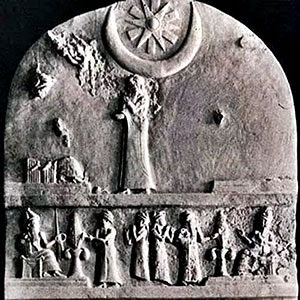 What is Pre-Islam?
Pre-Islam refers to the period in history before the emergence and widespread adoption of Islam. It specifically denotes the time before the Prophet Muhammad's revelations and the establishment of Islamic faith, culture, and civilization.
 What is Kabah?
The Black Stone (al-Hajaru al-Aswad, "Black Stone") is a rock set into the eastern corner of the Kaaba, the ancient building located in the center of the Grand Mosque in Mecca, Saudi Arabia. It is revered by Muslims as an Islamic relic which, according to Muslim tradition, dates back to the time of Adam and Eve. The stone was venerated at the Kaaba in pre-Islamic pagan times. According to Islamic tradition, it was set intact into the Kaaba's wall by the prophet Muhammad in 605 CE, five years before his first revelation. Since then it has been broken into fragments and is now cemented into a silver frame in the side of the Kaaba. Muslim pilgrims circle the Kaaba as a part of the tawaf ritual during the hajj and many try to stop and kiss the Black Stone, emulating the kiss that Islamic tradition records that it received from Muhammad. Muslims do not worship the Black Stone.
 What is Islam?
One of the major religions of the world, Islam literally translates to "submission," as a follower of Islam (Muslims) devotes their life to that of their God. The religion began with the teachings of Muhammad in the 7th century. The theology of Islam is based on the Qur'an, which was given to Muhammad by God. Some of the major fundamental principles of Islam include the Five Pillars, which hope to unite all Muslims into a community. Two different factions of Muslims exist - the majority are known as Sunni, with a small percentage known as Shi'a - both predominantly reside throughout the Middle East. Muhammad died in 632 AD and the religion of Islam formally started after his death. The Quran was formally compiled and finalised in 650 AD, prior to which it was 'memorised' and written across many parchments.
 Who is GOD?
In monotheism and henotheism, God is conceived as the Supreme Being and principal object of faith. The concept of God as described by theologians commonly includes the attributes of omniscience (infinite knowledge), omnipotence (unlimited power), omnipresence (present everywhere), omnibenevolence (perfect goodness), divine simplicity, and eternal and necessary existence. In theism, God is the creator and sustainer of the universe In deism, God is the creator, but not the sustainer, of the universe Monotheism is the belief in the existence of one God or in the oneness of God In pantheism, God is the universe itself In atheism, God is purported not to exist, while deemed unknown or unknowable within the context of agnosticism.