465 views
·
Last viewed: 1 day ago
Uploaded: 20 Jun 2012 (14 years ago) · Shared: 05 Dec 2017
Duration: 8:02
Uploaded: 20 Jun 2012 (14 years ago) · Shared: 05 Dec 2017
Duration: 8:02
Youtube Description
To respond to this video visit www.facebook.com/godnewevidence. Was the story of Jesus rising from the dead borrowed from pagan myths? | 'AfterLife?' the most up to date and convincing evidence for the resurrection of Jesus
This video is part #5 of our series 'After Life? The most up to date and convincing case for the resurrection of Jesus Christ,' featuring Professor William Lane Craig, Professor Gary Habermas, Professor Mike Licona, Amy Orr-Ewing and Professor Tom Wright talking about the evidence that Jesus really did rise from the dead, and what we can know about life after death.
Explore More
Yaqeen Institute Jonathan Brown Omar Suleiman NT Wright Religions Pagan GOD ONS SinSearch Google Search Explore Topics
 Who are Yaqeen Institute? (MEMBER OF YI)
The Yaqeen Institute for Islamic Research is an independent American research institute and think tank founded in 2016, mainly interested in the advanced study of modernity, Islam and Muslim societies. It works to aggregate complex Islamic topics for audiences outside of the field of Islamic academia. Yaqeen Institute was founded by American Islamic scholar Omar Suleiman and is based in Irving, Texas. It has published works have covered a variety of topics at the intersection of Islam, including perennialism, international politics, parenting, and historical preservation of Islamic texts. It works to "pioneer Islamic research in cutting-edge, creative formats."
 Who is Jonathan Brown? (MEMBER OF YI)
Jonathan Andrew Cleveland Brown (born 1977) is an American scholar of Islamic studies. Since 2012, he has been associate professor at Georgetown University's Edmund A. Walsh School of Foreign Service. He holds the Alwaleed bin Talal Chair of Islamic Civilization at Georgetown University. Brown has also published articles in the fields of Hadith, Islamic law, Salafism, Sufism, and Arabic language.
 Who is Omar Suleiman? (MEMBER OF YI)
Omar Suleiman (born 1986) is an American Muslim scholar, civil rights activist and speaker. He is the Founder and President of the Yaqeen Institute for Islamic Research professor of Islamic Studies at Southern Methodist University. Suleiman is also the Resident Scholar of the Valley Ranch Islamic Center and the Co-Chair of Faith Forward Dallas at Thanks-Giving Square.
 Who is NT Wright?
Nicholas Thomas Wright (born 1948) is a leading English New Testament scholar, Pauline theologian, and retired Anglican bishop. In academia, he is published as N.T. Wright, but is also known as Tom Wright. Between 2003 and his retirement in 2010, he was the Bishop of Durham. He then became Research Professor of New Testament and Early Christianity at St Mary's College in the University of St Andrews in Scotland.
 What are Religions?
Religion is a range of social-cultural systems, including designated behaviors and practices, ethics, morals, beliefs, worldviews, texts, sanctified places, prophecies, or organizations, that generally relate humanity to supernatural, transcendental, and spiritual elements. There is no scholarly consensus over what precisely constitutes a religion. It is an essentially contested concept. Different religions may or may not contain various elements ranging from the divine, sacredness, faith, and a supernatural being or beings. The origin of religious belief is an open question, with possible explanations including awareness of individual death, a sense of community, and dreams. Religions have sacred histories, narratives, and mythologies, preserved in oral traditions, sacred texts, symbols, and holy places, that may attempt to explain the origin of life, the universe, and other phenomena. Religious practice may include rituals, sermons, commemoration or veneration (of deities or saints), sacrifices, festivals, feasts, trances, initiations, matrimonial and funerary services, meditation, prayer, music, art, dance, or public service. There are an estimated 10,000 distinct religions worldwide, though nearly all of them have regionally based, relatively small followings. Four religions: Christianity, Islam, Hinduism, and Buddhism account for over 77% of the world's population, and 92% of the world either follows one of those four religions or identifies as non-religious, meaning that the vast majority of remaining religions account for only 8% of the population combined.
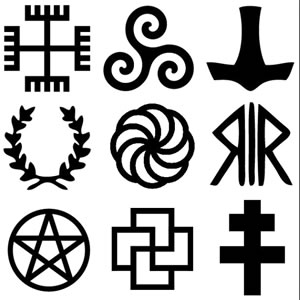 What is Pagan?
Paganism is a term first used in the fourth century by early Christians. It was applied on populations of the Roman Empire who practiced polytheism, either because they were increasingly rural and provincial relative to the Christian population or because they were not milites Christi (soldiers of Christ). Alternate terms in Christian texts for the same group were hellene, gentile, and heathen. Pagan and paganism were pejorative terms for the same polytheistic group, implying its inferiority. Paganism has broadly connoted the "religion of the peasantry", and for much of its history was a derogatory term. Both during and after the Middle Ages, pagan was a pejorative term that was applied to any non-Abrahamic or unfamiliar religion, and the term presumed a belief in false god(s).
Who is GOD?In monotheism and henotheism, God is conceived as the Supreme Being and principal object of faith. The concept of God as described by theologians commonly includes the attributes of omniscience (infinite knowledge), omnipotence (unlimited power), omnipresence (present everywhere), omnibenevolence (perfect goodness), divine simplicity, and eternal and necessary existence. In theism, God is the creator and sustainer of the universe In deism, God is the creator, but not the sustainer, of the universe Monotheism is the belief in the existence of one God or in the oneness of God In pantheism, God is the universe itself In atheism, God is purported not to exist, while deemed unknown or unknowable within the context of agnosticism.
 Who are ONS?
The Office for National Statistics (ONS) is the official national statistical institute of the United Kingdom.
What is Sin?In Abrahamic contexts, sin is the act of violating God's will. Sin can also be viewed as anything that violates the ideal relationship between an individual and God; or as any diversion from the ideal order for human living. To sin has been defined as "to miss the mark". Sins fall in a spectrum from minor errors to deadly misdeeds. Catholicism regards the least corrupt sins as venial sins which are part of human living and carry immediate consequences on earth, and, if unrepented for, more painful purgation, assuming the person is destined to heaven, as it is written in the formation letter "Purgatory", "most of the early Fathers of the Church speak of a cleansing fire, though we cannot tell whether this means actual or spiritual fire." Conversely, sins of great evil are mortal sins which bring the consequence of hell if they are not addressed either through an act of perfect contrition or going to confession about them.