Explore More
Abrahamic Jerusalem Religions USA ABRAHAM
Search Google Search Explore Topics
 What is Abrahamic?
The Abrahamic religions are a set of monotheistic religions that respect or admire the religious figure Abraham as a patriarch, namely Judaism, Christianity, and Islam. The term also often encompasses several smaller faiths. The religions of this set share doctrinal, historical, and geographic overlap that contrasts them with Indian religions, Iranian religions, and East Asian religions. The term, introduced in the 20th century, replaced "Judeo-Christian" to include Islam as an Abrahamic religion and acknowledge differences between Judaism and Christianity. The term Abrahamic religions (and its variations) is a collective religious descriptor for elements shared by Judaism, Christianity, and Islam. It features prominently in interfaith dialogue and civil discourse, as well as academic discourse.
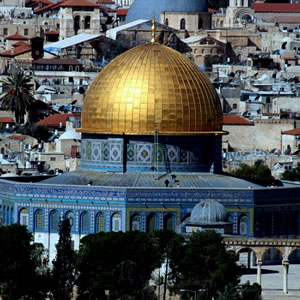 Where is Jerusalem?
Jerusalem is a city in the Middle East. It is located on a plateau in the Judaean Mountains between the Mediterranean and the Dead Sea. It is one of the oldest cities in the world, and is considered holy to the three major Abrahamic religions: Judaism, Christianity, and Islam. Both Israel and the Palestinian Authority claim Jerusalem as their capital, as Israel maintains its primary governmental institutions there and the State of Palestine ultimately foresees it as its seat of power; however, neither claim is widely recognized internationally.
What are Religions?Religion is a range of social-cultural systems, including designated behaviors and practices, ethics, morals, beliefs, worldviews, texts, sanctified places, prophecies, or organizations, that generally relate humanity to supernatural, transcendental, and spiritual elements. There is no scholarly consensus over what precisely constitutes a religion. It is an essentially contested concept. Different religions may or may not contain various elements ranging from the divine, sacredness, faith, and a supernatural being or beings. The origin of religious belief is an open question, with possible explanations including awareness of individual death, a sense of community, and dreams. Religions have sacred histories, narratives, and mythologies, preserved in oral traditions, sacred texts, symbols, and holy places, that may attempt to explain the origin of life, the universe, and other phenomena. Religious practice may include rituals, sermons, commemoration or veneration (of deities or saints), sacrifices, festivals, feasts, trances, initiations, matrimonial and funerary services, meditation, prayer, music, art, dance, or public service. There are an estimated 10,000 distinct religions worldwide, though nearly all of them have regionally based, relatively small followings. Four religions: Christianity, Islam, Hinduism, and Buddhism account for over 77% of the world's population, and 92% of the world either follows one of those four religions or identifies as non-religious, meaning that the vast majority of remaining religions account for only 8% of the population combined.
 What is USA?
The United States of America (USA), commonly known as the United States or America. It is a country comprising 50 states, a federal district, five major self-governing territories, and various possessions. At 3.8 million square miles (9.8 million km2), the United States is the world's third or fourth largest country by total area and is slightly smaller than the entire continent of Europe's 3.9 million square miles (10.1 million km2). With a population of over 327 million people, the US is the third most populous country.