EGO EIMI
The use of this phrase in some of the uses found in the Gospel of John is given theological significance by many Christians. When used as a copula, with a predicate, "I am X", then usage is equivalent to English. When used alone, without a predicate, "I am", "he is", "they are", typically mean "I exist" etc.
FAQ on Ego Eimi (10)
1.What does the Greek phrase Ego Eimi mean in the Bible?
The Greek phrase 'Ego Eimi' (??? ????) literally translates to 'I am' or 'I exist.' While it is grammatically a common first-person singular present-tense copula used in everyday conversation, it carries profound theological significance in the Gospel of John, where Jesus uses it to claim a unique divine identity and pre-existence.
2.How many I AM statements are in the Gospel of John?
There are exactly seven famous metaphorical 'I AM' statements where Jesus uses a predicate (e.g., Bread of Life, Light of the World, Gate, Good Shepherd, Resurrection and the Life, Way/Truth/Life, and True Vine). However, there are also several 'absolute' or unpredicated uses (such as John 8:58) where 'Ego Eimi' stands alone, totaling over 20 deliberate uses.
3.Did Jesus claim to be God when He said Before Abraham was I AM?
In Trinitarian Christian theology, yes. In John 8:58, Jesus uses 'Ego Eimi' in a timeless present tense contrasted with Abraham's beginning in time ('was born'). By claiming eternal pre-existence, He deliberately invoked the character of the divine name, which is why the Jewish religious leaders immediately picked up stones to execute Him for blasphemy.
4.What is the connection between Ego Eimi and Exodus 3:14?
In Exodus 3:14, God reveals His divine name to Moses as 'I AM WHO I AM' (Hebrew: Ehyeh Asher Ehyeh). In the Greek Old Testament (Septuagint), this is rendered as 'Ego eimi ho on' ('I am the Being'). Scholars note that Jesus' absolute uses of 'Ego Eimi' echo both Exodus 3:14 and the self-declarations of Yahweh found throughout the book of Isaiah.
5.Why did the soldiers fall backward when Jesus said Ego Eimi in John 18?
In John 18:5-6, when the soldiers and temple guards come to arrest Jesus and state they are looking for Jesus of Nazareth, He responds with 'Ego Eimi' ('I am He'). The text notes they instantly drew back and fell to the ground. This physical reaction represents a supernatural manifestation of divine power and majesty tied to the utterance of the divine name.
6.What are the seven metaphorical I AM / Ego Eimi statements of Jesus?
The seven metaphorical statements are: 1) 'I am the bread of life' (John 6:35); 2) 'I am the light of the world' (John 8:12); 3) 'I am the door/gate' (John 10:7); 4) 'I am the good shepherd' (John 10:11); 5) 'I am the resurrection and the life' (John 11:25); 6) 'I am the way, the truth, and the life' (John 14:6); and 7) 'I am the true vine' (John 15:1).
7.What is an absolute or unpredicated I AM statement?
An absolute 'I AM' statement occurs when Jesus says 'Ego Eimi' without adding a metaphor or predicate noun following it (such as 'he' or 'the bread'). Examples include John 4:26 (to the Samaritan woman), John 8:24, John 8:28, and John 8:58. In these instances, the phrase shifts from simple identification to an explicit assertion of absolute, timeless deity.
8.Why did the blind man in John 9:9 say Ego Eimi without claiming to be God?
In John 9:9, the healed blind man says 'Ego eimi' to mean 'I am the one' or 'It's me' when neighbors debate his identity. This demonstrates that 'Ego Eimi' is ordinary Greek for self-identification. The key difference is context: the blind man used it casually to identify his physical person, whereas Jesus used it in timeless, unpredicated, and pre-existent contexts.
9.How do Unitarians and Jehovah's Witnesses translate John 8:58?
Non-Trinitarian groups often translate 'Ego Eimi' in John 8:58 as a progressive perfect tense rather than a present tense, rendering it as 'I have been' (e.g., 'before Abraham came into existence, I have been'). They argue that Jesus was asserting his literal or conceptual pre-existence as God's first creation (the Messiah), rather than claiming to be Yahweh Himself.
10.How does Isaiah influence the meaning of Ego Eimi in John?
In the Septuagint translation of Isaiah (e.g., Isaiah 41:4, 43:10, and 45:18), God repeatedly declares 'Ego Eimi' to assert that He alone is Yahweh and there is no other Savior. New Testament scholars recognize that John's Jesus adopts this precise phrasing from Isaiah to show that the long-awaited salvation and physical embodiment of Yahweh is now present in Christ.
 In Exodus 3:14, John 6:20, John 8:24, John 8:58, Mark 6:50, Mark 13:6, Luke 21:8, Matthew 14:27 and Acts 26:29 Jesus claims I AM (
 In John 8:58 and Exodus 3:14, Jesus invokes the divine name I AM (
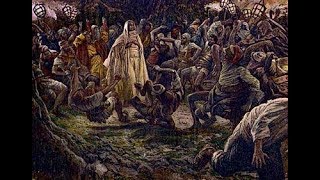 In John 18:6, Jesus said I AM (