What is Aramaic?

ARAMAIC 

Aramaic was the language of Jesus, who spoke the Galilean dialect during his public ministry, as well as the language of large sections of the biblical books of Daniel and Ezra, and also one of the languages of the Talmud.

Aramaic is a language or group of languages belonging to the Semitic subfamily of the Afroasiatic language family. More specifically, it is part of the Northwest Semitic group, which also includes the Canaanite languages such as Hebrew and Phoenician. The Aramaic alphabet was widely adopted for other languages and is ancestral to the Hebrew, Syriac and Arabic alphabets. During its approximately 3,100 years of written history, Aramaic has served variously as a language of administration of empires and as a language of divine worship, religious study and as the spoken tongue of a number of Semitic peoples from the Near East.

Youtube Videos on Aramaic (14)
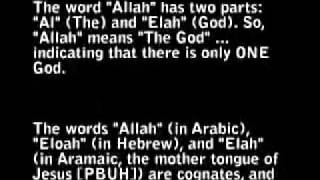
Video: In Aramaic, Jesus called to Allah In Aramaic, Jesus called to Allah   1:18
491 views
Video: Matthew was originally in Aramaic. Anonymous scribes translated to Greek - Mike Licona Matthew was originally in Aramaic. Anonymous scribes translated to Greek - Mike Licona   1:38
304 views
Video: Jesus Jesus' disciples were Aramaic speaking, lower class, uneducated labourers. Gospels were written by highly educated, Greeks 50 years after Jesus - Bart Ehrman   1:16
1,130 views
Video: Paul spoke Greek. How did he communicate with Jesus Paul spoke Greek. How did he communicate with Jesus' Aramaic speaking disciples? - Bart Ehrman   0:46
705 views
Video: Jesus, an Aramaic speaking Palestinian. New Testament originally in Greek, language of Rome - Bart Ehrman Jesus, an Aramaic speaking Palestinian. New Testament originally in Greek, language of Rome - Bart Ehrman   2:21
1,361 views
Video: Jesus spoke Aramaic. Mark spoke Aramaic. Why is Mark Jesus spoke Aramaic. Mark spoke Aramaic. Why is Mark's Gospel write in Koine Greek? - Frank Turek   11:36
922 views
Video: Does the Quran have Syriac or Aramaic Origins? - Hamza Tzortzis Does the Quran have Syriac or Aramaic Origins? - Hamza Tzortzis   15:28
1,013 views
Video: Original Quran was written in Syriac, Kufic, Aramaic or Classical Arabic? - Imran London vs Gary Original Quran was written in Syriac, Kufic, Aramaic or Classical Arabic? - Imran London vs Gary   55:11
1,058 views
Video: Jesus spoke Aramaic. Not Greek or Latin - Bart Ehrman Jesus spoke Aramaic. Not Greek or Latin - Bart Ehrman   3:23
535 views
Video: Jesus, a religious Jew spoke Aramaic. Not the Jesus, a religious Jew spoke Aramaic. Not the 'hated' Hellenistic Gentile language of Greek   8:13
231 views
Video: 1st century religious Jews spoke Aramaic, not the 1st century religious Jews spoke Aramaic, not the 'foreign' Hellenized language of Greek   15:49
284 views
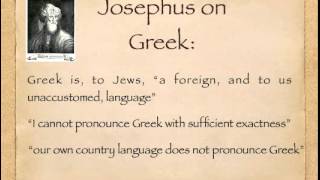
Video: Josephus (37-100 AD): Aramaic was language of Jews in Roman Judea Josephus (37-100 AD): Aramaic was language of Jews in Roman Judea   20:28
603 views
Video: Jesus prayed to Al (The) + Elaha (God/Elohim) in the Aramaic language - Adnan Rashid vs Christian Jesus prayed to Al (The) + Elaha (God/Elohim) in the Aramaic language - Adnan Rashid vs Christian   32:11
820 views
Video: Does Quran acknowledge the Semitic languages: Arabic, Hebrew, Aramaic and Akkadian? | Exploring Quran Bible Does Quran acknowledge the Semitic languages: Arabic, Hebrew, Aramaic and Akkadian? | Exploring Quran Bible   17:41
206 views

FAQ on Aramaic (8)

1.Who is Allah?

Allah is the official Arabic word used to signify God. The title is entirely unique because it has no plural or gendered forms, unlike standard words like gods or goddesses. It simply translates to 'The One and Only True God'. Linguistic origins show variants like 'Elah' or 'Eloh' in the Hebrew Torah, as well as in the original Aramaic language spoken by Jesus.

2.Where did the name Allah come from?

The word Allah is the standard Arabic word for God used in all Arabic Bible translations, and its roots are identical to the Aramaic word 'Eloi' used by Jesus on the cross.

It was used in some English translations of the Bible like the original 'Scofield Reference Bible'

In the New Testament, Jesus is believed to cry before his death 'ELOI, ELOI, LAMA SABACHTHANI', Eloi is the exact Arabic word 'Elahi' which comes from the same root as Allah.

3.Is Jesus the English name for Yeshua?

Yes, 'Jesus' is the modern English translation of the historical Hebrew and Aramaic name Yeshua. It evolved phonetically over centuries as it passed from the original Aramaic into Greek as Iesous, then into Latin as Iesus, before eventually taking its current English form.

4.How did the prophets Moses, Jesus, Abraham etc. call out to God?

Historical and linguistic evidence shows that these prophets spoke ancient Semitic languages, meaning they addressed God using linguistic cognates tightly linked to the Arabic word Allah. Abraham and Moses historically used the Hebrew names El or Elohim, while Jesus addressed God in Aramaic using Elah or Alaha, all of which share identical ancient roots across the Semitic language family tree.

5.What language did Jesus speak?

Jesus and his closest disciples natively spoke Aramaic, a Northwest Semitic tongue that served as the common everyday language of first-century Judea and Galilee.

6.What language is the earliest New Testament in?

The earliest New Testament manuscripts are in Koine Greek. But there are Aramaic phrases in the Gospels. Therefore, Scholars believe an Aramaic layer lies beneath the written Greek of the New Testament, one which may never have been written down.

If true, the Greek text is itself a translation, and English text would be a translation of a translation, which raises textual inerrancy and corruption issue.

Since every translation is a personal judgement of which word to best use, made at the translators discretion.

7.What nation or people descended from Aram?

Aram is traditional considered the progenitor of the Arameans, an ancient Semitic group that inhabited regions of modern-day Syria and upper Mesopotamia. The region of Syria is often referred to as 'Aram' in the Hebrew Scriptures, and his descendants gave rise to the Aramaic language, the historical language spoken by Jesus.

8.How is Shem connected to the origin and meaning of the term 'Semitic'?

The term 'Semitic' used to describe a major family of Middle Eastern languages (including Arabic, Hebrew, Aramaic, and Amharic) and ethnic groups originates directly from the name Shem (Sem). As the patriarchal ancestor of these nations, his lineage is central to Middle Eastern history.

Articles on Aramaic (1)

Jesus Prayed to 'Allah': Evidence from Aramaic
31,257 views

About  |  Q&A  |  Contact Us    •    Terms  |  Privacy  |  Disclaimer  |  Sitemap
Connect:      Facebook  |    Twitter  |    Youtube
MuslimProphets.com is an educational website on the Prophets of God: David, Noah, Abraham, Moses, Jesus and Muhammad, who established the Abrahamic faiths of Judaism, Christianity and Islam.

MuslimProphets.com explores contemporary social themes through Scripture, Evidences, Photo, Video, Maps, Current Affairs, Debate and 'alternative' Views held by Theologians, Apologists, Scholars and Street Preachers.

In accordance with Islamic etiquette, all prophet names should be followed with 'Peace Be Upon Him (PBUH)'. This is omitted to minimise text.

DISCLAIMER
The historical information provided on this website is for educational and informational purposes only.
History is an ongoing interpretation of past events. Historical accounts are shaped by the perspectives, biases, and cultural influences of their time; therefore, no content on this website should be taken as absolute, 100% factual truth. We encourage readers to approach historical narratives with a critical mind.

All website content is available in the public domain. While all information is gathered from sources believed to be reliable, its absolute accuracy cannot be guaranteed.

EXTERNAL LINKS & SEO
External links are provided as a convenience and for informational purposes only. They do not constitute an endorsement or approval of any products, services, or opinions of any organization or individual. Title and text links may be edited for external SEO, internal site structure, and keyword search purposes. We bear no responsibility for the accuracy, legality, or content found on any external website or its subsequent links.

MEDIA & SOURCE ATTRIBUTIONS
Unless otherwise indicated, all images and content are licensed under a Creative Commons Attribution License distributed by Wikipedia, Wikimedia Commons, Pixabay, Unsplash, and similar platforms. While every effort is made to accurately source all media, contact us if you believe your copyright has been infringed so we can address and resolve the matter promptly.

All videos are hosted on and viewable via YouTube servers. Video titles are generated based on the original video title, the overall content theme (including actual dialogue and transcripts), and AI-based recommendations optimized for SEO, keyword density, and internal search functions. Video titles do not represent the views held by the YouTube video uploader, or any associated individual, organisation, or business.

All Torah, Psalms, and Old/New Testament Bible quotes are from the King James Version (KJV) Holy Bible, which is in the public domain.
All Quran quotes are from the Taqi-ud-Din al-Hilali / Muhsin Khan English Quran translation.

CORRECTIONS
If you spot a mistake, error, or omission of information, please contact us so we can review and correct it.