ARAMAIC
Aramaic is a language or group of languages belonging to the Semitic subfamily of the Afroasiatic language family. More specifically, it is part of the Northwest Semitic group, which also includes the Canaanite languages such as Hebrew and Phoenician. The Aramaic alphabet was widely adopted for other languages and is ancestral to the Hebrew, Syriac and Arabic alphabets. During its approximately 3,100 years of written history, Aramaic has served variously as a language of administration of empires and as a language of divine worship, religious study and as the spoken tongue of a number of Semitic peoples from the Near East.
Youtube Videos on Aramaic (14)
 In
 Matthew was originally in
 Jesus' disciples were
 Paul spoke Greek. How did he communicate with Jesus'
 Jesus, an
 Jesus spoke
 Does the Quran have Syriac or
 Original Quran was written in Syriac, Kufic,
 Jesus spoke
 Jesus, a religious Jew spoke
 1st century religious Jews spoke
 Josephus (37-100 AD):
 Jesus prayed to Al (The) + Elaha (God/Elohim) in the
 Does Quran acknowledge the Semitic languages: Arabic, Hebrew,
FAQ on Aramaic (8)
1.Who is Allah?
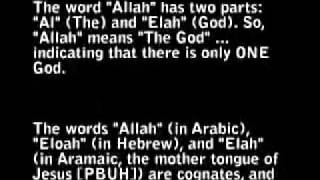
Allah is the official Arabic word used to signify God. The title is entirely unique because it has no plural or gendered forms, unlike standard words like gods or goddesses. It simply translates to 'The One and Only True God'. Linguistic origins show variants like 'Elah' or 'Eloh' in the Hebrew Torah, as well as in the original Aramaic language spoken by Jesus.
2.Where did the name Allah come from?
The word Allah is the standard Arabic word for God used in all Arabic Bible translations, and its roots are identical to the Aramaic word 'Eloi' used by Jesus on the cross.
It was used in some English translations of the Bible like the original 'Scofield Reference Bible'
In the New Testament, Jesus is believed to cry before his death 'ELOI, ELOI, LAMA SABACHTHANI', Eloi is the exact Arabic word 'Elahi' which comes from the same root as Allah.
3.Is Jesus the English name for Yeshua?
Yes, 'Jesus' is the modern English translation of the historical Hebrew and Aramaic name Yeshua. It evolved phonetically over centuries as it passed from the original Aramaic into Greek as Iesous, then into Latin as Iesus, before eventually taking its current English form.
4.How did the prophets Moses, Jesus, Abraham etc. call out to God?
Historical and linguistic evidence shows that these prophets spoke ancient Semitic languages, meaning they addressed God using linguistic cognates tightly linked to the Arabic word Allah. Abraham and Moses historically used the Hebrew names El or Elohim, while Jesus addressed God in Aramaic using Elah or Alaha, all of which share identical ancient roots across the Semitic language family tree.
5.What language did Jesus speak?
Jesus and his closest disciples natively spoke Aramaic, a Northwest Semitic tongue that served as the common everyday language of first-century Judea and Galilee.
6.What language is the earliest New Testament in?
The earliest New Testament manuscripts are in Koine Greek. But there are Aramaic phrases in the Gospels. Therefore, Scholars believe an Aramaic layer lies beneath the written Greek of the New Testament, one which may never have been written down.
If true, the Greek text is itself a translation, and English text would be a translation of a translation, which raises textual inerrancy and corruption issue.
Since every translation is a personal judgement of which word to best use, made at the translators discretion.
7.What nation or people descended from Aram?
Aram is traditional considered the progenitor of the Arameans, an ancient Semitic group that inhabited regions of modern-day Syria and upper Mesopotamia. The region of Syria is often referred to as 'Aram' in the Hebrew Scriptures, and his descendants gave rise to the Aramaic language, the historical language spoken by Jesus.
8.How is Shem connected to the origin and meaning of the term 'Semitic'?
The term 'Semitic' used to describe a major family of Middle Eastern languages (including Arabic, Hebrew, Aramaic, and Amharic) and ethnic groups originates directly from the name Shem (Sem). As the patriarchal ancestor of these nations, his lineage is central to Middle Eastern history.
Articles on Aramaic (1)
Jesus Prayed to 'Allah': Evidence from Aramaic

31,264 views
|