Live Screenshot
Source link:
https://www.pewresearch.org/fact-tank/2015/12/21/where-christian-churches-stand-on-gay-marriage/Published by: PEW RESEARCH on 21 Dec 2015
1736 views · Last view: 11 hrs ago
 LOT
News Text (from PEW RESEARCH)
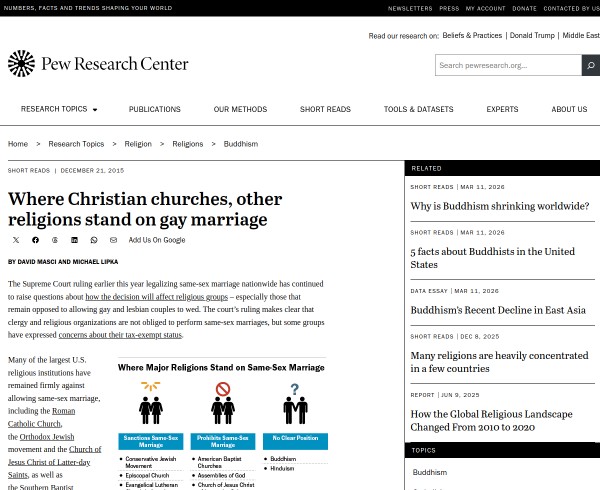
| The Supreme Court ruling earlier this year legalizing same-sex marriage nationwide has continued to raise questions about how the decision will affect religious groups – especially those that remain opposed to allowing gay and lesbian couples to wed. The court’s ruling makes clear that clergy andreligious organizations are not obliged to perform same-sex marriages, but some groups have expressed concerns about their tax-exempt status.
Many of the largest U.S. religious institutions have remained firmly against allowing same-sex marriage, including the Roman Catholic Church, the Orthodox Jewish movement and the Church of Jesus Christ of Latter-day Saints, as well as the Southern Baptist Convention and other evangelical Protestant denominations. The nation’s largest historically black church, the National Baptist Convention, and its biggest Pentecostal denomination, the Assemblies of God, also prohibit their clergy from marrying same-sex couples.
At the same time, in [...]
Explore More
TOPIC Pew Research Homosexual Religions Lesbian Church LGBT Gay
LOT
Search Google Search Explore Topics
 Who are Pew Research?
The Pew Research Center is a nonpartisan, nonadvocacy American think tank and "fact tank" based in Washington, D.C. It informs the public by conducting empirical social science research, public
opinion polling, and demographic analysis.
 What is Homosexual?
Homosexuality is romantic attraction, sexual attraction or sexual behavior between members of the same gender. As a sexual orientation, homosexuality is "an enduring pattern of emotional, romantic
and/or sexual attractions" to people of the same sex. It also refers to a person's sense of identity based on those attractions, related behaviors, and membership in a community of others who share those attractions.
What are Religions?Religion is a range of social-cultural systems, including designated behaviors and practices, ethics, morals, beliefs, worldviews, texts, sanctified places, prophecies, or organizations, that
generally relate humanity to supernatural, transcendental, and spiritual elements. There is no scholarly consensus over what precisely constitutes a religion. It is an essentially contested concept. Different religions may or may not contain various elements ranging from the divine, sacredness, faith, and a supernatural being or beings.
The origin of religious belief is an open question, with possible explanations including awareness of individual death, a sense of community, and dreams. Religions have sacred histories, narratives, and mythologies, preserved in oral traditions, sacred texts, symbols, and holy places, that may attempt to explain the origin of life, the universe, and other phenomena. Religious practice may include rituals, sermons, commemoration or veneration (of deities or saints), sacrifices, festivals, feasts, trances, initiations, matrimonial and funerary services, meditation, prayer, music, art, dance, or public service.
<br><br>
There are an estimated 10,000 distinct religions worldwide, though nearly all of them have regionally based, relatively small followings. Four religions: Christianity, Islam, Hinduism, and Buddhism account for over 77% of the world's population, and 92% of the world either follows one of those four religions or identifies as non-religious, meaning that the vast majority of remaining religions account for only 8% of the population combined.
What is Lesbian?Homosexuality is romantic attraction, sexual attraction or sexual behavior between members of the same gender. As a sexual orientation, homosexuality is "an enduring pattern of emotional, romantic
and/or sexual attractions" to people of the same sex. It also refers to a person's sense of identity based on those attractions, related behaviors, and membership in a community of others who share those attractions.
 What is the Church?
A church is a building used for Christian worship services and Christian activities. The earliest identified Christian church is a house church founded between 233 AD and 256 AD. The word church also
describes a body or assembly of Christian believers, while "the Church" refers to the worldwide Christian religious community.
What is LGBT?Homosexuality is romantic attraction, sexual attraction or sexual behavior between members of the same gender. As a sexual orientation, homosexuality is "an enduring pattern of emotional, romantic
and/or sexual attractions" to people of the same sex. It also refers to a person's sense of identity based on those attractions, related behaviors, and membership in a community of others who share those attractions.
What is Gay?Homosexuality is romantic attraction, sexual attraction or sexual behavior between members of the same gender. As a sexual orientation, homosexuality is "an enduring pattern of emotional, romantic
and/or sexual attractions" to people of the same sex. It also refers to a person's sense of identity based on those attractions, related behaviors, and membership in a community of others who share those attractions.


 3:31
552 views · 16 secs ago
 37:27
 29:26
881 views · 2 mins ago
 11:15
583 views · 2 mins ago

 5:42

 18:13
186 views · 4 mins ago
 58:04
637 views · 4 mins ago