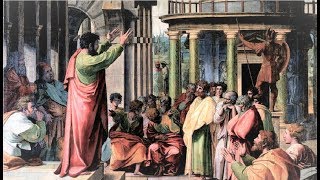
At Lystra a certain man sat, impotent in his feet, a cripple from his mother’s womb, who never had walked.
He was listening to Paul speaking, who, fastening eyes on him, and seeing that he had faith to be made whole,
said with a loud voice, “Stand upright on your feet!” He leaped up and walked.
When the multitude saw what Paul had done, they lifted up their voice, saying in the language of Lycaonia, “The gods have come down to us in the likeness of men!”
They called Barnabas “Jupiter”, and Paul “Mercury”, because he was the chief speaker.
The priest of Jupiter, whose temple was in front of their city, brought oxen and garlands to the gates, and would have made a sacrifice along with the multitudes.
But when the apostles, Barnabas and Paul, heard of it, they tore their clothes, and sprang into the multitude, crying out,
“Men, why are you doing these things? We also are men of like passions with you, and bring you good news, that you should turn from these vain things to the living God, who made the sky, the earth, the sea, and all that is in them;
who in the generations gone by allowed all the nations to walk in their own ways.
Yet he didn’t leave himself without witness, in that he did good and gave you rains from the sky and fruitful seasons, filling our hearts with food and gladness.”
Even saying these things, they hardly stopped the multitudes from making a sacrifice to them.
But some Jews from Antioch and Iconium came there, and having persuaded the multitudes, they stoned Paul, and dragged him out of the city, supposing that he was dead.
But as the disciples stood around him, he rose up, and entered into the city. On the next day he went out with Barnabas to Derbe.
ACTS 14:8-20
Apostle Paul and Barnabas are mistaken for pagan gods in Lystra
Trace the chaotic missionary frontier as the local population mistakes the Apostle Paul and Barnabas for pagan gods after a miracle. 701 views · Last view: 1 day ago
Trace the chaotic missionary frontier as the local population mistakes the Apostle Paul and Barnabas for pagan gods after a miracle. 701 views · Last view: 1 day ago
Explore More
Apostle Paul Pagan GODSearch Google Search Explore Topics
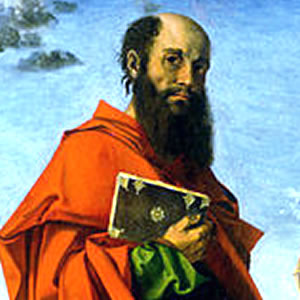 Who was Apostle Paul?
Paul the Apostle (Latin: Paulus), commonly known as Saint Paul and also known by his Jewish name Saul of Tarsus was an apostle (though not one of the Twelve Apostles) who taught the gospel of Christ to the first century world. Paul is generally considered one of the most important figures of the Apostolic Age and in the mid-30s to the mid-50s AD he founded several churches in Asia Minor and Europe. He took advantage of his status as both a Jew and a Roman citizen to minister to both Jewish and Roman audiences. According to writings in the New Testament and prior to his conversion, Paul was dedicated to persecuting the early disciples of Jesus in the area of Jerusalem. In Acts, Paul was traveling on the road from Jerusalem to Damascus on a mission to 'arrest them and bring them back to Jerusalem' when the resurrected Jesus appeared to him in a great light. He was struck blind, but after three days his sight was restored by Ananias of Damascus and Paul began to preach that Jesus of Nazareth is the Jewish Messiah and the Son of God.
 What is Pagan?
Paganism is a term first used in the fourth century by early Christians. It was applied on populations of the Roman Empire who practiced polytheism, either because they were increasingly rural and provincial relative to the Christian population or because they were not milites Christi (soldiers of Christ). Alternate terms in Christian texts for the same group were hellene, gentile, and heathen. Pagan and paganism were pejorative terms for the same polytheistic group, implying its inferiority. Paganism has broadly connoted the "religion of the peasantry", and for much of its history was a derogatory term. Both during and after the Middle Ages, pagan was a pejorative term that was applied to any non-Abrahamic or unfamiliar religion, and the term presumed a belief in false god(s).
 Who is GOD?
In monotheism and henotheism, God is conceived as the Supreme Being and principal object of faith. The concept of God as described by theologians commonly includes the attributes of omniscience (infinite knowledge), omnipotence (unlimited power), omnipresence (present everywhere), omnibenevolence (perfect goodness), divine simplicity, and eternal and necessary existence. In theism, God is the creator and sustainer of the universe In deism, God is the creator, but not the sustainer, of the universe Monotheism is the belief in the existence of one God or in the oneness of God In pantheism, God is the universe itself In atheism, God is purported not to exist, while deemed unknown or unknowable within the context of agnosticism.