HARE KRISHNA
The mantra is either spoken or meditated to bring a higher level of consciousness. His Divine Grace A. C. Bhaktivedanta Swami Prabhupada, an Indian monk, would begin learning the philosophy in the early-mid 20th century. He would arrive in America in the 1960s to spread the word of his teachings, which inadvertently led to the Hare Krishna movement.
Search Result on 'Hare Krishna' (12 total)
FAQ on Hare Krishna (10)
1.What is the Hare Krishna religion?
The Hare Krishna movement officially named the International Society for Krishna Consciousness (ISKCON) is a monotheistic branch of Hinduism. It belongs to the Gaudiya Vaishnavism tradition, which originated in India during the 16th century. Followers focus their devotion entirely on the Supreme Lord Krishna, and actively promote spiritual consciousness through the chanting of sacred mantras, study of scripture and congregational community living.
2.Who founded the Hare Krishna movement?
The global Hare Krishna movement was founded in New York City in 1966 by A.C. Bhaktivedanta Swami Prabhupada (reverently called Srila Prabhupada). At the age of 69, Prabhupada travelled from India to the United States under the instructions of his spiritual master to introduce the ancient teachings of Bhakti Yoga to the Western world, quickly expanding the movement into a globally recognized spiritual organization.
3.What do Hare Krishna followers believe?
The core beliefs of Hare Krishna are rooted in the ancient Vedic scriptures of India, most notably the Bhagavad-gita. They believe that every living being is an eternal, spiritual soul (atman) rather than a physical body. The ultimate goal of life is to reawaken a dormant love for God (Krishna). Adherents live by the laws of karma and reincarnation, teaching that the soul continuously cycles through births until achieving absolute spiritual liberation.
4.What is the meaning of the Hare Krishna mantra?
The Hare Krishna mantra also known as the Maha Mantra (Great Mantra) is a 16-word prayer composed of three Sanskrit names for the Supreme Lord: Hare, Krishna, and Rama.
The mantra reads:
'Hare Krishna, Hare Krishna, Krishna Krishna, Hare Hare / Hare Rama, Hare Rama, Rama Rama, Hare Hare'
Followers chant this mantra continuously as a sound vibration to cleanse the mind, dissolve negative karma, and directly connect the soul with divine energy.
5.Why do Hare Krishna monks shave their heads?
Shaving the head a practice known as tonsure is a traditional Vedic symbol of renunciation, humility, and detachment from material vanity. Male monks (brahmacharis) leave a small tuft of hair at the back of the head called a sikha, which signifies their specific dedication to Krishna as their spiritual center. Married or lay practitioners living outside temples are not required to shave their heads.
6.What are the four regulative principles of ISKCON Hare Krishna?
To cultivate spiritual purity and advance in Bhakti yoga, all initiated Hare Krishna followers strictly follow four regulative principles:
1. Vegetarianism: Abstaining from eating meat, fish, or eggs to practice non-violence (ahimsa).
2. No Intoxication: Completely avoiding alcohol, drugs, tobacco, and caffeine (including coffee and tea).
3. No Gambling: Rejecting all forms of gambling, which is believed to cloud moral judgment.
4. No Illicit Sex: Restricting sexual activity exclusively to marriage for the purpose of procreation.
7.What is the difference between Hare Krishna and mainstream Hinduism?
Hare Krishna is not a separate religion from Hinduism; rather, it is a highly focused monotheistic tradition within Hinduism. While mainstream Hinduism often encompasses a vast pantheon of various gods and paths, Gaudiya Vaishnavism teaches that Krishna is the Supreme Personality of Godhead, and that all other deities are his expansions or demigods. It places an exclusive emphasis on Bhakti (loving devotion) over intellectual philosophy or ascetic rituals.
8.What kind of food do Hare Krishna adherents eat?
Hare Krishnas eat a strictly lacto-vegetarian diet consisting of grains, vegetables, fruits, and dairy products. Crucially, their food is prepared as a spiritual offering to God and is called Prasadam (meaning 'mercy'). Furthermore, they explicitly avoid cooking with onions and garlic, as Vedic dietary laws state that these roots disturb the mind and stimulate baseline passions, hindering deep meditation.
9.What happens during a Hare Krishna temple service?
Daily temple services center on Arati (deity worship rituals) and vibrant congregational chanting called Kirtan, where devotees dance and sing the Maha Mantra accompanied by traditional instruments like the mridanga drum and kartals (cymbals). Sunday is universally celebrated across all ISKCON centers as the Sunday Feast, featuring a public philosophical lecture on the Bhagavad-Gita followed by a free, multi-course vegetarian feast.
10.Is the Hare Krishna movement considered a cult?
While the movement faced intense cultural skepticism and anti-cult labels during its rapid expansion in the 1970s, sociologists and religious scholars today classify ISKCON as an authentic, orthodox branch of ancient Hinduism. The organization operates transparently with thousands of temples globally, values family life, actively engages in worldwide humanitarian food relief (such as Food For Life), and is legally recognized as a mainstream religious charity in multiple nations.
Youtube Videos on Hare Krishna (1)
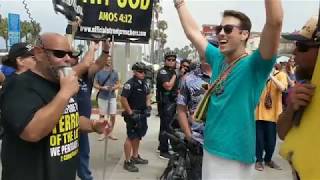 It's Hurry Jesus. Not Hare Krishna, the idol God - Ruben Israel vs Hindu Parade
20:23 612 views
|