The Christian Trinity doctrine evolved over many years due to the verdicts at various councils.
"Now we say, that if all of history were silent, if no record had come down to us respecting the faith of the first centuries, these creeds themselves would furnish incontrovertible evidence that the doctrine of the Trinity did not exist prior to the middle of the 4th century, and that it was a corruption, gradually introduced, of the true original doctrine."
Cheneviere, M. (1832). Essais Theologiques-- Du Systeme Theologique de la Trinite. In Francis Jenks, James Walker, Francis William et al. (eds), The Christian Examiner and General Review, Volume 12. Boston: Gray and Bowen. p.42
Cheneviere, M. (1832). Essais Theologiques-- Du Systeme Theologique de la Trinite. In Francis Jenks, James Walker, Francis William et al. (eds), The Christian Examiner and General Review, Volume 12. Boston: Gray and Bowen. p.42
"No responsible New Testament scholar would claim that the doctrine of the Trinity was taught by Jesus or preached by the earliest Christians, or consciously held by any writer in the New Testament. It was in fact slowly worked out in the course of the first few centuries in an attempt to give an intelligent doctrine of God."
Anthony T. Hanson, Professor of Theology, University of Hull, England
The Image of the Invisible God, SCM Press, London (1982) p.87
Anthony T. Hanson, Professor of Theology, University of Hull, England
The Image of the Invisible God, SCM Press, London (1982) p.87
"While it is necessary to make distinctions in the Godhead, these are of various kinds and do not lend themselves to a neat Trinitarian pattern. Different problems and distinctions are involved. Their terms cannot be treated as identical and summed up under the symbols of Father, Son and Spirit."
Cyril C. Richardson, The Doctrine of the Trinity, Abington Press, Nashville TN (1958) p.13
Cyril C. Richardson, The Doctrine of the Trinity, Abington Press, Nashville TN (1958) p.13
In addition to the official council-sanctioned Creeds, the actual concept of Trinity was disputed by many early Jewish-Christians. The table below detail the various Trinitarian positions held.
1. TRINITY : Jesus is the FatherJesus Christ is the same personage as God. He is the Father manifest in the flesh. There are not three persons; there is only one God.Also known as:
Supported by:
|
2. TRINITY : Jesus, manifestation of GodJesus Christ is but one of several modes, or manifestations of the one true God.Also known as:
Supported by:
|
3. TRINITY : Jesus, attribute of GodJesus Christ is but one of several attributes or appropriation, such as power, love, wisdom etc. of a single God.Supported by:
|
4. TRINITY : Jesus, part of GodJesus Christ is the same thing as the Father, but distinguishable, even as the root is the same as, but distinguishable from the tree, and the sun from its rays. The Father is the "whole", while Jesus Christ is the part.Supported by:
|
5. TRINITY : Jesus, a ProphetJesus Christ is not God except in an 'honorific sense' through the Father's grace, but is subordinate to the Father. He is made of a 'similar' or 'same type of' substance (Homoiousios) as the Father. And, because Jesus was created by the Father, only the Father is eternal.Jesus is even considered by some to be a great man, prophet, religious leader, teacher, angel sent from God, or a Messiah. Also known as:
Supported by:
Islam is in agreement with Arianism. Muslims believe Jesus, was a great Prophet sent by the Father. He was a Man gifted with many miracles, who successfully delivered the message of Monotheism to his disciples.
|
6. TRINITY : Trinity (Athanasius)Jesus Christ is 'begotten' and not created, and is therefore, eternal, and of the same substance (Homoousios) as the Father. But, God is also comprised of three substances (Hypostasis).Also known as:
Supported by:
|
7. TRINITY : Three Substances, One PersonThe Son, the Father and the Holy Spirit are three individual substances (Hypostasis) that are of one substance (Ousis) analogous to three people (Hypostasis), who are all human (Ousis).Jesus Christ is 'the Son' (Hypostasis), and 'God' (Ousis). However, since the three Hypostasis are the only form that the Ousis has, or ever will take, the 'Threeness' cannot be separated from the 'Oneness'. The emphasis is on the 'Threeness' over the 'Oneness'. Also known as:
Supported by:
|
8. TRINITY : One Substance, Three PersonsThe Son, the Father, and the Holy Spirit are of one substance (Substantia), three persons (Personea). Emphasis on the 'Oneness' over the 'Threeness'. The distinction of 'Persons' is only that of 'Relations'.Also known as:
Supported by:
|
9. TRINITY : One Substance Three PersonsThe Son, the Father, and the Holy Spirit are of one substance (Substantia), three persons (Personea). The endeavor is to think simultaneously Unity and Threefoldness.Also known as:
Supported by:
|
10. TRINITY : Three Distinct GodsJesus is one of three Gods (in one sense of the term 'God') comprising a Godhead. Yet there is only one God and mankind has the potential to become Gods, just as generations of other worlds have produced Gods.Also known as:
Supported by:
|
11. TRINITY : ValentianismThere exist 16 male/female pairs of emissions (Aeon) from the divine substance; which, along with the Supreme God (Bythius), constitute the Pleroma ('Fulness', Godhead or world of gods).Jesus is depicted as a man (Aeon or Projection) who descends from the Pleroma in order to impart saving knowledge. Some have suggested that he was the incarnation of Simon Magus. Also known as:
Supported by:
|
12. TRINITY : Hierarchy of GodsThere exists a hierarch of Gods and Jehovah (creator God) being a 'lower God'.Also known as:
Supported by:
|
13. TRINITY : Tritheism - Three GodsJesus is one of three Gods (Father, Son and Holy Spirit).Also known as:
Supported by:
|
14. TRINITY : Bithestic VariantsJesus was the human body, while Christ was the spirit personage that inhabited the body until the time of Crucifixion. Christ is a part of the Godhead.Also known as:
Supported by:
|
15. TRINITY : Good God vs Evil GodThere are two Gods: the Evil and Merciless God of the Old Testament; and the Good and Merciful God of the New Testament.There is also the Messiah of the Old Testament, who is seen as the enemy of the Christ of the New Testament. The Christ of the New Testament was not incarnate. Also known as:
Supported by:
|
74-trinity-position
| Author: Guest • Updated: 05 Sep 2026 • 22,786 views | 3 hrs ago |
Explore More
 What is Church Council?
A Council, Church Council or Synod is a council of a church, usually convened to decide an issue of doctrine, administration or application. The word synod means "assembly" or "meeting", and it is synonymous with the Latin word concilium meaning "council". Originally, synods were meetings of
bishops, and the word is still used in that sense in Catholicism, Oriental Orthodoxy and Eastern Orthodoxy. In modern usage, the word often refers to the governing body of a particular church, whether its members are meeting or not.
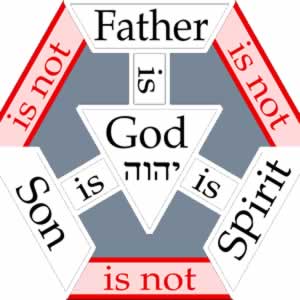 What is Trinity?
The Christian doctrine of the Trinity (Latin: trinus "threefold") holds that God is one God, but three coeternal consubstantial persons or hypostases. These being the Father, the Son (Jesus Christ), and the Holy Spirit - as "one God in three Divine Persons". The three Persons are distinct, yet are
one "substance, essence or nature" (homoousios).