The Romans included Greek and pagan Gods into all aspects of their daily life.
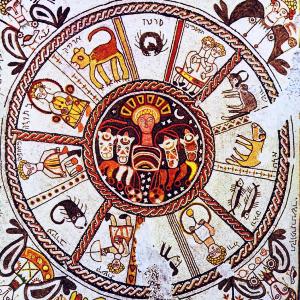
To increase the number of converts to Christianity, the Romans included Greek and pagan Gods they worshipped into their subjects lives. They did so by naming 7 days and 12 months after them.
DAYS OF WEEK
Monday
Moon GOD
Day of the Moon
Monday comes from the Anglo-Saxon 'monandaeg' which is the "Moon's Day". On this day people gave homage to the goddess of the moon. It was believed by ancients that there were three Mondays during the year that were considered to be unlucky: first Monday in April, second in August and last in December.
Tiu (Twia) is the English/Germanic god of war and the sky. He is identified with the Norse god Tyr.
Mars is the Roman god of war.
Ares is the Greek god of war.
Tuesday is the first to be named after a Germanic god – Tiu (or Twia) – a god of war and the sky and associated with the Norse god Tyr, who was a defender god in Viking mythology. Tiu is associated with Mars. He is usually shown with only one hand. In the most famous myth about Týr he placed his hand between the jaws of the wolf Fenrir as a mark of good faith while the other gods, pretending to play, bound the wolf. When Fenrir realised he had been tricked he bit off Tyr's hand.
Woden is the chief Anglo-Saxon/Teutonic god. Woden is the leader of the Wild Hunt. Woden is from wod "violently insane" + -en "headship". He is identified with the Norse Odin.
Mercury is the Roman god of commerce, travel, theivery, eloquence and science. He is the messenger of the other gods.
Hermes is the Greek god of commerce, invention, cunning, and theft. He is the messenger and herald of the other gods. He serves as patron of travelers and rogues, and as the conductor of the dead to Hades.
Wednesday means "Woden's Day" (in Norse, 'Odin'), the Old Norse's equivalent to Mercury, who was the messenger to the gods and the Roman god of commerce, travel and science. He was considered the chief god and leader of the wild hunt in Anglo-Saxon mythology, but the name directly translated means "violently insane headship" – not exactly the name of a loving and kind god! Woden was the ruler of Asgard, the hoe of the gods, and is able to shift and change into different forms.
Thor is the Norse god of thunder. He is represented as riding a chariot drawn by goats and wielding the hammer Miölnir. He is the defender of the Aesir, destined to kill and be killed by the Midgard Serpent.
Jupiter (Jove) is the supreme Roman god and patron of the Roman state. He is noted for creating thunder and lightning.
Zeus is Greek god of the heavens and the supreme Greek god.
Thursday was "Thor's Day", named after the Norse god of thunder and lightning and is the Old Norse equivalent to Jupiter. Thor is often depicted holding a giant hammer and during the 10th and 11th centuries when Christians tried to convert the Scandinavians, many wore emblems of Thor's hammer as a symbol of defiance against the new religion.
Freya (Fria) is the Teutonic goddess of love, beauty, and fecundity (prolific procreation). She is identified with the Norse god Freya. She is leader of the Valkyries and one of the Vanir.
Venus is the Roman goddess of love and beauty.
Aphrodite (Cytherea) is the Greek goddess of love and beauty.
Friday is associated with Freya, the wife of Woden and the Norse goddess of love, marriage and fertility, who is equivalent to Venus, the Roman goddess of love.
Saturn is the Roman and Italic god of agriculture and the consort of Ops. He is believed to have ruled the earth during an age of happiness and virtue.
Cronus (Kronos, Cronos) is the Greek god (Titan) who ruled the universe until dethroned by his son Zeus.
Saturday derives from "Saturn's Day", a Roman god associated with wealth, plenty and time. It is the only English week-day still associated with a Roman god, Saturn. The Hebrews called Saturday the "Sabbath", meaning, day of rest. The Bible identifies Saturday as the last day of the week.
Sunday, as you may be able to guess, is the "Sun's Day" – the name of a pagan Roman holiday. In many folklore traditions, Sunday was believed to be a lucky day for babies born. Many societies have worshiped the sun and sun-gods. Perhaps the most famous is the Egyptian Sun-god Ra, who was the lord of time.
Janus is the Roman god of gates and doorways, depicted with two faces looking in opposite directions. His festival month is January.
In 1582, Pope Gregory adjusted the calendar, so most western nations began celebrating the start of the year on January 1. This new calendar became known as the "Gregorian calendar."
Mars is the Roman god of war. He is identified with the Greek god Ares.
The ancient Romans insisted that all wars cease during the time of celebration between the old and new years. Since March was the first month of the new year in ancient Rome.
Juno is the principle goddess of the Roman Pantheon. She is the goddess of marriage and the well-being of women. She is the wife and sister of Jupiter. She is identified with the Greek goddess Hera.
Apparently, June has always been a popular month for weddings! The Romans named June after Juno, the queen of the gods and patroness of marriage and weddings.
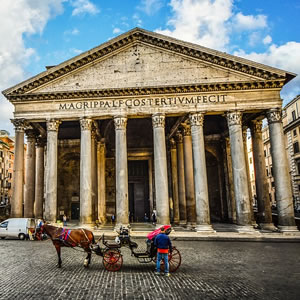
What is Roman? In historiography, ancient Rome is Roman civilization. From the founding of the city of Rome in the 8th century BC to the collapse of the Western Roman Empire in the 5th century AD, encompassing the Roman Kingdom, Roman Republic and Roman Empire until the fall of the western empire. The civilization
began as an Italic settlement in the Italian peninsula, dating from the 8th century BC, that grew into the city of Rome and which subsequently gave its name to the empire over which it ruled and to the widespread civilisation the empire developed. The Roman empire expanded to become one of the largest empires in the ancient world, though still ruled from the city, with an estimated 50 to 90 million inhabitants (roughly 20% of the world's population) and covering 5.0 million square kilometres at its height in AD 117.

Who is GOD? In monotheism and henotheism, God is conceived as the Supreme Being and principal object of faith. The concept of God as described by theologians commonly includes the attributes of omniscience (infinite knowledge), omnipotence (unlimited power), omnipresence (present everywhere), omnibenevolence
(perfect goodness), divine simplicity, and eternal and necessary existence.
In theism, God is the creator and sustainer of the universe
In deism, God is the creator, but not the sustainer, of the universe
Monotheism is the belief in the existence of one God or in the oneness of God
In pantheism, God is the universe itself
In atheism, God is purported not to exist, while deemed unknown or unknowable within the context of agnosticism.