Live Screenshot
Source link:
https://www.wsws.org/en/articles/2019/04/09/ctas-a09.htmlPublished by: WSWS on 9 Apr 2019
1883 views · Last view: 1 hr ago
News Text (from WSWS)
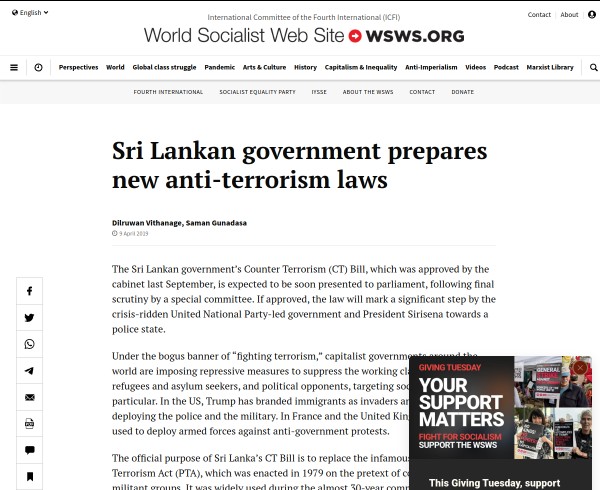
The Sri Lankan government’s Counter Terrorism (CT) Bill, which was approved by the cabinet last September, is expected to be soon presented to parliament, following final scrutiny by a special committee. If approved, the law will mark a significant step by the crisis-ridden United National Party-ledgovernment and President Sirisena towards a police state.
Under the bogus banner of “fighting terrorism,” capitalist governments around the world are imposing repressive measures to suppress the working class, the poor, refugees and asylum seekers, and political opponents, targeting socialists in particular. In the US, Trump has branded immigrants as invaders and terrorists and is deploying the police and the military. In France and the United Kingdom, laws are used to deploy armed forces against anti-government protests.
The official purpose of Sri Lanka’s CT Bill is to replace the infamous Prevention of Terrorism Act (PTA), which was enacted in 1979 on the pretext of combatting [...]
Explore More
TOPIC Government Terrorism Terrorist TerrorSearch Google Search Explore Topics
 What is Government?
A government is the system or group of people governing an organized community, generally a state. In the case of its broad associative definition, government normally consists of legislature
executive, and judiciary. Government is a means by which organizational policies are enforced, as well as a mechanism for determining policy. Each government has a kind of constitution, a statement of its governing principles and philosophy.
 What is Terrorism?
Terrorism is the use of intentionally indiscriminate violence as a means to create terror among masses of people. With aim to create fear to achieve a financial, political, religious or ideological
aim. It is used in this regard primarily to refer to violence against peacetime targets or in war against non-combatants. The terms "terrorist" and "terrorism" originated during the French Revolution of the late 18th century but gained mainstream popularity during the U.S. presidency of Ronald Reagan (1981-89) after the 1983 Beirut barracks bombings and again after the 2001 September 11 attacks. There is no commonly accepted definition of "terrorism". Being a charged term, with the connotation of something "morally wrong", it is often used, both by governments and non-state groups, to abuse or denounce opposing groups.
What is Terrorist?Terrorism is the use of intentionally indiscriminate violence as a means to create terror among masses of people. With aim to create fear to achieve a financial, political, religious or ideological
aim. It is used in this regard primarily to refer to violence against peacetime targets or in war against non-combatants. The terms "terrorist" and "terrorism" originated during the French Revolution of the late 18th century but gained mainstream popularity during the U.S. presidency of Ronald Reagan (1981-89) after the 1983 Beirut barracks bombings and again after the 2001 September 11 attacks. There is no commonly accepted definition of "terrorism". Being a charged term, with the connotation of something "morally wrong", it is often used, both by governments and non-state groups, to abuse or denounce opposing groups.
What is Terror?Terrorism is the use of intentionally indiscriminate violence as a means to create terror among masses of people. With aim to create fear to achieve a financial, political, religious or ideological
aim. It is used in this regard primarily to refer to violence against peacetime targets or in war against non-combatants. The terms "terrorist" and "terrorism" originated during the French Revolution of the late 18th century but gained mainstream popularity during the U.S. presidency of Ronald Reagan (1981-89) after the 1983 Beirut barracks bombings and again after the 2001 September 11 attacks. There is no commonly accepted definition of "terrorism". Being a charged term, with the connotation of something "morally wrong", it is often used, both by governments and non-state groups, to abuse or denounce opposing groups.

 26:21

 13:09
1042 views · 2 mins ago
 39:53
234 views · 4 mins ago


 3:55
713 views · 5 mins ago