
Live Screenshot
Source link:
https://www.rawstory.com/2014/12/many-of-these-gods-come-from-stars-the-fascinating-true-story-of-angels-virgin-birth-and-jesus/Published by: RAW STORY on 25 Dec 2014
1566 views · Last view: 15 hrs ago
News Text (from RAW STORY)
Valerie Tarico interviews Dr. Tony Nugent, scholar of world religions. Dr. Nugent is a symbologist, an expert in ancient symbols. He taught at Seattle University for fifteen years in the Department of Theology and Religious Studies and is an ordained Presbyterian minister. Many Americans have heardthat December 25 was a birthday of Roman gods long before it was chosen to celebrate the birth of Jesus. Some people also know that our delightful mélange of Christmas festivities originated in ancient Norse, Roman and Druid traditions – or, in the case of Rudolph, on Madison Avenue. But where does the Christmas story itself come from: Jesus in the manger, the angels and wise men?
Nugent: The familiar Christmas story, including the virgin conception and birth of Jesus, is found in the gospels of Matthew and Luke. Scholars have pointed out that these stories are somewhat disconnected from other parts of these Gospels and the rest of the New Testament. In fact, by the time he is a young [...]
Explore More
TOPIC Virgin Birth Polytheism Polytheist Raw Story The Gods Angel Idols GODSearch Google Search Explore Topics
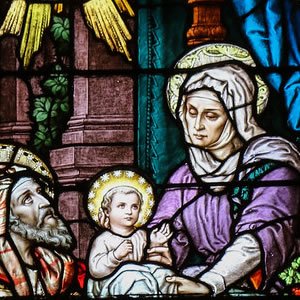 What was the Virgin Birth?
In Christianity and Islam, it is asserted that Jesus of Nazareth was conceived by his mother Mary solely through divine intervention and without sexual intercourse, thus resulting in his virgin birth
In accordance with these beliefs, Jesus had just one biological parent instead of the necessary two; Mary's husband Joseph was his father only in the legal sense. Most Christians hold that Mary's virginity was perpetual. Though not biologically related, Jesus being Joseph's adoptive son is cited as linking him to the Davidic line. The Christian understanding is that the birth of Jesus by a virgin woman was made possible by the Holy Spirit of the Trinity.
 What is Polytheism?
Polytheism is the worship of or belief in multiple deities, usually as a pantheon of gods and goddesses. In most religions which accept polytheism, the different gods and goddesses are representations
of forces of nature or ancestral principles, and can be viewed either as autonomous or as aspects or emanations of a creator deity or transcendental absolute principle (monistic theologies), which manifests immanently in nature (panentheistic and pantheistic theologies). Most of the polytheistic deities of ancient religions, with the notable exceptions of the Ancient Egyptian and Hindu deities, were conceived as having physical bodies. Polytheism is a type of theism. Within theism, it contrasts with monotheism, the belief in a singular God, in most cases transcendent. Important polytheistic religions practiced today include Chinese traditional religion, Hinduism, Japanese Shinto, and various neopagan faiths.
What is Polytheist?Polytheism is the worship of or belief in multiple deities, usually as a pantheon of gods and goddesses. In most religions which accept polytheism, the different gods and goddesses are representations
of forces of nature or ancestral principles, and can be viewed either as autonomous or as aspects or emanations of a creator deity or transcendental absolute principle (monistic theologies), which manifests immanently in nature (panentheistic and pantheistic theologies). Most of the polytheistic deities of ancient religions, with the notable exceptions of the Ancient Egyptian and Hindu deities, were conceived as having physical bodies. Polytheism is a type of theism. Within theism, it contrasts with monotheism, the belief in a singular God, in most cases transcendent. Important polytheistic religions practiced today include Chinese traditional religion, Hinduism, Japanese Shinto, and various neopagan faiths.
 Who are Raw Story?
Raw Story is an independent American progressive online news site that focuses on national politics, criminal justice, social justice, right-wing extremism, and current events.
What is The Gods?Polytheism is the worship of or belief in multiple deities, usually as a pantheon of gods and goddesses. In most religions which accept polytheism, the different gods and goddesses are representations
of forces of nature or ancestral principles, and can be viewed either as autonomous or as aspects or emanations of a creator deity or transcendental absolute principle (monistic theologies), which manifests immanently in nature (panentheistic and pantheistic theologies). Most of the polytheistic deities of ancient religions, with the notable exceptions of the Ancient Egyptian and Hindu deities, were conceived as having physical bodies. Polytheism is a type of theism. Within theism, it contrasts with monotheism, the belief in a singular God, in most cases transcendent. Important polytheistic religions practiced today include Chinese traditional religion, Hinduism, Japanese Shinto, and various neopagan faiths.
 What is an Angel?
An angel is generally a supernatural being found in various religions and mythologies. In Abrahamic religions, angels are often depicted as benevolent celestial beings who act as intermediaries
between God or Heaven and Humanity. Other roles of angels include protecting and guiding human beings, and carrying out God's tasks. Within Abrahamic religions, angels are often organized into hierarchies, although such rankings may vary between sects in each religion, and are given specific names or titles, such as Gabriel or 'Destroying angel'.
What is Idols?Polytheism is the worship of or belief in multiple deities, usually as a pantheon of gods and goddesses. In most religions which accept polytheism, the different gods and goddesses are representations
of forces of nature or ancestral principles, and can be viewed either as autonomous or as aspects or emanations of a creator deity or transcendental absolute principle (monistic theologies), which manifests immanently in nature (panentheistic and pantheistic theologies). Most of the polytheistic deities of ancient religions, with the notable exceptions of the Ancient Egyptian and Hindu deities, were conceived as having physical bodies. Polytheism is a type of theism. Within theism, it contrasts with monotheism, the belief in a singular God, in most cases transcendent. Important polytheistic religions practiced today include Chinese traditional religion, Hinduism, Japanese Shinto, and various neopagan faiths.
 Who is GOD?
In monotheism and henotheism, God is conceived as the Supreme Being and principal object of faith. The concept of God as described by theologians commonly includes the attributes of omniscience
(infinite knowledge), omnipotence (unlimited power), omnipresence (present everywhere), omnibenevolence (perfect goodness), divine simplicity, and eternal and necessary existence.
<ul>
<li>In theism, God is the creator and sustainer of the universe</li>
<li>In deism, God is the creator, but not the sustainer, of the universe</li>
<li>Monotheism is the belief in the existence of one God or in the oneness of God</li>
<li>In pantheism, God is the universe itself</li>
<li>In atheism, God is purported not to exist, while deemed unknown or unknowable within the context of agnosticism. </li>
</ul>
 8:55
891 views · 5 secs ago


 2:40
749 views · 41 secs ago

 1:22
658 views · 48 secs ago
 7:59
 3:02
587 views · 1 min ago

 10:04
562 views · 1 min ago

 10:59
402 views · 2 mins ago