Live Screenshot
Source link:
https://www.huffingtonpost.co.uk/entry/gods-wife-asherah_n_839226Published by: HUFFINGTON on 22 Mar 2011
1792 views · Last view: 2 days ago
News Text (from HUFFINGTON)
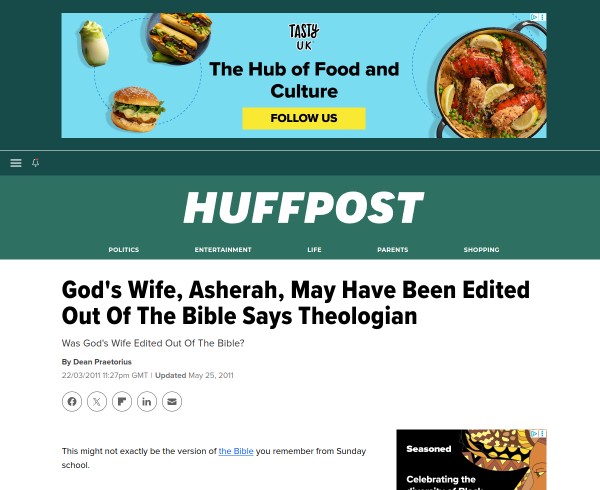
This might not exactly be the version of the Bible you remember from Sunday school. Early versions of the Bible apparently featured a fertility godess, Asherah, who may have been God's wife, at least according to one British theologian. Back in 1967, historian Raphael Patai mentioned ancientIsraelites worshiped both Yahweh and Asherah, according to Discovery.
Francesca Stavrakopoulou, who began her work at Oxford and is now a senior lecturer in the department of Theology and Religion at the University of Exeter, is shedding new light on the theory. However, even if she's right, the Bible's editors may very well have wiped her almost clean from the document, reports TIME.
From TIME:
What remains of God's purported other half are clues in ancient texts, amulets and figurines unearthed primarily in an ancient Canaanite coastal city, now in modern-day Syria. Inscriptions on pottery found in the Sinai desert also show Yahweh and Asherah were worshipped as a pair, and a passage in the [...]
Explore More
TOPIC Huffington The Bible Asherah GODSearch Google Search Explore Topics
 Who are Huffington?
HuffPost (originally launched as The Huffington Post in 2005) is an American digital news outlet and blog known for its progressive commentary, political reporting, and lifestyle content.
 What is The Bible?
The Bible is a canonical collection of texts sacred in Judaism and Christianity. There is no single "Bible" and many Bibles with varying contents exist. The term Bible is shared between Judaism and
Christianity, although the contents of each of their collections of canonical texts is not the same.
<br><br>
Different religious groups include different books within their Biblical canons, in different orders, and sometimes divide or combine books, or incorporate additional material into canonical books.
<br><br>
The Hebrew Bible, or Tanakh, contains 24 books. Christian Bibles range from the 66 books of the Protestant canon to the 81 books of the Ethiopian Orthodox Church canon.
<br><br>
The first part of Christian Bibles is the Old Testament, which contains, at minimum, the 24 books of the Hebrew Bible divided into 39 books and ordered differently from the Hebrew Bible. The Catholic Church and Eastern Christian churches also hold certain deuterocanonical books and passages to be part of the Old Testament canon.
<br><br>
The second part is the New Testament, containing 27 books: the 4 Canonical gospels, Acts of the Apostles, 21 Epistles or didactic letters, and the Book of Revelation.
Who was Asherah?Asherah in ancient Semitic religion, is a mother goddess who appears in a number of ancient sources. She appears in Akkadian writings by the name of Asratu, and in Hittite as Aserdu or Asertu. Asherah
is generally considered identical with the Ugaritic goddess Atirat. Asherah is identified as the queen consort of the Sumerian god Anu, and Ugaritic El, the oldest deities of their respective pantheons, as well as Yahweh, the god of Israel and Judah. Despite her association with Yahweh in extra-biblical sources, Deuteronomy 12 has Yahweh commanding the destruction of her shrines so as to maintain purity of his worship.
 Who is GOD?
In monotheism and henotheism, God is conceived as the Supreme Being and principal object of faith. The concept of God as described by theologians commonly includes the attributes of omniscience
(infinite knowledge), omnipotence (unlimited power), omnipresence (present everywhere), omnibenevolence (perfect goodness), divine simplicity, and eternal and necessary existence.
<ul>
<li>In theism, God is the creator and sustainer of the universe</li>
<li>In deism, God is the creator, but not the sustainer, of the universe</li>
<li>Monotheism is the belief in the existence of one God or in the oneness of God</li>
<li>In pantheism, God is the universe itself</li>
<li>In atheism, God is purported not to exist, while deemed unknown or unknowable within the context of agnosticism. </li>
</ul>
 6:19
151 views · 4 secs ago
 9:58
48 views · 5 secs ago


 10:04
769 views · 2 mins ago