Live Screenshot
Source link:
https://www.cam.ac.uk/research/news/male-converts-to-islam-landmark-report-examines-conversion-experience-of-british-muslimsPublished by: UNIVERSITY OF CAMBRIDGE on 3 Feb 2016
1805 views · Last view: 22 hrs ago
News Text (from UNIVERSITY OF CAMBRIDGE)
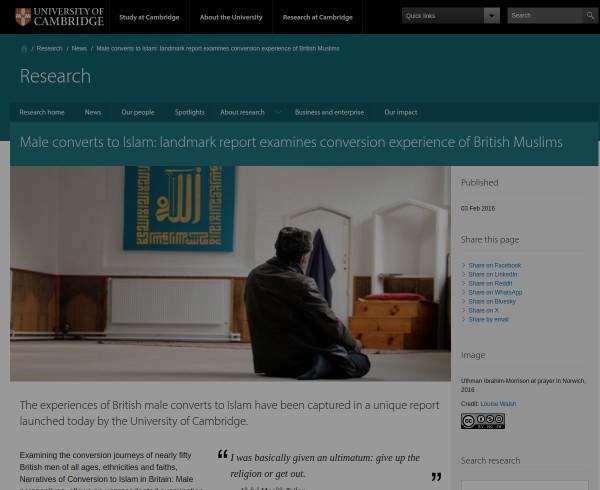
The experiences of British male converts to Islam have been captured in a unique report launched today by the University of Cambridge. Examining the conversion journeys of nearly fifty British men of all ages, ethnicities and faiths, Narratives of Conversion to Islam in Britain: Male perspectivesallows an unprecedented examination of the challenges and concerns facing converts to Islam in the UK today.
The landmark report, produced by Cambridge’s Centre of Islamic Studies, captures the isolation and dislocation felt by many new converts, and the sense of being a ‘minority within a minority’ as they adjust to life as a follower of one of the most maligned and misunderstood faiths in the UK.
With converts drawn from white, black and South Asian backgrounds from across the UK, Cambridge assembled nearly 50 British males over the course of the 18-month project in an attempt to understand and record the experiences of British male converts to Islam. The converts were from a [...]
Explore More
TOPIC University of Cambridge British Convert Muslim IslamSearch Google Search Explore Topics
 Who are University of Cambridge?
The University of Cambridge is a world-renowned collegiate public research institution in England, founded in 1209 by scholars fleeing a dispute in Oxford. As the second-oldest university in the
English-speaking world, it connects over 24,000 students from more than 140 countries across its historic campuses.
 What is British?
British people or Britons, also known colloquially as Brits, are the citizens and diaspora of the United Kingdom, the British Overseas Territories, and the Crown dependencies. British nationality
law governs modern British citizenship and nationality, which can be acquired, for instance, by descent from British nationals.
The British are a diverse, multinational, multicultural and multilingual people, with "strong regional accents, expressions and identities". The social structure of the United Kingdom has changed radically since the 19th century, with a decline in religious observance, enlargement of the middle class, and increased ethnic diversity, particularly since the 1950s, when citizens of the British Empire were encouraged to immigrate to Britain to work as part of the recovery from World War II.
The population of the UK stands at around 67 million, with around 50 million being White British. This includes 44.4 million in England and Wales as of 2021, and 4.2 million in Scotland as of 2022. 1.8 million identify as White in Northern Ireland, including White British and other White ethnicities, as of 2021.
 What is Convert?
Religious conversion is the adoption of a set of beliefs identified with one particular religious denomination. Thus "religious conversion" would describe the abandoning of adherence to one
denomination and affiliating with another. People convert to a different religion for various reasons, including active conversion by free choice due to a change in beliefs, secondary conversion, deathbed conversion, conversion for convenience, marital conversion, and forced conversion.
 What is Muslim?
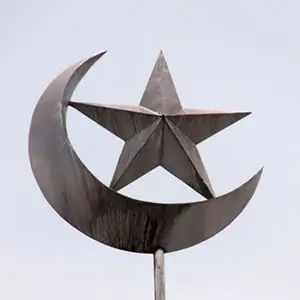
One of the major religions of the world, Islam literally translates to "submission," as a follower of Islam (Muslims) devotes their life to that of their God. The religion began with the teachings of
Muhammad in the 7th century. The theology of Islam is based on the Qur'an, which was given to Muhammad by God. Some of the major fundamental principles of Islam include the Five Pillars, which hope to unite all Muslims into a community. Two different factions of Muslims exist - the majority are known as Sunni, with a small percentage known as Shi'a - both predominantly reside throughout the Middle East.<br><br>
<i class="fa fa-calendar"></i> Muhammad died in 632 AD and the religion of Islam formally started after his death. The Quran was formally compiled and finalised in 650 AD, prior to which it was 'memorised' and written across many parchments.
What is Islam?One of the major religions of the world, Islam literally translates to "submission," as a follower of Islam (Muslims) devotes their life to that of their God. The religion began with the teachings of
Muhammad in the 7th century. The theology of Islam is based on the Qur'an, which was given to Muhammad by God. Some of the major fundamental principles of Islam include the Five Pillars, which hope to unite all Muslims into a community. Two different factions of Muslims exist - the majority are known as Sunni, with a small percentage known as Shi'a - both predominantly reside throughout the Middle East.<br><br>
<i class="fa fa-calendar"></i> Muhammad died in 632 AD and the religion of Islam formally started after his death. The Quran was formally compiled and finalised in 650 AD, prior to which it was 'memorised' and written across many parchments.
 18:17
286 views · 14 secs ago
 2:09
477 views · 21 secs ago
 52:43
1092 views · 1 min ago
 3:53
 17:12
1265 views · 1 min ago
 2:14
1170 views · 2 mins ago
 6:04
701 views · 2 mins ago
 31:01
909 views · 2 mins ago
 3:52
194 views · 2 mins ago